


North Korea fires 4 missiles
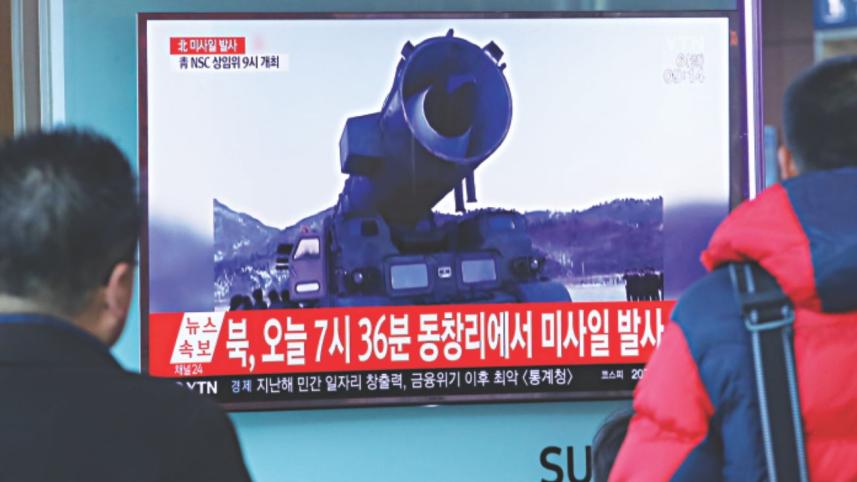
Nuclear-armed North Korea launched four ballistic missiles yesterday in another challenge to President Donald Trump, with three landing provocatively close to America's ally Japan.
Seoul and Washington began annual joint military exercises last week that always infuriate Pyongyang, with the North's military warning of "merciless nuclear counter-action".

Under leader Kim Jong-Un, Pyongyang has ambitions to develop an intercontinental ballistic missile (ICBM) capable of reaching the US mainland -- which Trump has vowed will not happen.
Seoul said four missiles were fired from Tongchang County, North Pyongan province into the East Sea -- its name for the Sea of Japan.
The missiles travelled around 1,000 kilometres and reached an altitude of 260 kilometres, said a spokesman for South Korea's Joint Chiefs of Staff, adding they were unlikely to be ICBMs.
Regional and world powers lined up to condemn the launches.
Japanese Prime Minister Shinzo Abe said three of the North Korean missiles came down in Tokyo's Exclusive Economic Zone (EEZ) -- waters extending 200 nautical miles from its coast, reported AFP.
"This clearly shows North Korea has entered a new stage of threat," Abe told parliament.
The North's repeated launches "clearly violate UN Security Council resolutions", he said. "We can never tolerate this."
Pyongyang carried out two atomic tests and a series of missile launches last year, but yesterday was only the second time its devices had entered Japan's EEZ.
After an emergency meeting of South Korea's National Security Council, acting president Hwang Kyo-Ahn called the North's nuclear and missile provocations "immediate and real threats" to his country.
"Considering the North Korean leadership's brutality and recklessness shown through the murder of Kim Jong-Nam, the results of the North having a nuclear weapon in its hands will be gruesome beyond imagination," he said.
Seoul has blamed Pyongyang for the killing of the half-brother of the North's leader by two women using VX nerve agent at Kuala Lumpur's international airport last month.
Hwang called for "swift deployment" of a US missile defence system, THAAD, a proposal which has infuriated neighbouring China, the North's key diplomatic protector and main provider of trade and aid.
BIG, BIG PROBLEM
In Washington, the State Department condemned the launches, saying the US was ready to "use the full range of capabilities at our disposal against this growing threat".
"We remain prepared -- and will continue to take steps to increase our readiness -- to defend ourselves and our allies from attack," acting spokesman Mark Toner said in a statement.
Yesterday's launch came ahead of a trip to Japan, China and South Korea by new US Secretary of State Rex Tillerson this month, pointed out Dongguk University professor Kim Yong-Hyun.
Moscow is seriously worried about North Korea's latest missile drills, Kremlin spokesman Dmitry Peskov said yesterday.
"Definitely, we are seriously worried - these are the sort of actions that lead to a rise in tension in the region and of course in this situation, traditionally, Moscow calls for restraint from all sides," Peskov told a conference call with reporters.
France also condemned North Korea's firing of four ballistic missiles into the sea off Japan's northwest.
 For all latest news, follow The Daily Star's Google News channel.
 A French foreign ministry statement said Paris would consult UN Security Council members on the issue, reported Reuters.
EXERCISE RESTRAINT
Beijing has become increasingly frustrated with Pyongyang's nuclear and missile activities, and last month announced a suspension of all coal imports from the North until the end of the year -- a crucial source of foreign currency.
Chinese Foreign Ministry spokesman Geng Shuang said at a daily news briefing that China, which is holding its annual meeting of the National People's Congress, had noted North Korea's latest action.
"All sides should exercise restraint and not do anything to irritate each other to worsen regional tensions," Geng said, referring to both the missile launch and US-South Korean military exercises.
Pyongyang was "trying to send a message early on in Trump's term that North Korea will not be dragged around by his administration", he said.
The North is barred under UN resolutions from any use of ballistic missile technology.
But six sets of UN sanctions since Pyongyang's first nuclear test in 2006 have failed to halt its drive for what it insists are defensive weapons.
Three years ago, Barack Obama ordered the Pentagon to increase cyber attacks against North Korea to try to sabotage its missiles before launch or just as they lift off, the New York Times reported at the weekend.
Comments