


Diplomatic push loses steam
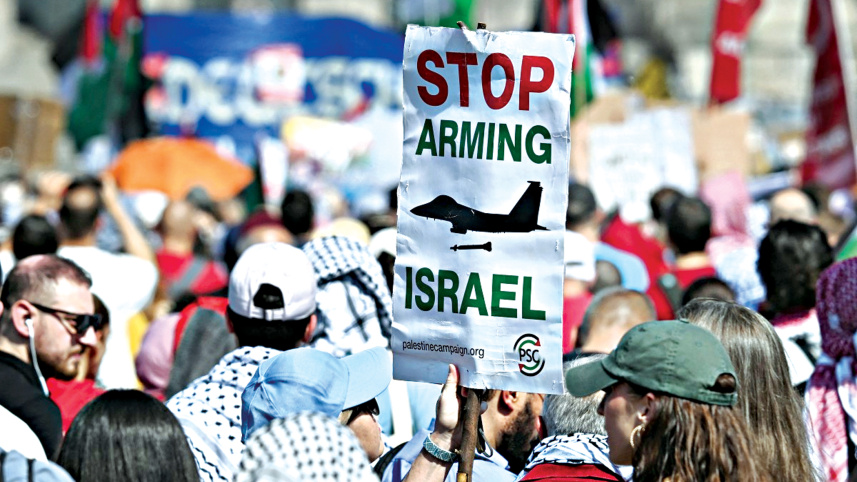
Iran and Israel carried out strikes on each other for the ninth consecutive day yesterday, amid a diplomatic push by European powers to ease the crisis -- a move US President Donald Trump said is unlikely to be helpful.
The US president also said his two-week ultimatum to Tehran was the "maximum", indicating that possible American air strikes might take place even before that if no progress is visible.

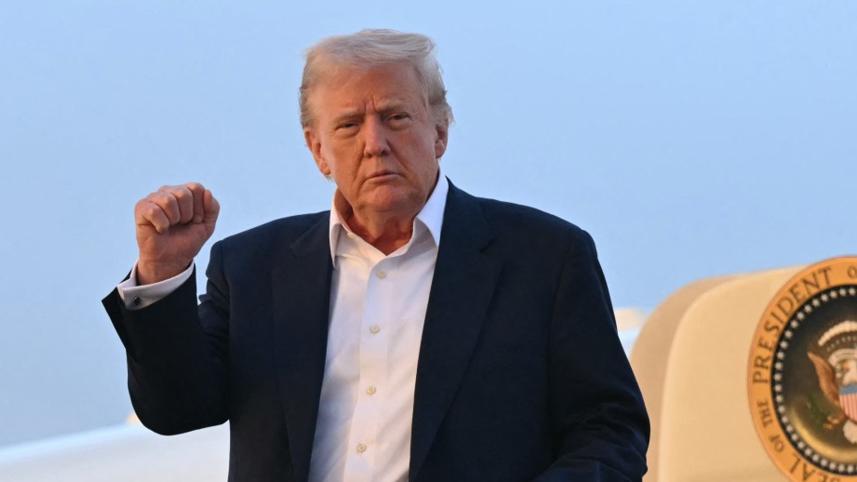
"Iran doesn't want to speak to Europe… Europe is not going to be able to help in this."
Meanwhile, a senior Iranian official told Reuters that the discussions and proposals made by the European powers to Iran over its nuclear programme in Geneva were unrealistic.
He added that zero enrichment was a dead end and that Iran would not negotiate over its defensive capabilities, including its missile programme.
The developments came as news reports claimed that B-2 stealth bombers left the Whiteman Air Force Base in Missouri en route to a US Air Force base in Guam. However, it is not immediately clear whether this is related to escalating tensions in the Middle East.
The bombers apparently refuelled after launching from Missouri, suggesting they launched without full fuel tanks due to a heavy onboard payload, which could be bunker-buster bombs.
The B-2 is capable of carrying America's heaviest payloads, including the bunker-busting GBU-57, a 30,000-pound (13,607 kg) warhead capable of penetrating 200 feet (61 meters) underground before exploding.
Such a bomb, which Israel is not known to possess, is the only weapon capable of destroying Iran's deeply buried nuclear facilities.
When reached for comment, the Pentagon referred AFP to the White House, which did not immediately respond.
Trump, who rarely spends weekends in Washington, is due to return to the White House yesterday evening to hold an unspecified "National Security Meeting."
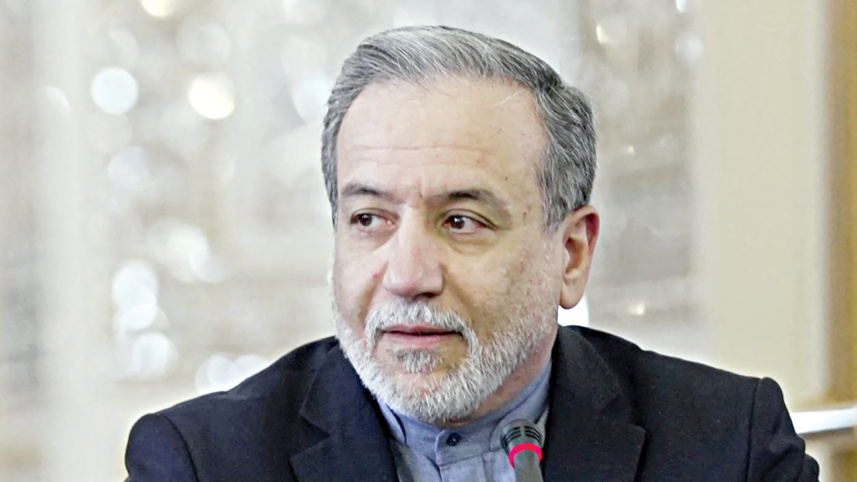
"Negotiations by the US were a cover for what the Israelis did. We don't know how we can trust them [the US] anymore."
On the ground, Israel yesterday said it had killed three Iranian commanders in its unprecedented bombing campaign across the Islamic republic, which Foreign Minister Gideon Saar claimed had already delayed Tehran's presumed nuclear plans by two years.
Overnight, Iran said it targeted central Israel with drones and missiles.
Israel's military said its fighter jets successfully targeted a top Iranian official Saeed Izadi, in charge of coordination with Palestinian militant group Hamas, in Qom, south of Tehran and announced the deaths of two other commanders from Iran's Revolutionary Guards.
As Israel continued to strike Iran's nuclear facilities and military targets, Israeli Foreign Minister Gideon Saar said in an interview that by the country's own assessment, it had "already delayed for at least two or three years the possibility for them to have a nuclear bomb".
"We will do everything that we can do there in order to remove this threat," Saar told German newspaper Bild, asserting Israel's onslaught would continue.
 For all latest news, follow The Daily Star's Google News channel.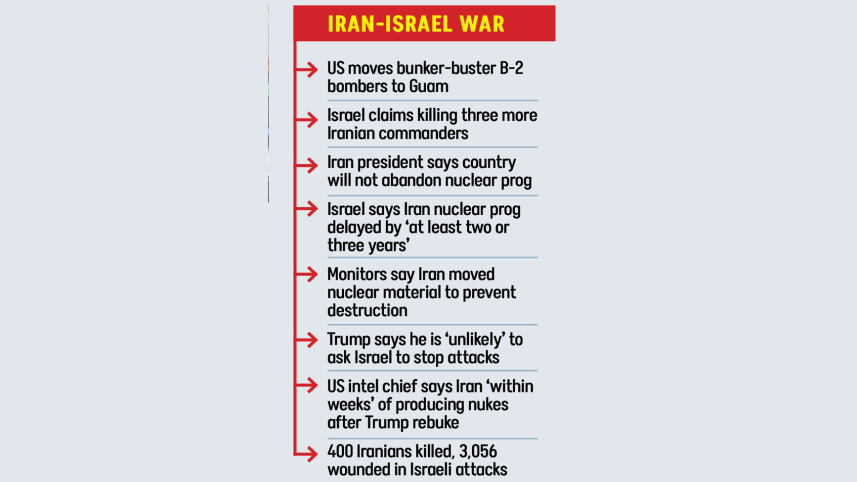
However, Iran's President Masoud Pezeshkian yesterday warned of a "more devastating" retaliation should Israel continue to attack Iran, saying the Islamic republic would not halt its nuclear programme "under any circumstances".
In a phone call with French President Emmanuel Macron, Pezeshkian said Iran was "ready to discuss and cooperate to build confidence in the field of peaceful nuclear activities".
"However, we do not agree to reduce nuclear activities to zero under any circumstances," he added, according to Iran's official IRNA news agency.
Meanwhile, US-based defence think tanks -- the Institute for the Study of War (ISW) and the Critical Threats Project (CTP) -- said in their latest joint assessment of the conflict that Iranian nuclear material was relocated to secure locations to prevent its destruction.
"Protecting Iranian nuclear material by hiding the material" would make "a US or Israeli effort to destroy the material more difficult," the ISW/CTP said.
"This statement is presumably intended to suggest to a Western audience that destroying all of Iran's nuclear material would require a long, challenging, and possibly futile hunt for hidden material and that therefore the West should negotiate with Iran," it said.
Israel and Iran have traded wave after wave of devastating strikes, after Israel launched its aerial campaign on June 13, saying Tehran was on the verge of developing a nuclear weapon -- an ambition Iran has denied.
Israel said it had attacked Iran's Isfahan nuclear site for a second time after its air force said it had also launched salvos against missile storage and launch sites in central Iran.
The military later said it struck military infrastructure in southwest Iran.
Trump warned on Friday that Tehran has a "maximum" of two weeks to avoid possible American air strikes, as Washington weighs whether to join Israel's unprecedented bombing campaign.
Iranian Foreign Minister Abbas Araghchi, who arrived in Istanbul yesterday for a meeting of the Organisation of Islamic Cooperation to discuss the conflict, told NBC News that "we're not prepared to negotiate with them [the United States] anymore, as long as the aggression continues."
Top diplomats from Britain, France and Germany met Araghchi in Geneva on Friday and urged him to resume talks with the United States that had been derailed by Israel's attacks.
Trump was dismissive of European diplomatic efforts, telling reporters, "Iran doesn't want to speak to Europe. They want to speak to us. Europe is not going to be able to help in this."
"I'm giving them a period of time, and I would say two weeks would be the maximum," Trump told reporters when asked if he could decide to strike Iran before that.
He added that the aim was to "see whether or not people come to their senses."
On Thursday, Trump gave a two-week window to mull US involvement in the conflict, citing a "substantial chance of negotiations." But his latest remarks suggest he may act sooner if no progress is made on dismantling Iran's nuclear program.
Trump also said he is unlikely to ask Israel to stop its attacks to get Iran back to the table.
"If somebody's winning, it's a little bit harder to do," he said.
Meanwhile, US Director of National Intelligence Tulsi Gabbard yesterday said Iran could produce nuclear weapons "within weeks", months after she testified before Congress that the country was not building them.
Her change of position came after Trump said she was "wrong" and that intelligence showed Iran had a "tremendous amount of material" and could have a nuclear weapon "within months".
Iran says its nuclear program is for peaceful purposes.
RIA Novosti news agency yesterday reported that President Vladimir Putin had told Israel repeatedly that Iran does not intend to acquire nuclear weapons.
At the OIC meeting, where the Israel-Iran conflict topped the agenda, Turkish President Tayyip Erdogan said Israel's attacks on Iran right before a planned new round of nuclear talks with the US aimed to sabotage negotiations and showed Israel did not want to resolve issues through diplomacy.
Turkish Foreign Minister Hakan Fidan accused Israel of leading the Middle East towards "total disaster".
Iran's health ministry said in an updated toll yesterday that Israeli strikes on Iran have killed more than 400 people.
"As of this morning, Israeli attacks have claimed the lives of over 400 defenceless Iranians and left 3,056 others wounded by missiles and drones," health ministry spokesman Hossein Kermanpour said in a post on X.
Iran's retaliatory strikes have killed at least 25 people, in Israel, according to official figures.
Traffic police and Fars news agency reported congestion on roads into Tehran yesterday, indicating some inhabitants were returning to the capital.
Internet service was partially restored in Iran yesterday, after Tehran imposed a blackout during its war with Israel, London-based online watchdog NetBlocks said.
Overnight, Iran said it targeted central Israel with drones and missiles.
Israeli rescuers said there were no casualties after an Iranian missile struck a residential building in Beit She'an.
Israel's air force yesterday said it intercepted about 40 drones overnight.
Israel's National Public Diplomacy Directorate said more than 450 missiles have been fired at the country so far, along with about 400 drones.
Meanwhile, the International Atomic Energy Agency's chief Rafael Grossi told CNN there was no evidence to suggest that Tehran had all the components to make a functioning nuclear warhead.
Iran, meanwhile, filed a complaint to the UN secretary-general and president of the Security Council against Grossi for failing to condemn Israel's military action against Iran.
In early June, Grossi said Iran had continually evaded providing details on its nuclear programme, meaning the agency "will not be in a position to provide assurance that Iran's nuclear programme is exclusively peaceful".
Comments