


The wheels turning Bangladesh’s economy

Everything around us—from the food on our tables and the clothes we wear to the materials used to build our cities—has, at some point, travelled on a truck.
Often overlooked, trucking is the circulatory system of the economy. Over the past two decades, Bangladesh’s industry has moved from a largely fragmented, informal sector towards a more organised and technology-enabled backbone of national logistics. The broader freight and logistics market was valued at an estimated $31.97 billion in 2025, while road transport carries roughly 70% to 80% of inland freight.

From Bedford to a new generation
Bangladesh’s trucking story has deep roots. British-built Bedford TJ and TK trucks became widely used from the late 1950s. Their rugged construction suited difficult roads, and the yellow flatbed Bedford became a familiar symbol of commercial transport. Surviving models are now mostly seen hauling bricks at night—a reminder of how far the fleet has changed.
The market now ranges from 700-kilogram pickups for small consignments to heavy-duty trucks capable of carrying up to 50 tonnes. That breadth reflects Bangladesh’s transition from an agriculture-led economy towards manufacturing, exports and mass consumption. It has also created distinct vehicle segments, each shaped by payload, route, fuel cost and the urgency of delivery.
A market transformed
The commercial vehicle market more than doubled in value from Tk 2,000 crore in 2010 to Tk 4,400 crore in 2021. High import duties encouraged a shift from completely built-up vehicles towards completely knocked-down kits and local assembly. The market remains concentrated: Nitol-Niloy Group’s Tata brand was reported to hold a 31% share in 2023, while IFAD assembles Ashok Leyland vehicles at Dhamrai. Runner, Akij Motors, Rangs Group and Energypac represent other major brands and partnerships.
The rise of light commercial vehicles was another turning point. Commercial transport had traditionally meant trucks carrying one tonne or more. Smaller Japanese pickups and vans were available, but larger engines and fully built imports kept prices relatively high.
The Tata Ace, launched in 2005, demonstrated demand for a compact, lower-cost workhorse and opened the market to a new class of micro-entrepreneurs. Rivals soon followed. By 2021, vehicles below six tonnes represented an estimated Tk 1,200 crore market and about 45% of commercial vehicle sales, with roughly 11,000 units sold annually. Industry estimates suggest light commercial vehicles accounted for half of the 20,000 new trucks sold in 2023.
The credit conundrum
Financing remains one of the industry’s hardest constraints. With formal bank credit difficult to obtain, distributors have increasingly acted as lenders. Seasonal downturns can then translate into missed instalments, bad debts and repossessions, placing pressure on both buyers and vehicle companies.
External shocks amplify that risk. In 2022, higher fuel costs, dollar shortages and import restrictions contributed to a 22% fall in sales. BRTA truck registrations declined from 5,789 units in 2021 to 4,528 in 2022. Even when demand exists, high interest rates and documentation requirements can leave small operators unable to finance a vehicle on sustainable terms.
Technology takes the wheel
Digital platforms are beginning to dismantle the traditional truck-stand model by connecting shippers directly with vehicle owners. These services promise faster matching, clearer pricing and better fleet utilisation, while telematics can help operators monitor routes, fuel use, idling and maintenance needs.
Truck Lagbe, founded in 2017, says its network includes more than 80,000 registered trucks and 150,000 customers. Lalamove, Loop Freight and Goods in Motion have also introduced digital booking, fleet-management and freight services. Functioning loosely as ride-hailing platforms for trucks and pickups, they serve both one-off users and recurring commercial clients.
The green truck arrives
Electric mobility is emerging as the next frontier. In June 2026, the government waived import tariffs on electric buses and trucks through June 2030, alongside a stated ambition to move 30% of trucks towards electric power. A month later, RangsX delivered 18 electric vans to DHL Express, described as Bangladesh’s first commercial corporate EV fleet.
E-commerce and pharmaceutical companies are natural early adopters because last-mile vehicles often follow predictable routes and return to a depot. Lower fuel and maintenance costs could strengthen the business case. High purchase prices, limited charging infrastructure, battery range and resale uncertainty, however, remain substantial barriers.
The road ahead
The industry’s most visible challenge is the age of its fleet. According to the Bangladesh Road Transport Authority, at least 38,123 registered highway trucks are beyond the 25-year operational threshold. Older vehicles raise questions about emissions, braking, reliability and the economics of maintenance. Driver fatigue and loosely enforced working hours add another layer of road-safety risk.
 For all latest news, follow The Daily Star's Google News channel.
 The National Logistics Policy points towards multimodal infrastructure, stronger safety standards, formal financing and EV charging networks. Its effect will depend on implementation: whether financing becomes accessible to small operators, fleet-renewal rules are enforceable, digital systems reach beyond large companies and charging capacity grows outside the major cities.
The next challenge is therefore not simply to put more trucks on the road. It is to make every truck more productive, every journey more predictable and every kilometre safer and more sustainable.
Before the wheels turn
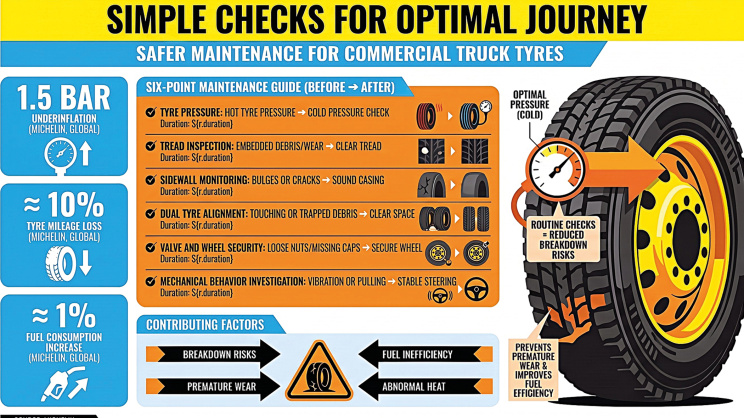
A truck’s tyres carry far more than the weight of the vehicle and its cargo. They also affect braking, steering stability, fuel consumption and the likelihood of an unexpected roadside breakdown. Yet tyre problems often develop gradually, beginning with a small pressure loss, uneven wear or damage hidden between a pair of dual tyres.
Heavy loads, long journeys, high road temperatures and rough surfaces make regular inspection particularly important for commercial vehicles. Incorrect inflation can generate excessive heat, weaken the casing and shorten tyre life, while cuts, bulges and embedded objects may signal a more immediate danger. A brief check before departure can therefore protect the driver, the cargo and other road users while reducing downtime and replacement costs. The following six-point inspection provides a practical starting routine for every journey.
Comments