


Beyond the fuel pump

For many residents in Dhaka, the morning commute has become an exercise in economic endurance. As global geopolitical tensions, particularly the volatility surrounding the Iran-US war, continue to rattle energy markets, the ripples are felt directly at local refueling stations. As of April 2026, the government adjusted fuel prices again, pushing octane and petrol rates to historic highs. While the average Dhaka commuter watches the digital digits on the fuel pump climb past 130 Taka per liter, a new breed of drivers is bypassing the queue entirely. For them, the fuel of the future comes from a wall socket at a fraction of the cost. This is how this shift is portraying the luxury of survival in an era of unpredictable energy costs.
Global Volatility Hits Local Pumps

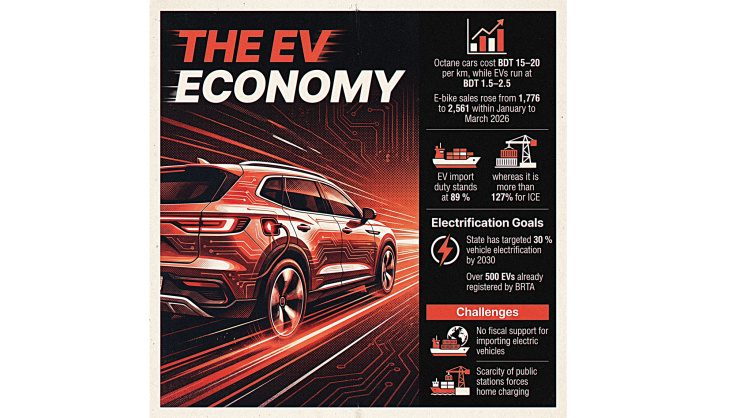
The recent surge in fuel prices is not merely a local phenomenon but a reflection of a fragile global supply chain. With octane prices hovering around BDT 125 to BDT 130 per litre, the cost of operating an internal combustion engine (ICE) vehicle has reached a breaking point for the middle class. Recognising this vulnerability, the Bangladesh government under the draft National Electric Vehicle (EV) Policy 2025, led by the Ministry of Industries, has proposed an ambitious roadmap: ensuring 30% of all vehicles on the road are electric by 2030.
This policy shift is driven by a need for energy security and environmental commitments. According to various reports, the government has already mandated that 30% of its own fleet must transition to electric power by the end of the decade. This top-down approach is designed to signal confidence to the private sector and individual buyers that the era of fossil-fuel dominance is nearing its sunset.
The Growing Electric Fleet
Electric Vehicles (EVs) are slowly moving away from becoming a rare sight on Dhaka’s roads. What began as a niche market for high-end enthusiasts is now expanding into a competitive arena. Premium brands like Audi, with its e-tron series, and BMW, with the iX, were early entrants that established the luxury EV segment. Meanwhile, brands like Hyundai and MG have introduced more accessible crossovers, catering to a broader demographic.
The entry of BYD , the world’s largest New Energy Vehicle manufacturer, has further intensified this landscape in the country. Unlike traditional brands, BYD’s approach focuses on the “maturity curve” of the market. Imtiaz Nawsher, CMO of BYD Bangladesh, observes that the country is in an early adoption phase but is progressing quickly.
He notes, “Bangladesh represents a unique convergence of urban density and rising fuel costs. It is a market that is ready to leapfrog, not gradually transition, from internal combustion to electrified mobility.”
Bridging The Charging Divide
Despite the growing interest, a significant policy gap remains. While the government promotes EV adoption, the physical infrastructure is lagging. Currently, there are very few public fast-charging stations across the country. Most EV owners are forced to rely on home charging, which limits long-distance travel and restricts ownership to those with dedicated parking and electrical provisions.
Furthermore, the duty structure remains a point of contention. While fossil-fuel SUVs face massive taxes, the total tax incidence for EVs still stands at around 89%. Industry experts argue that for the 30% target to be realistic, the government needs to provide clearer incentives for private charging entrepreneurs and further reduce import duties for entry-level electric cars. Without a unified policy on charging standards and grid management, the transition may remain confined to urban centers.
A Future Beyond Fuel
As seen in the recent European markets, where EV sales often surge following petrol price hikes, Bangladesh is at a similar crossroads. This time the transition greatly being economically resilient rather than just green. The entry of global leaders like BYD and Mercedes-Benz provides the technological depth needed to build trust, but the government must close the infrastructure gap to turn the 2030 vision into a reality.
The silence of an electric motor on a congested Dhaka street is more than just a lack of noise. It is a signal of a country moving toward energy independence. For the Bangladeshi driver, the choice is becoming clear: continue watching the rising digits at the pump or plug into the future. The road ahead is long, yet the silent engines suggest the journey has already begun.
 For all latest news, follow The Daily Star's Google News channel.
Comments