


The lost art of boredom
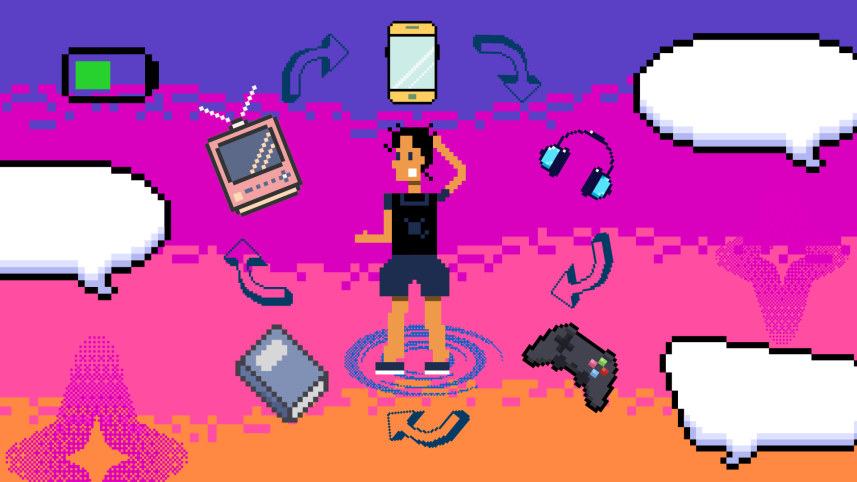
The day is gradually coming to an end. At last, you finally have some time to yourself. So, for the next few hours, you endlessly scroll through reels, watch a few episodes of the series you’re currently obsessed with or maybe game for a bit,
Not once do you allow your brain to rest. Not once do you leave space for boredom.

At a time when productivity defines you as a person, when short-form content is the norm, when we are constantly caving in to the latest trending movie or series, and when silence must be filled with music, we have lost the art of doing nothing.
Is it far-fetched to dwell upon the growing dismissal of boredom? Or is it scary? Is it the emptiness we fear? Or exposure?
Boredom is not relaxing, I must admit, not because it's mundane but because it’s uncomfortable. Far too many of us are afraid to be alone with our thoughts, even when we realise it’s a rabbit hole. Feelings shoved under the rug, moments we don’t want to relive, questions we don’t want to ask. We never stay in this moment long enough to see the good it might do, as thoughts take shape, associations are formed, and critical thinking is put into place. We don’t want to look deep into the emptiness and uncover how profound it can actually be.
There’s an image problem with boredom; it's frowned upon and best if avoided. It’s an itch which must be scratched. Yet, according to the neuroscience of boredom, in the moments of “emptiness”, our brain actually shifts. When you are not occupied, the brain triggers the default mode network (DMN), inducing self-reflection, daydreaming, sifting through memories, etc. In the simplest of words, it makes space for new things. Boredom is misunderstood. It’s not a dead state. It’s our brain at its most active. We just refuse to let it be.
“We figured out a way to eliminate boredom. We’ve been able, almost completely, to shut off the default mode network in our brains,” says Harvard professor Arthur C Brooks.
We love to romanticise the notion of philosophy, the strange allure of deep conversations, and the idea of life’s meaning, its existence, and its purpose, as long as we don’t extend it to ourselves. When we get to the ugly bits of understanding too much, we give up. Boredom is confrontation. We don’t like it, so we must get on our phones immediately.
Anytime there is a moment of pause, we reach for instant gratification, enveloping the silence with a song, watching a movie, or going out for a snack. Anything but stillness. Not allowing ourselves to be bored might come off as always giving in to distractions. Yet, it is ultimately deprivation.
Yes, it could be reflexive. Guilt manifests when we do nothing. “Why am I sitting still?” and “Why am I not doing enough?” are some of the questions we ask ourselves. Productivity in a capitalistic world has robbed us of being by ourselves and shamed us into always being on the go.
This moment of shame also surfaces when we intentionally stumble upon people creating something, whether it’s a recipe from scratch or a quirky piece of art. “God, I wish I were that creative,” we wonder. But do we allow ourselves to be? When the brain is constantly stimulated, when relentless entertainment erases our imagination, when there is no space for thoughts to be mulled over, for an idea to form, for it to be materialised, how can one expect creativity? In the process, we have rendered ourselves as passive beings, always consuming, seldom thinking, and never creating.
Boredom isn’t something that happens to us. It’s a skill that needs practice. The next time you have that urge to reach for your phone, the pressure to do something productive, resist it. Sit with it. Allow your thoughts to drift. You never know what you might discover.
Reference:
Harvard Business Review (August 28, 2025). You Need to Be Bored. Here’s Why.
Anica Bushra Rahmaan is a student of Economics. Reach her anicarahmaan@gmail.com.
 For all latest news, follow The Daily Star's Google News channel.
Comments