


Digital dream, paper reality
When the Social Obligation Fund (SOF) was created in 2011, it was meant to finance internet access in faraway districts and remote places the market would not reach.
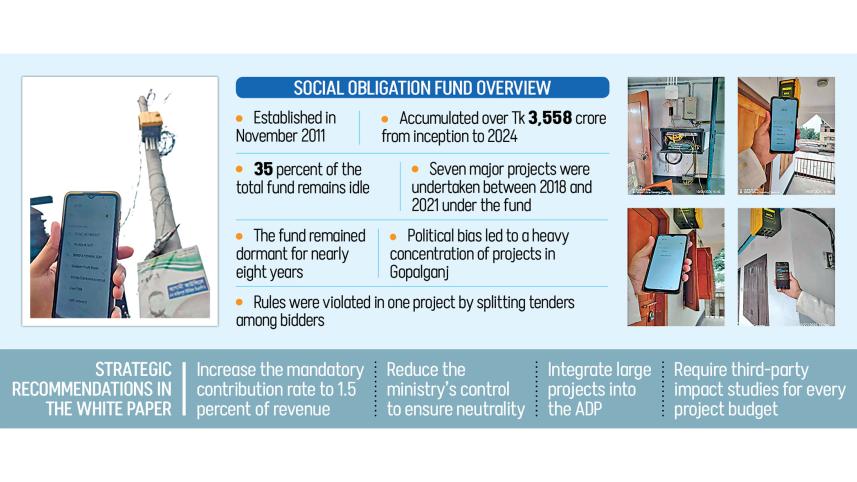
Fourteen years and gathering more than Tk 3,500 crore later, a government-appointed white paper concluded that the fund has yielded few results.

And the culprits, according to the paper, are prolonged inaction, weak oversight, and politically influenced spending. These altogether have left large sections of the country still disconnected.
The white paper on the telecom sector, commissioned in April 2025 and published last week, reviewed project documents, financial records, and field inspections conducted by a telecom sector reform taskforce.
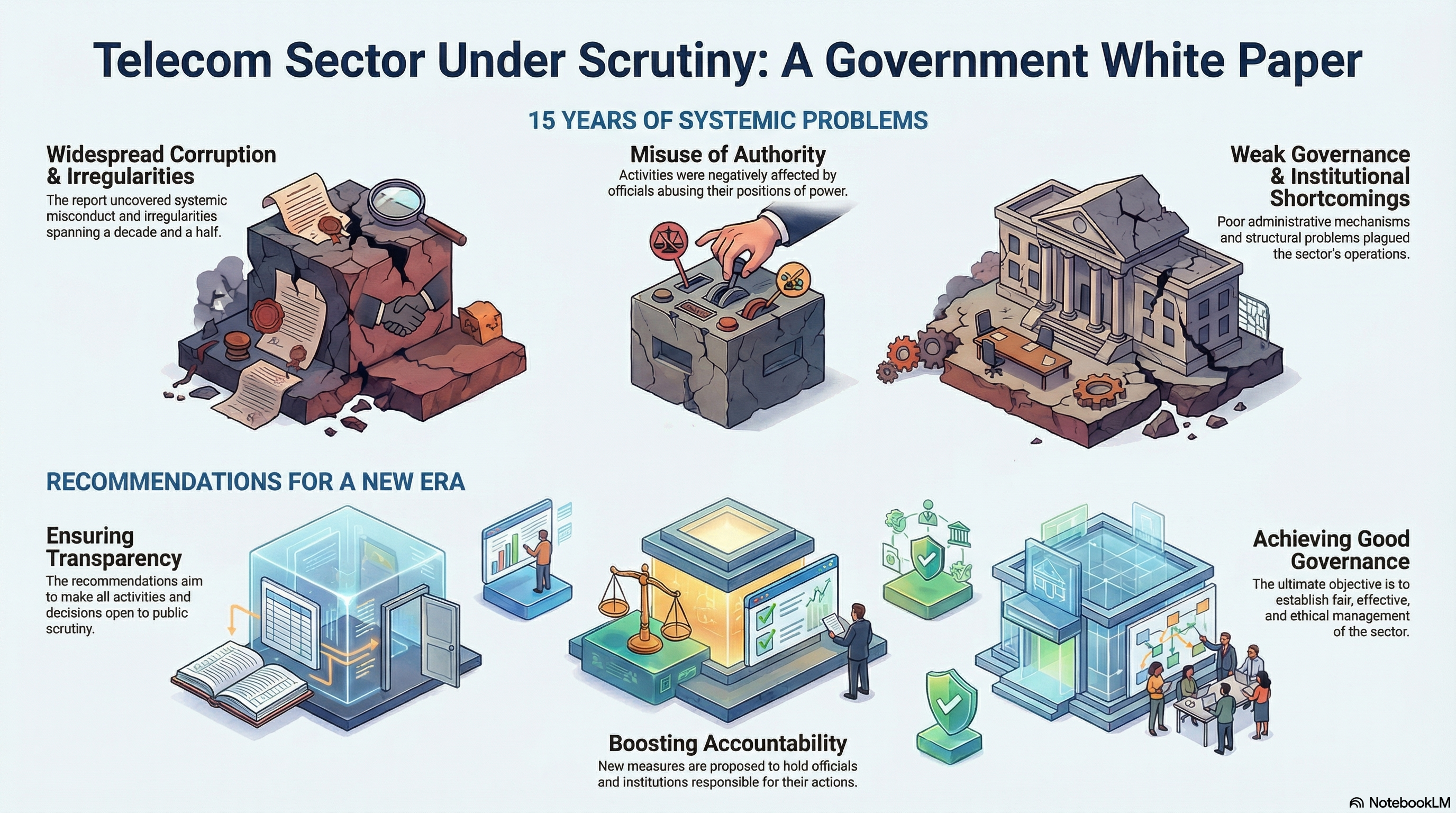
It found that the ambitious project, financed through mandatory contributions from licensed telecom operators, suffers from systemic governance failures, including delayed activation, lack of impact assessment, procurement violations and ineffective monitoring.
In multiple cases, infrastructure reported as “functional” was found to be unusable on the ground.
The failures documented in the report are linked to seven specific projects approved under the SOF.
Tk 450cr BTCL PROJECT: FUNCTIONAL IN PAPER ONLY
One of the seven projects reviewed by the white paper was a Tk 449.91 crore connectivity initiative implemented by the Bangladesh Telecommunication Company Ltd (BTCL) under the SOF.
The project, officially titled “Expansion of Telecommunication Facilities (Broadband Wi-Fi) for the Underprivileged Population of Remote Areas of Haor and Baor”, was scheduled to run from April 2020 to June 2026.
According to project documents cited in the white paper, the initiative aimed to expand broadband access across 64 districts, covering 242 upazilas and 1,470 unions.
BTCL was tasked with installing 12,800 public Wi-Fi hotspots and laying 11,197 kilometres of optical fibre, primarily at government offices, union parishads, schools and health complexes in remote and underserved areas.
The white paper found that a significant number of these installations were either “non-functional” or “unreliable”.
The shortcomings are evident in Dinajpur’s Fazilpur union. Project documents say the site is “functional” and provides free high-speed connectivity.
During field inspections by the white paper taskforce, however, no Wi-Fi signal could be detected at the location. The same scenario unfolded at multiple other locations.
Local officials told inspectors that the connection is chronically unreliable, forcing them to purchase private internet services out of their own funds to carry out routine government work.
The taskforce cited the findings as evidence that project outputs reported on paper did not translate into usable services on the ground.
Summarising the pattern observed across multiple sites under the BTCL project, the white paper concluded, “The Dinajpur findings expose how weak maintenance capacity, absence of transparent performance auditing, and opportunistic behaviour among implementing partners render even subsidised internet unreachable to its intended beneficiaries.”
A DECADE OF INACTION
 For all latest news, follow The Daily Star's Google News channel.
 The SOF was established in November 2011 under the Telecommunication Act (Amendment) 2010.
It requires all telecom operators, including mobile network operators, to contribute 1 percent of their audited gross annual revenue to a pooled fund dedicated to expanding connectivity in underserved regions such as coastal belts, river islands, and hill tracts.
Despite a steady inflow of contributions, the fund remained largely inactive for nearly eight years.
By 2024, Tk 3,558.98 crore had accumulated in the SOF account, yet the white paper states that around 35 percent of the total funds collected over 14 years remained unused due to regulatory bottlenecks and the absence of operational guidelines.
The SOF Management Committee did not approve its first projects until 2018. “The SOF is a story of delayed activation, underuse, and missed development opportunities,” the report concludes.
POLITICAL PATRONAGE AND THE ‘GOPALGANJ FACTOR’
One of the findings of the whitepaper is the blatant political bias in how these public funds were allocated. While the fund was intended for the most disadvantaged regions, the geographic distribution of projects tells a story of political patronage.
While Chattogram Division received the largest number of installations, consistent with its hilly and coastal geography, the Dhaka Division accounted for a disproportionately high share despite being the country’s most urbanised region.
The white paper attributes part of this imbalance to what it terms the “Gopalganj factor”.
Two upazilas in Gopalganj district -- Sadar and Kotalipara -- ranked among the 10 most targeted areas nationwide.
In Tungipara, inspectors found overlapping infrastructure, with multiple SOF-funded projects installed at the same locations, contrary to the fund’s objective of expanding access to unserved areas.
The commission also documented attempts to rename SOF-funded “Smart Classrooms” after political figures, describing such efforts as attempts to politicise publicly financed welfare initiatives.
7 PROJECTS, LITTLE IMPACTS
Between 2018 and 2021, seven major SOF-funded projects were approved, with a combined cost exceeding Tk 2,000 crore. These included fibre-optic backbone expansion by BTCL, satellite-based connectivity through Bangladesh Satellite Company Ltd (BSCL), mobile broadband initiatives, and education digitisation programmes.
Across all seven projects, the commission found no formal assessment of outcomes. “None of the 7 projects reviewed involved an impact study. There was no stakeholder feedback recorded either,” the white paper states.
The report detailed project-specific weaknesses.
BTCL’s fibre-optic initiative aimed to lay more than 10,000 kilometres of cable, but without effective partnerships with local internet service providers, much of the backbone capacity remained underutilised.
BSCL’s VSAT-based connectivity for remote islands was hindered by high operating costs and the absence of trained local technicians to maintain equipment.
An education digitisation project distributed laptops and interactive boards to 650 primary schools, including schools without electricity or trained teachers, while digital content was procured at inflated prices from politically connected vendors, according to the taskforce.
OVERSIGHT FAILURES, PROCUREMENT VIOLATIONS
The white paper identifies governance failures as a central cause of poor outcomes.
The SOF Management Committee, chaired by the post and telecom minister, operated with what the report calls an “exceptionalism” that allowed projects to bypass standard government scrutiny.
Such exceptionalism of SOF projects’ governance is also a key reason for their vulnerability in terms of conception, implementation and impact framework, it noted.
Investigators also documented violations of Public Procurement Rules, weak auditing practices, and widespread non-compliance.
In one BSCL project, a major contract was split equally between two bidders, violating procurement rules that require awarding contracts to the lowest responsive bidder.
In several cases, project documents were prepared within seven working days at the request of the minister, leaving little scope for feasibility analysis or cost-benefit assessment.
Because SOF projects are excluded from the Annual Development Programme, they were not monitored by the Implementation Monitoring and Evaluation Division or audited by the audit directorate.
This structural exclusion, the taskforce argues, allowed mismanagement to persist unchecked.
The report also notes that while major telecom operators comply with SOF contribution requirements, there is widespread default among smaller internet service and international gateway operators.
As a result, the actual fund balance is significantly lower than it would be if all 3,000+ licensed entities were fully compliant.
PROPOSED REFORMS
As per the white paper, the SOF has been characterised by “delayed activation, underuse, and missed development opportunities”.
While thousands of crores of taka have been spent, the digital divide remains a chasm for the villagers in Dinajpur and other remote regions who still wait for the connectivity they were promised over a decade ago.
To prevent further misuse, the white paper recommends a restructuring of the SOF framework.
Proposals include performance-based funding; mandatory political neutrality clauses prohibiting the use of funds for politically branded initiatives or partisan constituencies; compulsory impact studies greater inclusion of private sector instead of funnelling all funds to struggling state-owned entities like BTCL; third-party evaluations; allowing watchdogs to verify that the promised internet services are actually delivered; and greater participation by local stakeholders in both implementation and oversight.
Faiz Ahmad Taiyeb, special assistant to the chief adviser with executive authority over the post and telecommunication ministry, said the government is aligning the SOF framework with the white paper’s recommendations.
A revised SOF management policy, previously drafted but withheld, will now be issued after incorporating the taskforce’s guidance.
“We have instructed that all recommendations and guidelines given by the white paper committee be accommodated, and that a revised SOF policy be issued accordingly,” Taiyeb told The Daily Star.
He added that new inspection mechanisms, including three-stage inspections and third-party physical verification, have already identified problems such as cable theft and battery damage linked to outdated equipment.
The revised framework will also require pilot projects for high-value investments, clearer definitions of disaster-prone areas, exit strategies for major initiatives, safeguards against fund misuse, and placement of SOF funds in fixed deposits at financially sound banks, he said.
Comments