


A decade on, half of China’s $20 billion pledge enters aid pipeline


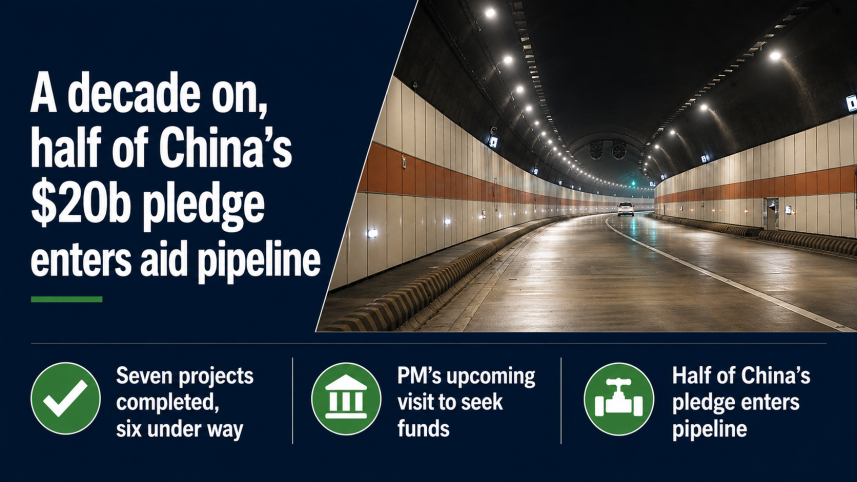
When Xi Jinping landed in Dhaka in October 2016, it was the first visit by a Chinese president in three decades, and Beijing marked it with pledges worth around $20 billion in loans and assistance over the following four years.
At the time, it was the largest commitment any single country had made to Bangladesh, and it came as China looked to deepen its presence in South Asia while India did the same. Nearly ten years later, about half of that money has entered Bangladesh’s foreign aid pipeline.

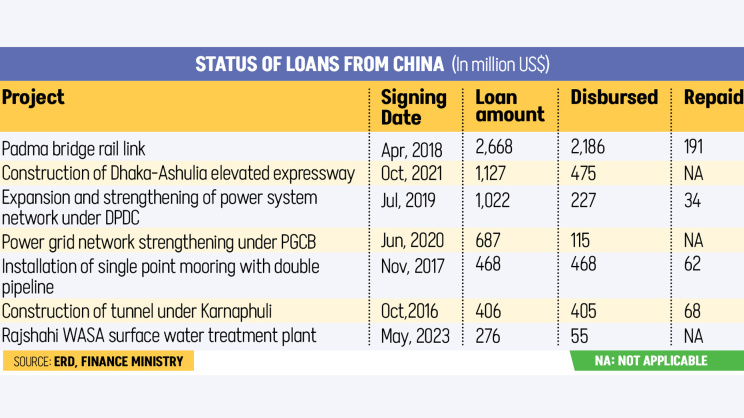
Under the initial agreement signed during Xi’s visit, China was expected to finance 27 projects. But as of June last year, Bangladesh and China had signed loan agreements for 13 projects worth $8.89 billion.
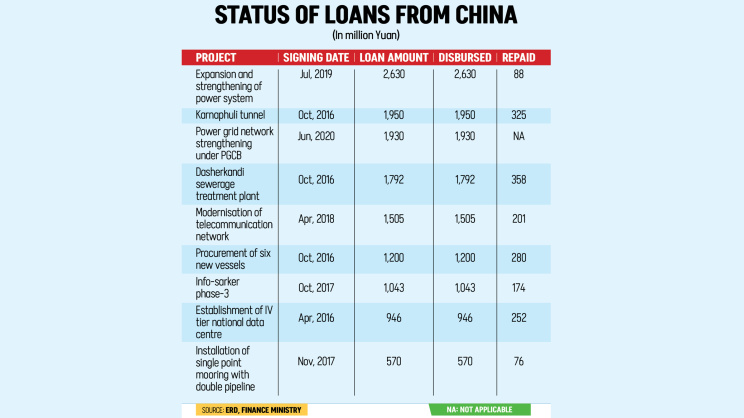
Of that amount, about $5.53 billion has been disbursed, according to finance ministry data. Dhaka has already begun repaying loans for 10 of those projects, with repayments reaching $483 million by June 2025.
While economists say signing a memorandum of understanding does not guarantee project implementation, finance ministry officials blamed the fund slowdown on the Covid pandemic, lengthy approval procedures in both countries and Beijing’s increasingly cautious approach to lending amid a foreign exchange crisis in Bangladesh.
Of the total $8.89 billion in signed loans, China provided financing in both US dollars and Chinese yuan (RMB). According to official data, RMB 15.16 billion, equivalent to $2.24 billion, was denominated in yuan, while the remaining $6.65 billion was provided in US dollars.
Against this backdrop, Dhaka is expected to seek Beijing’s financing for three major projects during Prime Minister Tarique Rahman’s upcoming visit to China.
APPROVAL DELAYS SLOW PROJECT ROLLOUT
Of the 13 projects with Chinese funding, nine were approved before the Covid-19 pandemic in 2020. Since then, progress on new project approvals has slowed considerably.
A finance ministry official said China became more cautious about extending new loans after the pandemic, pointing to a severe foreign exchange crunch in Bangladesh and rising economic pressures.
Another official involved in negotiations with Beijing, speaking on condition of anonymity, said bureaucratic hurdles on both sides, especially in China, have significantly slowed approval and disbursement.
In Bangladesh, projects require clearance from multiple committees before approval, a process that can take considerable time.
“And the process is even longer in China,” said a finance ministry official while talking to The Daily Star on condition of anonymity.
According to the official, if Chinese authorities disagree with or seek clarification on any part of the project documents, the files are often returned to Bangladesh for revision, forcing the process to start again.
Officials also pointed to capacity constraints at China’s Exim Bank, where only a limited number of officials handle overseas lending, contributing to slower fund releases.
Lobbying by competing Chinese companies seeking contracts for development projects has also caused delays, the officials said.
SEVEN PROJECTS COMPLETED, SIX UNDER WAY
Of the 13 projects, seven have been completed while six are ongoing.
Completed projects include the Padma Bridge Rail Link project, the Karnaphuli River Tunnel project, Phase III of the Info-Sarkar project, the Modernisation of Telecommunication Network for Digital Connectivity project, the Establishment of Tier-IV National Data Centre project, the Procurement of Six New Vessels project, and the Dasherkandi Sewerage Treatment Plant project.
Six other projects remain under implementation.
 For all latest news, follow The Daily Star's Google News channel.
 These include the Power Grid Network Strengthening Project under PGCB, the Expansion and Strengthening of Power System Network under the DPDC Area Project, another Power Grid Network Strengthening Project under PGCB, the Dhaka-Ashulia Elevated Expressway, and the Rajshahi WASA Surface Water Treatment Plant project.
The Single Point Mooring with Double Pipeline project in Maheshkhali has been completed but has yet to be commissioned due to contractor-related complications.
Most recently, Bangladesh and China signed a framework agreement for the Procurement of Four New Vessels project. Under the agreement, China will provide concessional financing at an interest rate of 2 percent, with a repayment period of 20 years, including a five-year grace period.
PM’S MAIDEN BEIJING VISIT TO SEEK CHINESE FUNDING
Bangladesh is expected to seek Chinese financing for three major projects during Prime Minister Tarique Rahman’s upcoming visit to China.
According to an official document prepared ahead of the visit, Dhaka will request funding for the expansion and modernisation of Mongla Port, the development of a Chinese Economic and Industrial Zone under the Bangladesh Economic Zones Authority (Beza), and the Bangladesh-China Friendship 1,000-bed General Hospital project.
The hospital is proposed to be implemented through Chinese grant assistance.
The document notes that both the Mongla Port expansion project and the Chinese Economic and Industrial Zone were included in a memorandum of understanding signed between the two countries in 2016.
Meanwhile, the Dhaka-Ashulia Elevated Expressway project is likely to receive a two-year extension as the current Development Project Proposal (DPP) is set to expire on June 30.
The project’s physical progress reached 63.5 percent as of last month.
Project Director Shafiqul Islam told The Daily Star that a proposal has already been sent to the Planning Commission seeking an extension until June 2028.
He said the proposal had received policy-level approval from the planning adviser and was now awaiting consideration by the Executive Committee of the National Economic Council (Ecnec).
EXPERTS CALL FOR SHIFT TOWARDS INVESTMENT
Mustafizur Rahman, distinguished fellow at Centre for Policy Dialogue (CPD), said the slow progress of Chinese-backed projects in Bangladesh is due to shifting priorities, implementation delays and government project reviews.
Referring to projects announced during Chinese President Xi Jinping’s 2016 visit, he said nearly half have been implemented, while others were revised, dropped or stalled over time.
“Signing an MoU does not mean every project will eventually be implemented,” he said, noting that some coal-fired power projects were later cancelled and several stalled initiatives are now being reconsidered.
Rahman cited the Chinese Economic and Industrial Zone in Anwara as an example of a project that lost momentum amid disputes over land acquisition and investment commitments but is now being revived.
He stressed the need to scrutinise the terms of new Chinese loans, including interest rates and repayment conditions.
According to him, Bangladesh should focus on attracting Chinese investment by leveraging China’s duty-free market access for Bangladeshi products, which Beijing has agreed to extend for two years after the country’s graduation from the least developed country (LDC) category.
Comments