


What being a Messi or Ronaldo fan says about you

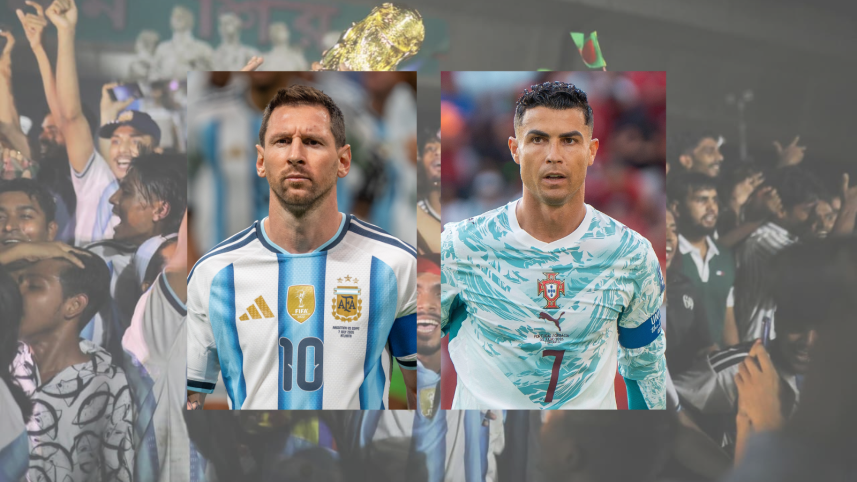
Do you notice a contrasting pattern between your Cristiano Ronaldo-loving and Lionel Messi-loving friends? Maybe your Ronaldo fan is into Andrew Tate–style influencers, holds forth on how a man should be… a man, and likes to put himself out there. And maybe your Messi fan is the shy, nerdy one — talking xG and tactics rather than whose goal won the match. Maybe these patterns hold in your football circles. Maybe they don't.
A new study spanning 26 countries and more than 10,000 people, conducted by researchers at Nanyang Technological University (NTU) in Singapore, suggests there's a correlation between your political ideology, your media habits, and which of these two mega-stars you back.

Nations split between Messi and Ronaldo
For two decades, Messi and Ronaldo have been the two gods of the planet's most popular game. The GOAT (greatest of all time) debate is arguably the most talked-about argument in sport — maybe in any arena — cutting across borders, ages, and genders alike.
With Messi's triumph at the 2022 World Cup, many — football pundits especially — considered the debate settled. But the NTU study shows that among ordinary supporters, it isn't.
Of the 26 countries, most (11) still lean Ronaldo. In 8, Messi comes out on top. The remaining seven are split almost evenly between the two.
What's striking is the pattern underneath. Several of the Ronaldo-leaning nations tend toward more authoritarian systems of government, while the Messi-leaning countries — and the evenly split ones — are largely liberal democracies. The study's authors caution, though, that this country-level link with democracy didn't reach statistical significance, and offer it only as a question for future research.
Brazil offers a twist. In the home of Argentina's arch-rivals, Messi is rated almost identically to Ronaldo — and both remarkably highly (5.80 and 5.82 out of 7), far above the European figures.
For comparison, in Spain — where both players spent their peak years — they scored just 4.68 and 4.34. It's possible the intense club rivalry there pushed fans to low-ball the other camp's man, dragging both ratings down. Other European countries cluster near these lower numbers.
Another curiosity: Messi outscored Ronaldo among respondents in every country he played in — except France. You can guess why. French fans weren't thrilled with his PSG spell, where the club twice failed to get past the Champions League Round of 16.
Ronaldo, meanwhile, scored lower than Messi in both the UK and Spain — the very places he won his Ballons d'Or.
But the sharpest finding may be how differently the two are treated at home. In Argentina, fans rate Messi 1.32 points above Ronaldo; in Portugal, fans rate Ronaldo just 0.37 above Messi — a home-country pull roughly four times weaker.
Put another way: the gap between how Argentines and Portuguese rate Ronaldo is thinner than the gap between Ronaldo and Messi within Portugal itself — Ronaldo's own countrymen barely put him ahead.
Identity and ideology
Remember your Ronaldo friend and your Messi friend from the top? The study can't see your group chat, but across more than 10,000 people it found a version of that same split — and it's sharper than you'd expect.
The researchers checked the obvious suspects first — age, gender, education, social class, even how empathetic people say they are. None of it showed any significant pull toward either player.
The strongest signal was political ideology. Liberals leaned towards Messi; conservatives leaned towards Ronaldo. Independently of politics, people who approve of strongman rule — leaders who needn't bother with parliaments or elections — also tilted towards Ronaldo, as did people reporting higher self-esteem. You see? Your Andrew Tate–loving friend picking Ronaldo isn't an anomaly. The pattern shows up all around the world.
Even political interest — how closely you actually follow politics — predicted nothing. It's not about following politics; it's the identity sitting underneath.
 For all latest news, follow The Daily Star's Google News channel.
Media habits mattered too. People who get their news from short-form video (SFV) — TikTok-style feeds and reels — leaned towards Ronaldo. Analytical thinking, measured by a short reasoning test, tilted slightly toward Messi — though the effect was small and wobbled under the study's own robustness checks. A hint, not a headline.
There's suggestive context elsewhere. A 2024 study by Dublin City University's Anti-Bullying Centre found short-form video algorithms fed accounts registered as teenage boys escalating "manosphere" content — rigid masculine norms, misogyny, spurious wealth advice; Andrew Tate territory. Whether that pipeline also nudges viewers toward dominance-coded public figures is speculation — neither study tested it — but the two findings rhyme.
But a simpler answer is, Ronaldo is native to social media and short-form reels. He has the most Instagram followers of any sportsman. His whole public grammar — physique, celebration, individual highlight edits, curated luxury — clips perfectly. Meaning SFV news consumers get more Ronaldo by default. Messi's genius– off-ball movement, build-up play, understatement– is mostly structurally illegible in 15 seconds.
The study also states, the politics-preference link was strongest among younger respondents and faded toward nothing in older ones.
Political leaning can also be linked to people’s personal and sporting philosophy. Messi’s always been seen as more of a team player. And as a person he’s seen as a quiet, family oriented person who’d rather his football do the talking. On the other hand, Ronaldo reads as individually dominant, openly ambitious, and loud about his own greatness. Political psychologists have a name for this fault line — a dominance-versus-community axis that also happens to separate right from left. So when you pick a player, you may be reaching for the persona that already matches your values.
But you still shouldn’t profile your friends based on their favourite player, or the team they support. Cause this is correlation, not causation or destiny. Take the lead author’s own caveat.
“Most of why we prefer one player is still personal — who we grew up watching, how much football we know, club loyalty. Politics is a consistent signal sitting underneath all of that. The takeaway isn't 'your politics decides your favourite footballer' but that political identity quietly colours even the choices we'd swear have nothing to do with it," said Associate Professor Saifuddin Ahmed.
Comments