


Atlas Lions unleashed: Morocco's unforgettable march to final 4

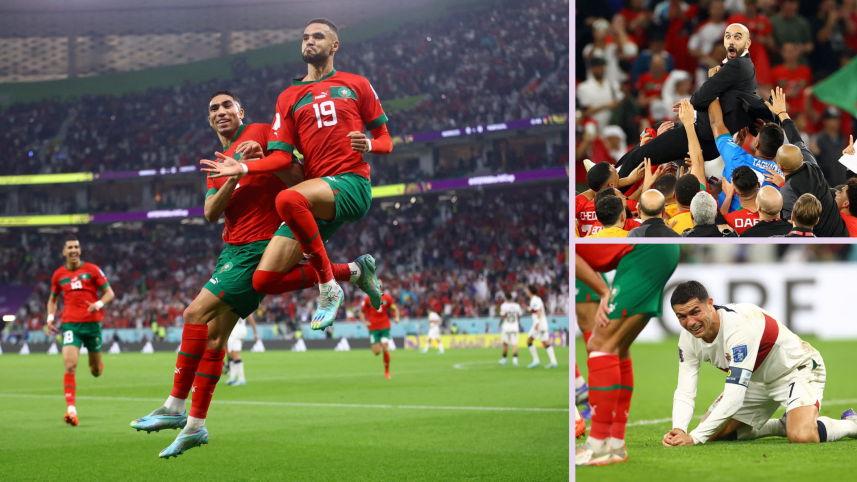
Cameroon 1990, Senegal 2002, Ghana 2010 – for the longest time, Africa’s journey on the World Cup stage seemed destined to end at the quarterfinals. Throughout a 92-year history, the door to the semifinals remained an impenetrable wall. However, in the desert oasis of the Qatar 2022 World Cup, Morocco finally cracked this long-standing deadlock of regret and longing.
Shaking off the traditional dominance of Europe and Latin America, they became only the third nation outside those regions – after US and South Korea – to reach the final four. The Atlas Lions authored a fairytale that the footballing world will remember for generations. Amidst the desert sands, they composed a footballing epic, with every line defined by indomitable courage and an unyielding spirit.

From the very beginning of the tournament, Morocco emerged as giant-killers. Faced with powerhouses like 2018 finalists Croatia and the "golden generation" of Belgium in the group stages, they remained entirely unfazed. They stunned the world by defeating Belgium and holding Croatia to a draw, eventually advancing to the knockout rounds as group winners under the guidance of Walid Regragui.
In the Round of 16, they stood across from the 2010 world champions, Spain. The Moroccans ensnared all of Luis Enrique’s tactics within their compact defensive web. After remaining goalless through regulation and extra time, the likes of Achraf Hakimi, Sofyan Amrabat, and Hakim Ziyech left the Spaniards stunned in the penalty shootout. By securing their ticket to the quarterfinals, Morocco announced the true extent of their prowess.
The stage for history was set at Doha’s Al Thumama Stadium against a formidable Portugal side featuring the legendary Cristiano Ronaldo. The Portuguese had reached the quarterfinals having scored 12 goals in their previous four matches. Conversely, Morocco’s ironclad defence had not allowed a single opposition player to score against them; the only goal they had conceded was an own goal by Nayef Aguerd against Canada.
The two teams had met on the world stage only twice before, both in the group stages, with their head-to-head record perfectly balanced. Morocco had claimed a brilliant 3-1 victory in 1986, while the Portuguese had the last laugh with a 1-0 win in 2018.
Then came the 42nd minute – an unforgettable moment in football history. Rising to meet a cross from teammate Yahia Attiyat Allah, Youssef En-Nesyri soared into the air for a magical header that seemed to defy gravity itself. As the ball hit the back of the Portuguese net, it wasn't just a goal being celebrated; it was the first verse in the ending of a century of heartbreak for the African continent.
In the second half, a star-studded Portugal became desperate to equalise, launching assault after assault on the Moroccan penalty area. Despite losing three of his four first-choice defenders to injury, Coach Regragui maintained an unshakeable fortress. Even after captain Romain Saïss was carried off on a stretcher and the team was reduced to ten men in stoppage time, the defence refused to buckle.
As a last resort, Ronaldo was brought off the bench, but he could not act as Portugal’s saviour. His departure through the tunnel in tears, carrying the frustration of not scoring in the knockout rounds and the bitter pain of exiting the World Cup, remains one of the most poignant images in the sport’s history. Meanwhile, on the pitch, the Moroccans were lost in unbridled celebration as the first African and Arab team to reach the semifinals.
Following the victory over Portugal, crowds poured into the streets, from the famous Jemaa el-Fnaa square in Marrakesh to the avenues of Rabat. The frenzy was not limited to Morocco; it spread from Abidjan in Ivory Coast to Riyadh in Saudi Arabia, and from Tunis in Tunisia to Misrata in Libya. Even on the Champs-Élysées in Paris and Edgware Road in London, the red and green flags of Morocco flew high.
An emotional Coach Regragui said after the win: "We were up against a really great Portugal team. We’re drawing on everything we have... we still have players injured. I told the guys before the match we had to write history for Africa. I’m very, very happy."
African football was swift to recognise the achievement. CAF, the continent’s governing body, tweeted: "Continental achievement!... What a milestone for the Atlas Lions." The team had become the standard-bearers for the entire Arab world and the African continent.
Alongside their performances on the pitch, certain images will remain etched in the hearts of football lovers forever. Players rushing to the stands to hug and kiss their mothers or dancing in joy on the green grass provided a unique canvas of pure affection. This display of human emotion beneath the veil of professionalism made Morocco beloved by fans everywhere.
However, in the dream semifinal, they eventually succumbed 2-0 to the experience of the defending champions, France. Falling behind to a Theo Hernandez goal in the fifth minute was a heavy blow, and Randal Kolo Muani’s late strike finally shattered their hopes of reaching the final. Despite holding 51 per cent of the possession, Regragui’s men could not break the French wall, yet they left the pitch with the immense pride of having gone toe-to-toe with the world champions.
This fairytale journey concluded with Morocco finishing fourth after a 2-1 defeat to their group-stage rivals Croatia in the third-place play-off. While they couldn't end on a winning note, for a squad ravaged by injury and exhaustion, reaching that stage was an extraordinary feat of endurance.
Ultimately, there was no room for tears. Amidst the thunderous applause of the spectators, there was only the joy of achievement. Morocco may not have won the trophy, but they undoubtedly won the hearts of millions across the globe.
 For all latest news, follow The Daily Star's Google News channel.
Comments