


How Man City’s financial ruling puts United’s ownership costs in the spotlight
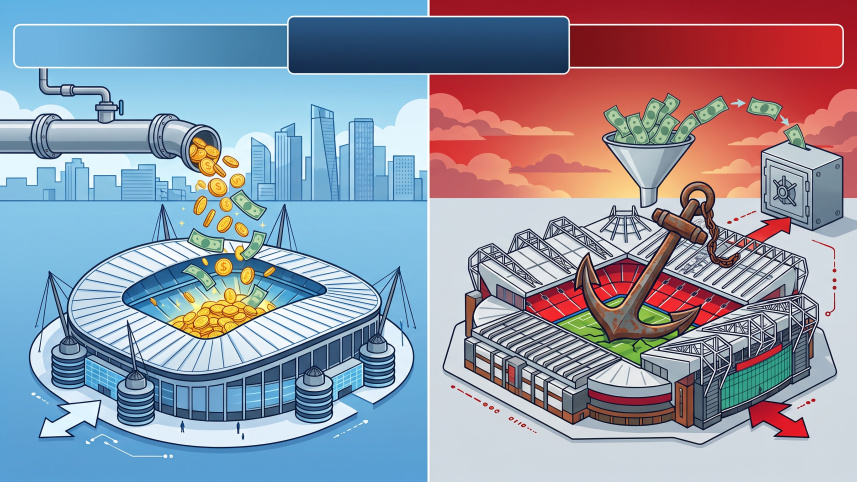
Manchester’s two biggest football clubs have spent years illustrating opposite answers to the same question: what should an owner’s money do to a football club?
At Manchester City, a financial ruling has put scrutiny on money that, according to the Premier League, entered the club as sponsorship income but was funded by their owner. At Manchester United, the more enduring financial question is what happens when the ownership structure leaves the club paying for the way it was bought.

The contrast is worth examining because both stories ultimately lead to the same place: the amount of money available to build a football team.
An independent commission examining City’s finances found that £830.69 million recorded as sponsorship income between 2009 and 2018 was funded by the Abu Dhabi United Group (ADUG).. The Premier League said the arrangements artificially inflated City’s revenues and reduced their costs by more than £900 million. City have appealed the findings.
United’s latest accounts tell a markedly different story. The club generated a record £677.6 million in revenue and £216.4 million in adjusted EBITDA for the year to June 2026, yet still recorded a loss. Interest payments were £38.9 million, while total borrowings stood at £689 million at the end of the financial year.
That is the important distinction. Revenue is not the same as money available to spend on football.
United remain one of the biggest revenue-generating clubs in the game, but that income has to carry a substantial financial load. Alongside wages and operating costs, there is debt to service, transfer commitments to meet and a proposed 100,000-seat stadium to finance.
The interest bill is part of a much longer legacy. Since the Glazer family’s leveraged takeover in 2005, football-finance analyst Swiss Ramble estimates United have paid around £852 million in interest. That is an estimate rather than a club-reported figure, and interest payments should not simply be equated with money taken directly from football. But the cumulative figure illustrates the scale of the financing burden attached to the ownership model.
And that burden is still being managed. In June, United issued $550 million of new senior secured notes at an interest rate of 5.36 per cent, maturing in 2031. The club also had £110 million drawn from its revolving facility at the end of June, while retaining £290 million of available capacity.
None of this means United are incapable of spending. They invested £148 million in the summer transfer window. The problem is that transfer spending now sits alongside a substantial list of existing obligations. The club reported £191.7 million in future transfer payments over the next five years, with additional sums potentially payable if certain contractual conditions are met.
That makes player trading particularly important. United have struggled to consistently recover significant fees from departures. Since Romelu Lukaku’s £74 million move to Inter Milan in 2019, only four United players have generated more than £25 million in transfer fees: Mason Greenwood, Scott McTominay, Rasmus Hojlund and Alejandro Garnacho.
The issue, then, is not simply how much United spend. It is how effectively they can recycle that spending. Elite clubs routinely use player sales to help fund squad rebuilding; United have too often had to rely on their own revenue and borrowing capacity.
The sporting consequences are difficult to separate from that equation. United need Champions League football to maximise revenue and strengthen their financial position, but building a squad capable of returning to Europe’s elite competition requires significant investment in the first place. Michael Carrick’s side finished third last season and secured United’s return to the Champions League after a two-year absence, but that progress does not remove the structural pressures underneath it.
Nor should debt become a catch-all explanation for United’s decline. Recruitment mistakes, managerial instability, expensive contracts and inconsistent sporting planning have all played major roles. A different ownership structure would not automatically have produced a better football department.
But City’s case does sharpen a wider question about football’s financial rules.
City’s dispute centres on whether owner-funded money was presented as genuine commercial income, potentially increasing the club’s financial capacity. United’s experience raises the mirror-image question: what happens when an ownership structure creates substantial financial obligations that the club itself has to carry?
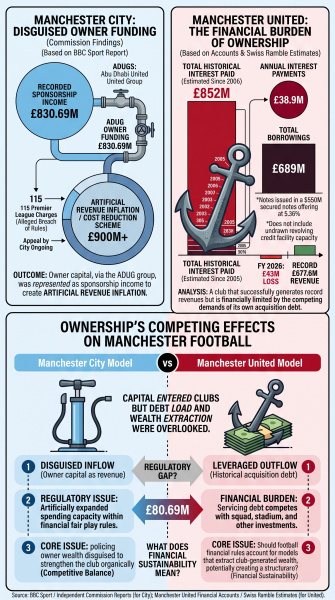
The two situations are neither legally nor financially equivalent. One concerns the treatment of sponsorship income and the regulatory limits around owner-related funding. The other concerns the financing of a leveraged acquisition and the costs subsequently borne by the club.
Yet both demonstrate how ownership can alter competitive power without simply appearing in a transfer budget.
Football’s financial regulations are designed to promote sustainability and prevent clubs gaining unfair advantages through certain forms of funding. United’s experience suggests that sustainability has another dimension worth considering: not only how much money an owner can put into a club, but how much of the club’s own money is consumed by the consequences of ownership.
That is particularly relevant at United because the club is not short of revenue. It is short of financial freedom.
 For all latest news, follow The Daily Star's Google News channel.
 Every pound used to service debt is unavailable for another purpose. That does not mean debt alone explains poor recruitment or sporting failure. It means the margin for error becomes smaller when a club already has significant obligations competing for the same resources.
That is the real contrast between the two Manchester clubs.
City are dealing with questions about the extent to which owner-backed funding strengthened their financial position. United are dealing with the continuing consequences of an ownership model that placed financial costs on the club.
For years, football has asked how much money an owner should be allowed to put into a club. Manchester United’s experience raises the other side of the question: how much of the money a club generates should remain available to build the team, improve its infrastructure and secure its future?
Manchester City’s financial ruling does not answer that question. But it has made it considerably harder to ignore.
Comments