What Bangladesh lost with the Baibari Ghar

[Editor's Note: This article is published as part of Inherited Memories, a series by Slow Reads in which we invited our readers to share personal essays and stories about family objects and the lives and memories connected to them. We continue to welcome submissions from our readers. Details of the submission guidelines can be found at the end of this essay.]
On monsoon afternoons in Gafargaon, Mymensingh, when the tin roof turned the whole world into noise, that room was where everything happened. Men came in from the fields, dripping. Vendors stopped mid-route. Someone's distant cousin from three villages over would appear out of nowhere, sit down on the wooden chowki without being asked, and stay for an hour. My grandfather never once asked anyone their business before offering them a place to sit.
I remember sitting on the chowki as a child, watching this happen. I didn't understand it then. I thought it was just what adults did. The visitors appeared, were received, then left, and life continued. It did not occur to me that the room itself was doing something. Its position at the very edge of the homestead, facing the road, was a kind of statement. Leaving the door open from morning to evening was a decision someone had made, long before my grandfather was born, and one that he was simply honouring.
That room was what we in Mymensingh call the 'Baibari Ghar', the outer house. And it is gone now. Not just from my grandfather's homestead, but from Bangladesh altogether, so quietly and completely that most people haven't even noticed it has left.
Walk through any village today and you'll see what replaced it: concrete boundary walls, iron spikes along the top, padlocked collapsible gates, steel grilles on every window. The new rural home is a fortress. It is designed, very deliberately, to keep people out.
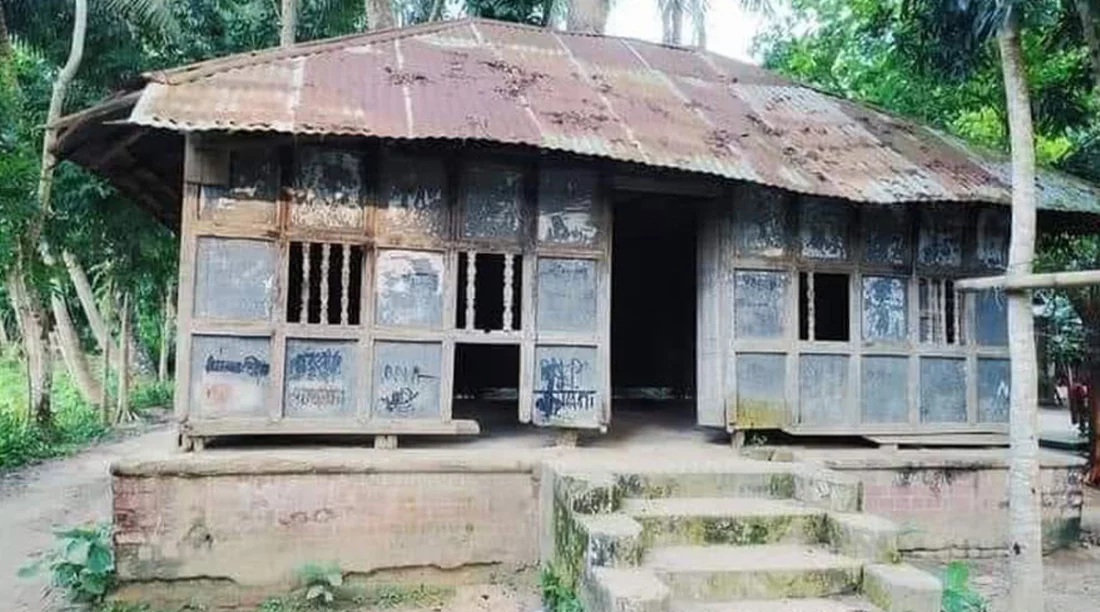
The old homestead was designed around the opposite logic. It had two worlds. The inner quarters, the andarmahal, were the family's private space, largely the women's domain, where the actual life of the household unfolded away from the road and its strangers. The outer house faced the village path. It was built at the edge of the property specifically so that anyone passing by could step in. No knock required. No invitation.
A farmer with a wooden plough. A stranger caught in a cloudburst. A wandering teacher with nowhere to be until evening. They all had an unspoken right to the shaded verandah, the cool mud floor, the wooden bench along the wall.
The room itself was nothing elaborate. A large chowki covered with a woven mat. Two long benches. Sometimes a single heavy armchair reserved, by unspoken custom, for the eldest man of the house. The walls were mud-plastered, the pillars bamboo or wood, the roof tin or thatch. It was designed to be comfortable in the way that functional things are comfortable. It did its job without calling attention to itself. There was no decoration to protect, nothing fragile to worry about. You could track mud across the floor and no one would say anything. The whole point of the room was that it could absorb whoever arrived.
This wasn't charity. It was architecture built on a belief that a stranger in a rainstorm probably just needs somewhere to sit.
The explanations for why the Baibari Ghar disappeared are all technically correct. Land got scarce. Joint families split into nuclear ones. Every square foot suddenly needed to earn its keep, and a whole building dedicated to strangers was hard to justify on a narrow plot. Money came in from the Gulf, from Dhaka, from abroad, and with it came new ideas about what a proper house looks like—concrete, vertical, sealed, imitating the apartment buildings of Dhaka.
The economics of the countryside changed in tandem. The old joint family structure, which pooled agricultural income and shared labour across generations, gave way to smaller households with tighter budgets and no surplus space. A separate outer building, maintained for the benefit of people who weren't even family, began to seem like an indulgence that only the previous century could afford. When the older generation passed away and the homestead was divided among siblings, the outer house was often the first thing lost—carved up, sold off, or simply left to decay while the main building was modernised.
And there was something else. The old outer house was also, in many ways, a men's space. Women managed the inner quarters. Men received guests, held informal court, and conducted whatever business of the village needed conducting, in the Baibari Ghar. The gender architecture of the homestead was rigid. To mourn the outer house without acknowledging that is to be dishonest about what we're mourning.
All of this is true. But I think these explanations miss the harder thing.
Architecture doesn't just reflect how we live. It reflects what we believe about other people. The outer house could only exist in a community that assumed the person walking down the road was probably fine. Not a threat. Not a problem to be managed. Just a person who might need a rest.
The Baibari Ghar was one of the few genuinely democratic spaces the village had. A wealthy landowner and a landless labourer could end up on the same bench, waiting out the same storm, talking about the same thing. Nobody planned it that way. It just happened, because the room was open and the rain didn't care who you were. That kind of accidental levelling doesn't happen in a padlocked drawing room where guests are vetted before the gate opens.
That assumption is gone. And I don't think it left because of land prices.
Something shifted in how we see strangers. I notice it in what Dhaka has exported to the village imagination—that hyper vigilant, high-density city logic where you don't make eye contact in lifts and you lock your door the second you're inside. That logic has migrated. It has travelled back along the same roads that remittance money, corrugated iron, and mobile phones have travelled, and it has settled into the village with the same quiet permanence.
The modern rural home now treats the uninvited visitor as a security anomaly. You don't sit them down. You ask what they want, at the gate, through the grille, and then you send them on their way. The casual caller, the neighbour stopping to talk, the distant relation passing through, now needs a reason to be there. Presence alone is no longer enough. A stranger standing at a modern verandah is looked at differently from a stranger who stepped onto an old chowki. The body language of the house has changed.
We call this being sensible. We tell ourselves that the world is more complicated now, that trust is a luxury, that you cannot simply leave a door open and expect nothing bad to happen. And perhaps that is true. But I keep wondering what we gave up to get there.
I want to be careful here, because nostalgia is a dishonest narrator. It smooths out the things that were actually hard. The Baibari Ghar existed within a social order that was, in many ways, suffocating for the people it constrained most, primarily women, who were kept in the inner quarters while men held court outside. The hospitality on display in the outer room was made possible by invisible labour happening in the inner one.
The Baibari Ghar was one of the few genuinely democratic spaces the village had. A wealthy landowner and a landless labourer could end up on the same bench, waiting out the same storm, talking about the same thing. Nobody planned it that way. It just happened, because the room was open and the rain didn't care who you were. That kind of accidental levelling doesn't happen in a padlocked drawing room where guests are vetted before the gate opens.
What passed through that room was not just people. It was information. The outer house was the village's informal news exchange, where you heard about the flooding upstream, the fair at the next thana, the price of rice in the district market, the illness of someone's father three villages away. None of this was organised. There were no announcements, no agendas. People talked because they were sitting in the same room with nothing else to do, and out of that idleness came the kind of knowledge that holds a community together.
When those spaces close, people don't just become more private. They become more separate. The village turns into a row of individual silos, families living ten feet apart and knowing almost nothing about each other. What used to travel through conversation now travels through WhatsApp groups—curated, filtered, shared between people who already agree, already know each other, already belong to the same circle. The accidental encounter, the stranger with news from somewhere else, the conversation that goes somewhere unexpected: these don't happen anymore. Or they happen much less. And every time they don't happen, the village becomes a slightly smaller version of itself.
I want to be careful here, because nostalgia is a dishonest narrator. It smooths out the things that were actually hard.
The Baibari Ghar existed within a social order that was, in many ways, suffocating for the people it constrained most, primarily women, who were kept in the inner quarters while men held court outside. The hospitality on display in the outer room was made possible by invisible labour happening in the inner one. The tea that appeared for the visitor, the food that materialised at mealtimes, the swept floor, and the filled water pot. None of that came from nowhere. The openness of the outer house was subsidised by the confinement of the inner one. That is not a small thing, and it deserves to be said plainly before we get too sentimental.
I am also not saying we can or should build outer houses again. The land isn't there. The joint families aren't there. The economics won't allow it. The piece of a homestead that gets divided among four siblings barely holds a single family's needs, let alone a room for strangers.
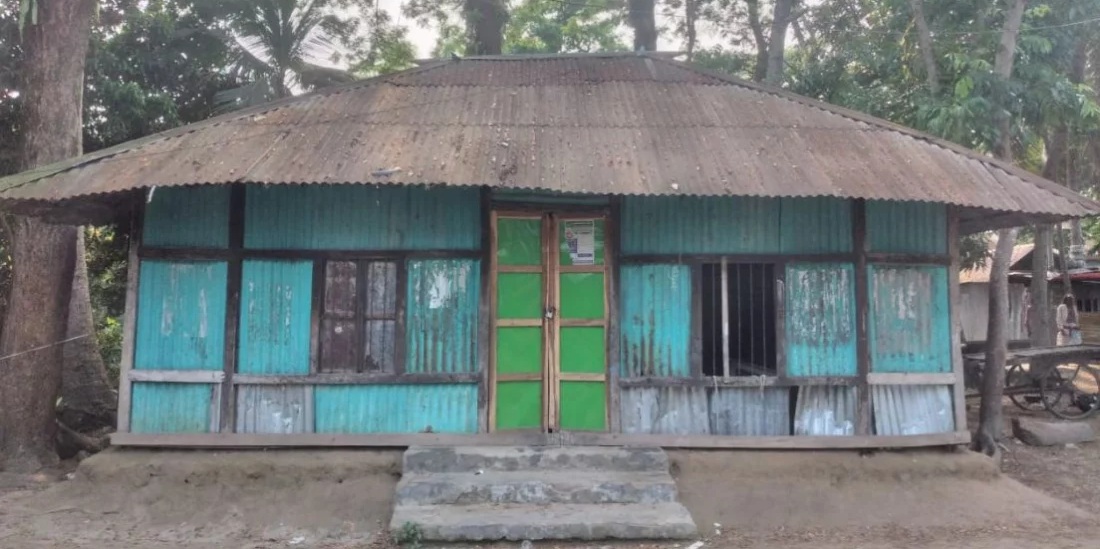
But ,I do think we lost something real when we stopped building spaces that trusted the person walking by. Not naïve trust. Not the refusal to acknowledge that some people mean harm. Just the baseline assumption that most people, most of the time, are simply people who are tired, or wet, or in need of a glass of water. That opening a door to them costs less than we think.
There is a version of development that makes you richer and more isolated at the same time. That is the version we got.
Last time I visited Gafargaon, I walked past the plot where my grandfather's house used to stand. The main structure has been rebuilt in brick. It looks solid, finished, respectable. A high wall runs along the front, freshly painted. There is a collapsible gate, padlocked even in the middle of the afternoon.
The corner where the outer house once stood, where I used to sit on the bench and watch strangers come and go, has a water tank on it now. Concrete. Practical. Taking up exactly the right amount of space.
I understand. I just think about it sometimes.
Md Rakibul Hasan works with Bangladesh Small and Cottage Industries Corporation (BSCIC). He can be reached at rakib4457@gmail.com.
Send your articles for Slow Reads to slowreads@thedailystar.net. Check out our submission guidelines for details.
And still, my father lives

Why this year’s Nobel-winning brain technology matters to you

Why do humans naturally drift to the left?

From chai to shampoo: The extraordinary journeys of ordinary words

Between Bangladesh and Australia: Learning the rules of freedom

When loyalty decides what counts as facts: Welcome to the age of epistemic fragmentation

Revisiting the origins of Sufism: Competing narratives of authenticity and borrowing

International Translation Day 2026 / Beyond equivalence: Translation and the politics of being understood
Between Ghumparani masi-pisi and Baby Shark: Why Bengali lullabies still matter in the age of screens