Language, power, and the erasure of Kol
To explore the future of linguistic diversity in Bangladesh from the perspective of the Kol language, I begin by revisiting a few unconventional yet academically sound facts about the Kol people. Such a discussion is necessary not only to correct persistent misrecognitions but also to situate the Kol within broader historical and linguistic debates. From there, I turn to the voices of the Kol community themselves, who speak of an ongoing shift in their language, culture, livelihood, and heritage. This situation of language endangerment raises fundamental concerns about the multilingual future that Bangladesh aspires to build.
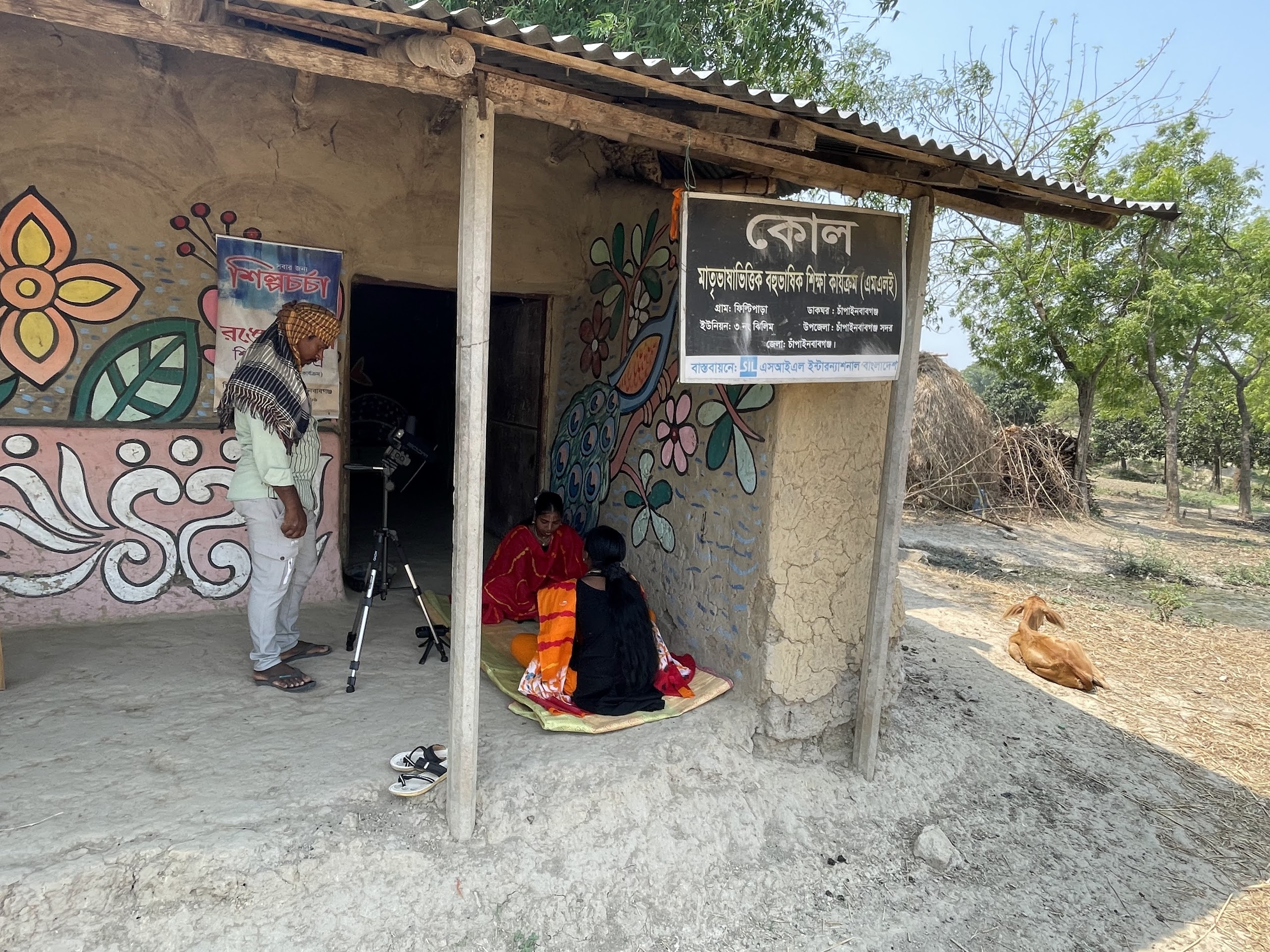
Kol is an endonym that refers to the Kol people, their land, culture, and language in both India and Bangladesh. In Bangladesh, the Kols are a marginal community among the indigenous peoples of the plains. While the origin of the language is not clearly known to Kol speakers themselves, various explanations of its probable origins have been proposed by linguists and anthropologists. Linguistically, Kol is an endangered language belonging to the Munda family. It is spoken in north-western Bangladesh and shares significant similarities with other Munda languages spoken in India. Kol is the primary language, or mother tongue, of the Kol indigenous community, which possesses its own distinct linguistic and cultural identity. However, many Kol people today express concern about losing their mother tongue and native traditions.
Currently, among Kol speakers, there is an increasing trend of borrowing words from other languages. The influence of Santali and Bangla is particularly noticeable. Kol speakers reside in several districts of Bangladesh, including Rajshahi, Chapai Nawabganj, Naogaon, Rangpur, Dinajpur, and Kushtia. More specifically, they are concentrated in Chapai Nawabganj (Sadar and Gomastapur), Rajshahi (Godagari and Sadar), and Dinajpur (Kotwali and Kahorol). According to the 2022 Population and Housing Census of Bangladesh, the ethnic Kol population stands at 3,822, of whom 1,842 are male and 1,980 are female.
At the same time, it is important to address a larger issue of naming and representation. In the plains of Bangladesh and eastern India, many indigenous communities are today homogenised under the generalised ethnolinguistic label ‘Santali’. This classificatory reduction overlooks the internal diversity of Munda-speaking populations and reproduces a long-standing simplification rooted in colonial knowledge production. While contemporary administrative and public discourse often collapses multiple identities into ‘Santali’, earlier scholarship used a different umbrella term, ‘Kol’. Although that label also carried colonial baggage, it reflected a broader recognition of a Munda linguistic-cultural cluster rather than a single dominant identity.
The shift from ‘Kol’ to ‘Santali’ is not merely terminological; it denotes changing regimes of representation, power, and visibility. Naming practices are political acts, as they determine which languages are recognised, which identities are institutionalised, and which communities become statistically invisible. From a decolonial perspective, the uncritical use of homogenising umbrella terms—whether ‘Kol’ in colonial archives or ‘Santali’ in contemporary bureaucratic discourse—constitutes an epistemic act that marginalises smaller Munda-speaking groups and erases localised linguistic ecologies.
Importantly, discussions of the Kol language tradition also bring forward a bold and alternative origin narrative of Bangla that foregrounds the historical and structural affinities between Bangla and the Kol–Munda language continuum. In 1977, anthropologist Clarence Maloney revisited conventional views on the evolution of Bengali. While acknowledging the widespread belief that Bengali was derived from Sanskrit, he argued that Sanskrit functioned primarily as a liturgical and literary language that enriched Bangla rather than serving as its direct ancestor. Engaging with G. A. Grierson’s outer-band theory, Maloney argued that structural differences among Bengali, Marathi, and other languages complicated the idea of a single Magadhan Prakrita origin.
Significantly, he proposed that Bengali may have developed as a pidgin on the Bengal plain through processes of Munda contact and pidginisation. Similarly, prominent linguist Suniti Kumar Chatterji acknowledged Kol (or Munda) influences in Bengali, identifying numerous words in modern Bangla—such as kadali, kambala, mayura, tambula, utpala, mera, and meni—as being of Kol origin. Reinforcing this line of inquiry, distinguished linguist Muhammad Shahidullah presented his influential paper ‘Munda Affinities of Bengali’, published in 1931. He demonstrated phonological, morphological, syntactical, and lexical connections between Bengali and Munda languages and concluded that the relationship between Bengali and Kol was intimate.
Beyond academic arguments, Kol remains a rich repository of folklore, song, rhyme, and religious literature within the Munda language family. In recent times, the Roman script has been used to write Kol, often with special diacritic markers. Kol speakers are fluently multilingual, typically using Santali and Bangla alongside their mother tongue. While Kol is used primarily within the community, Bangla dominates outside their villages. The influence of Munda languages on Bangla is visible in vocabulary related to agriculture, habitation, kinship, counting, and the natural world. Words such as kuri (twenty), pet (belly), chula (oven), and dhol (drum) are recognised as deshi words of indigenous origin. Thus, Kol is not peripheral to the linguistic history of this region. It is foundational.
However, the future of Kol remains fragile. According to Fishman’s Graded Intergenerational Disruption Scale (GIDS), Kol remains between level 6 and level 7, indicating a precarious state of intergenerational transmission. Field observations suggest that level 7 is increasingly applicable: while the child-bearing generation can speak the language, transmission to children is weakening. Under the Expanded GIDS (EGIDS), Kol is moving from ‘vulnerable’ (6a) towards ‘threatened’ (6b). Recent fieldwork indicates that it is already in a threatened state, as the youngest generation is gradually losing fluency in their mother tongue.
The situation of the Kol language in Bangladesh cannot be understood merely as a case of gradual linguistic decline. Rather, it must be situated within broader theoretical discussions of language endangerment as a political and historically structured process. Recent arguments in linguistics claim that language endangerment is not a ‘natural’ outcome of linguistic evolution but a consequence of power, inequality, and colonial history. This consideration is particularly relevant to the Kol case.
Language endangerment occurs when intergenerational transmission weakens or ceases. In the Kol context, field observations indicate precisely such a precarious condition: while older generations speak Kol fluently, younger generations increasingly shift towards Bangla and, in some cases, Santali. This pattern reflects what sociolinguists describe as language shift, where a community gradually abandons its ancestral language in favour of a dominant one. However, as theorists such as Roche and Belew cautioned in 2025, such shifts are rarely voluntary or ‘natural’. They are embedded in systems of linguistic inequality.
In Bangladesh, Bangla occupies a position of state prestige, educational dominance, and economic mobility. Santali, in certain contexts, also functions as a more numerically and institutionally recognised Munda language. Within this hierarchy, Kol becomes doubly marginalised: first by national linguistic centralisation around Bangla, and second by homogenising classifications that subsume smaller Munda-speaking groups under ‘Santali’. As a result, Kol speakers often adopt dominant languages for education, employment, and social acceptance. This mirrors Roche and Belew’s argument that language endangerment emerges through political domination, linguistic marginalisation, and cultural assimilation.
Importantly, the erasure of the name ‘Kol’ itself through shifting classificatory regimes illustrates how naming practices function as acts of power. When a language becomes statistically invisible, it becomes politically invisible. Thus, Kol endangerment is not simply about vocabulary loss or borrowing; it is about unequal recognition within state and knowledge systems.
In this contemporary phase, we now need to reconceptualise language revitalisation as a form of resistance and decolonisation. In the Kol context, documentation, community-based language teaching, and the assertion of Kol as an endonym are not merely academic exercises. They are acts of epistemic reclamation. Recording oral literature, transcribing narratives in Roman script with diacritic markers, and analysing Kol’s structural features are steps towards restoring intergenerational transmission and community dignity. Under Fishman’s GIDS and the Expanded GIDS framework, Kol currently falls within the vulnerable-to-threatened range, signalling a fragile stage of transmission. Therefore, language documentation is necessary, and revitalisation must be community-driven. Without active participation from Kol speakers themselves, especially the younger generation, documentation alone cannot secure survival.
Ultimately, the future of linguistic diversity in Bangladesh depends on whether languages like Kol are recognised not as relics of the past but as living systems shaped by historical contact, colonial intervention, and contemporary inequality. Bangladesh’s history is inseparable from the struggle for language rights. International Mother Language Day reminds us of that legacy each year. The question, therefore, is not whether Kol will survive on its own.
The question is whether Bangladesh is prepared to imagine a multilingual future that includes its endangered indigenous voices. I have often searched for this answer in my interactions with a Kol child named Aranya Biraj Kol, who now creates small online videos in his own language along with his father. At times, the answer remains unspoken in the quiet gaze of Rumali Hasda Kol, a Kol woman recently displaced from her ancestral homestead. If we can confront these existential questions beyond the month of February and beyond ceremonial remembrance, of course, we may finally begin to find answers to issues that are intricate, essential, and profoundly human.
Dr Mashrur Imtiaz is an Assistant Professor of Linguistics at the University of Dhaka.
Send your articles for Slow Reads to slowreads@thedailystar.net. Check out our submission guidelines for details.
Will the next generation speak Kokborok?
Hajong and the cost of being unwritten
Preserving the A’chik tongue
The last speaker of Saura
Thar: A language born on the rivers
The Bawm language at a crossroads

Bangla in the age of algorithms
Beyond Bangla: Why Bangladesh’s other languages matter
What two decades with Hyow taught me about language loss
Language, power, and the erasure of Kol