Hajong and the cost of being unwritten
Every ten years, there is a quiet argument that never makes the news. A census worker knocks on a door and asks a simple question: “Mother tongue?” The answer comes back—Hajong. It always does. The people saying it do not hesitate. They know the difference between Hajong, Bangla, and Assamese. They switch between languages every day without confusing them. The confusion usually happens on paper, somewhere far away, when someone decides that Hajong should just be grouped under Bangla anyway.
That is how a language begins to disappear without actually dying. Not through silence—Hajong is still spoken, sung, joked in, and argued in but through classification. Official records like neat categories. Hajong does not behave neatly. It lives in a strange middle space: historically shaped by Tibeto-Burman roots but now an Eastern Indo-Aryan language, carrying traces of both worlds in its bones.
The people who speak it have been clear about one thing for decades: Hajong is not Bangla, not Chakma, and not Rajbangshi. Yet official systems keep folding it into bigger linguistic umbrellas. The census might record the numbers, almost eighty thousand speakers identifying themselves, but recognition stops there. The language name shows up almost by accident, simply because the population crosses a statistical threshold.
Step into a Hajong household, and none of this bureaucratic confusion exists. Stories move from elders to children without translation. Songs carry rhythms that do not quite sound like neighbouring tongues. Children teach each other words in schoolyards. The language is alive, stubbornly so, even when outsiders barely know it exists.
And that is the strange tension at the heart of Hajong—a language fully present in everyday life but half-visible in official memory. It survives through people who keep speaking it, even while the world keeps trying to rename it. Between identity and administration, between heritage and paperwork, Hajong stands in a narrow space—not lost, not fully acknowledged, but constantly negotiating its right to be itself.
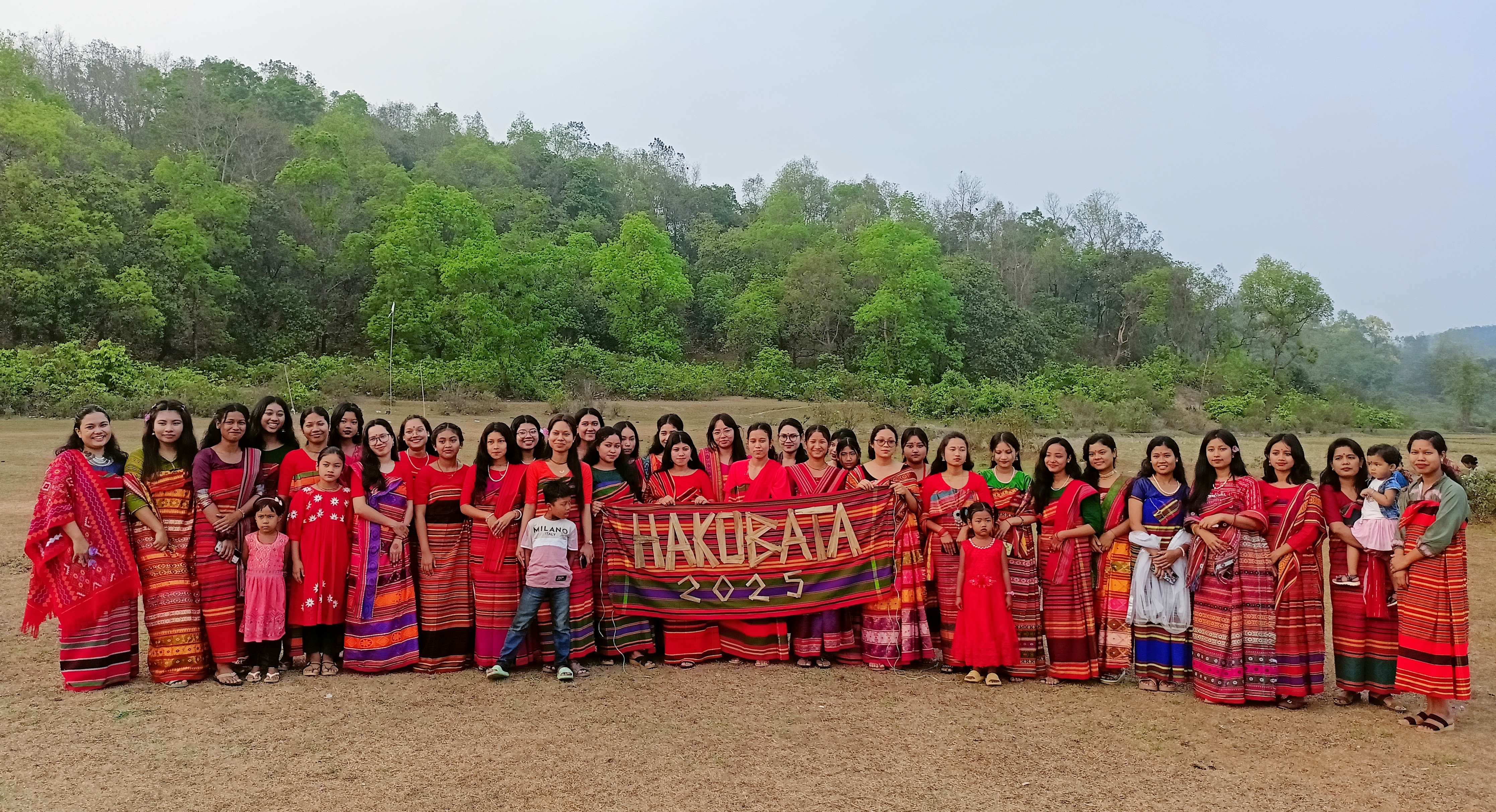
This is where the story begins: with a language that refuses to be absorbed into someone else’s category and a community that keeps answering the same question again and again—no, this is not Bangla. This is Hajong.
People ask the same question repeatedly: can a language without a script survive? It is a very modern worry, born from forms, keyboards, and official stamps, as if a language only matters when it has fonts and grammar books. Hajong does not work like that. It lives in stories, songs, gossip, and small jokes shared during long days of work.
The real pressure comes from the outside world. Modern Bangladesh runs on written words—certificates, applications, notices, and everything typed and sealed. Hajong speakers learn Bangla to move through this system. They switch easily. They have to. But every time Hajong stays outside the classroom door, a quiet message lingers: your language is private, not public.
There is tension, though. Younger speakers text in Bangla because the Hajong language lacks a standard written form. Online spaces rarely fit. Teachers rarely mention it. Official recognition remains vague, often buried under larger language labels. Speaking Hajong becomes a daily balance between practicality and identity.
So, can Hajong survive modern Bangladesh? Maybe survival is not the right word. The language is not fading quietly—it is alive and stubborn. The real question is growth. Can it step into classrooms, archives, and public spaces? Can a country built on written language make room for one that mostly lives in speech?
In Bangladesh and Northeast India, written Hajong literature exists, but in scattered forms. Researchers have documented grammar and folklore; a few community writers have published poems, memoirs, and cultural histories—often in Bangla, Assamese, or English rather than in Hajong itself. Small community booklets and school efforts try to turn spoken words into something that can be held and shared.
Yet challenges remain. Young Hajong activists are collecting songs, recording elders, and experimenting with writing systems. Along the fading borderlands, Antor Hajong carries a language on his shoulders. Moving from village to village, he teaches Hajong to children and elders, fearing its slow disappearance. Antor says, “I do not know about the future, but without a script or without any existence and literature, a language cannot survive.”
Financial hardship has stalled his efforts. Antor adds, “I started this programme for the sake of the language, but due to financial reasons, I could not continue it. Without the involvement of the government, the preservation of the language cannot happen.”
Writer and poet Dolon Hajong worries that Bangla words are steadily replacing native ones. Dolon Hajong states, “Almost 20–30 percent of words have been mixed with Bangla… not working in the long run.” With only a few works preserved by the Birishiri Cultural Academy, a government organisation for indigenous communities, hope now rests on a forthcoming Hajong dictionary.
In the age of AI and other technologies, digital tools learn dominant languages, and platforms prioritise widely used scripts. Where does a language without a standardised script stand? Can technology become a bridge—through digital dictionaries, audio archives, or AI-driven documentation—or will the absence of data push Hajong further into invisibility?
Dolon Hajong reflects, “There are no highly educated people in the Hajong language anymore. Maybe 10–12 years ago, there were, but not now. If you search today, perhaps you would find only two or three individuals. If there is no academic command over the language or no people with that level of expertise, then technology will be of no use. Before using technology, it is essential to strengthen our proficiency in the language.”
If algorithms are trained only on what is already written and published, how will they recognise a language that mostly survives in memory and speech? And if young Hajongs grow up scrolling more than listening, will technology archive their mother tongue—or quietly replace it? Only the future will be able to answer that.
SB Meraj is a writer, theatre artist, and film enthusiast. He can be reached at sbmeraz.14mgbhs@gmail.com.
Send your articles for Slow Reads to slowreads@thedailystar.net. Check out our submission guidelines for details.
Will the next generation speak Kokborok?
Hajong and the cost of being unwritten
Preserving the A’chik tongue
The last speaker of Saura
Thar: A language born on the rivers
The Bawm language at a crossroads

Bangla in the age of algorithms
Beyond Bangla: Why Bangladesh’s other languages matter
What two decades with Hyow taught me about language loss
Language, power, and the erasure of Kol