


Bangladesh–Türkiye relations

Bangladesh and Türkiye like to describe their relationship as brotherly, historic and increasingly strategic. The words are sincere. They are also insufficient. History gives Dhaka and Ankara emotional depth. The challenge now is to turn that warmth into meaningful strategic depth.
At a moment when both countries are searching for greater autonomy in a restless international order, Dhaka and Ankara must move beyond ceremonial warmth and build a partnership measured by delivery: trade, defence cooperation, humanitarian diplomacy, education, technology and people-to-people ties. Both countries are, in a sense, “bridge countries”: Türkiye between Asia and Europe, and Bangladesh between West-South Asia and Southeast-East Asia.
 For all latest news, follow The Daily Star's Google News channel.
 The emotional foundation is real. The connection between the Turks and Bengal reaches back to the early thirteenth century, when Ikhtiyaruddin Muhammad Bakhtiyar Khalji entered Bengal and, between 1202 and 1205, established Muslim authority over Gaur, later known as Lakhnauti. That period brought new administrative practices, encouraged the growth of mosques, madrasas and khanqahs, and laid the foundations of Muslim rule in Bengal.
Hazrat Shah Jalal, who came to Sylhet in 1303 with over 300 Sufi disciples, deepened the Sufi dimension of Bengal’s Sunni Islamic tradition and remains central to that memory. Hazrat Shah Jalal’s legacy reflects a form of religious influence rooted not only in rule, but also in spiritual authority, social service, devotional practice and community-building. The formal twinning of Konya in Türkiye, where the saint’s mother, a direct descendant of the Holy Prophet (PBUH), is buried, and Sylhet in Bangladesh adds another emotional layer to this inheritance. Turkish dynastic rule eventually ended, but its imprint remained in statecraft, architecture, Sufi networks, literature and social life.
That older memory acquired modern emotional force during the Turkish National Struggle. Bengali Muslims followed events in Anatolia with admiration, and Kazi Nazrul Islam’s poem “Kamal Pasha” captured the imagination of generations. Writers such as Kazi Abdul Wadud, Ismail Hossain Siraji, Qazi Motahar Husain and Abul Fazal saw in Mustafa Kemal Atatürk a symbol of renewal, dignity and national awakening. This is why Turkish names and institutions still carry resonance in Bangladesh. The affection is not manufactured; it has cultural roots.
But history is not policy. Modern diplomacy began cautiously. Türkiye’s close ties with Pakistan, shaped by Cold War alignments, delayed its recognition of Bangladesh. Ankara recognised Bangladesh on 22 February 1974 at the OIC Summit in Lahore; its embassy in Dhaka opened in 1976, and Bangladesh opened its embassy in Ankara in 1981. That delayed beginning is worth remembering because it offers a useful lesson: even emotionally connected nations must navigate hard geopolitical realities.
Since then, the relationship has advanced through visits, symbolism and institutional cooperation. President Ziaur Rahman visited Ankara in 1976; Turkish Prime Minister Turgut Özal visited Bangladesh in 1986; President Süleyman Demirel attended Bangladesh’s silver jubilee celebrations in 1997; and both countries became co-founders of the Developing-8 group in 1998. Later visits by President Abdullah Gül, Recep Tayyip Erdoğan, Sheikh Hasina and President Abdul Hamid kept the relationship politically active. Yet visits and declarations, however useful, cannot define a twenty-first-century partnership.
The relationship has also known strain. In 2016, Türkiye’s reaction to the trials and executions of Jamaat-e-Islami leaders convicted of war crimes during Bangladesh’s Liberation War created diplomatic discomfort, including the temporary withdrawal of Ankara’s ambassador after the execution of Motiur Rahman Nizami. Relations recovered after Bangladesh strongly condemned the attempted coup against the Erdoğan government in July 2016. The episode showed that political sensitivities can disrupt even friendly ties. It also showed that the relationship is durable enough to recover when both sides decide that the larger interest matters more than temporary disagreement.
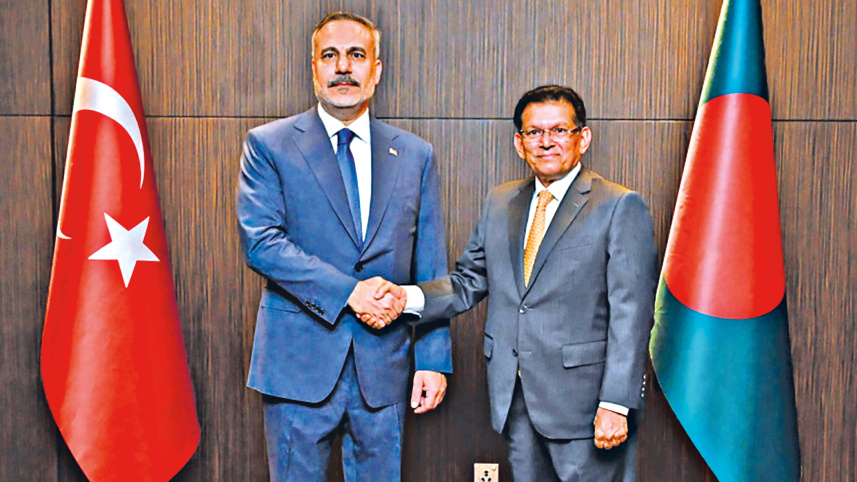
That larger interest is now becoming clearer. In 2026, Turkish Foreign Minister Hakan Fidan’s visit to Dhaka signalled a shift towards a more structured relationship. Bangladesh and Türkiye discussed annual foreign office consultations, a “2+2” format involving foreign and defence ministers, and mechanisms to coordinate political, economic and strategic cooperation. This is the right direction. A serious partnership needs regular channels, working groups, measurable objectives and the discipline to follow through.
The Rohingya crisis is a moral and practical test of that partnership. Türkiye’s humanitarian engagement in Cox’s Bazar through TİKA, AFAD, the Turkish Red Crescent, the Türkiye Diyanet Foundation and Turkish medical facilities has been visible and much appreciated.
Ankara has also supported the call for a safe, dignified and voluntary return of the Rohingya to Myanmar. For Bangladesh, which continues to carry an enormous humanitarian burden, this support matters. But sympathy is not enough. It must be translated into sustained international advocacy, burden-sharing and diplomatic pressure. The Rohingya issue cannot be allowed to become another frozen humanitarian tragedy.
Trade is where ambition has most clearly outrun performance. Bilateral trade has hovered around the one-billion-dollar mark, while recent discussions have aimed to raise it to about two billion dollars. Bangladeshi exports to Türkiye remain concentrated in apparel and jute; Türkiye supplies cotton, machinery, chemicals and industrial inputs. A Free Trade Agreement or Preferential Trade Agreement may help, but only if it is tied to practical trade facilitation, better market access, clearer investment incentives and quicker mechanisms for resolving business difficulties. Bangladesh should attract Turkish investment into economic zones in textiles, pharmaceuticals, ICT, shipbuilding, infrastructure, renewable energy and smart technologies. Türkiye should see Bangladesh not simply as a market, but as a production base and regional economic partner.
Defence cooperation may become the most consequential pillar. Bangladesh signed an agreement with Türkiye on military training, education and cooperation as early as 1981. In recent years, cooperation has expanded into equipment supply, training, technology transfer and discussions on joint production. Turkish platforms, including armoured vehicles, rocket systems, radar, surveillance equipment and drones, have drawn interest in Bangladesh as Dhaka seeks to diversify procurement and build domestic capacity. The real opportunity is not merely to buy equipment, but to develop transparent defence-industrial cooperation involving maintenance, training, technology transfer, local manufacturing and joint research where feasible.
People-to-people contact should not be treated as a soft add-on. It is a strategic asset. Türkiye offers scholarships to Bangladeshi students; educational, medical and tourism links are growing; and cultural curiosity runs in both directions. Bangladesh should send more students, researchers, professionals and entrepreneurs to Türkiye, while Türkiye should invest more seriously in language learning, technology training, medical collaboration and academic partnerships in Bangladesh. Long-term partnerships are not built only in ministries; they are built in classrooms, hospitals, business chambers and cultural spaces.
The wider geopolitical context makes the relationship more relevant. Türkiye is looking eastwards and seeking a larger role across Asia and the Muslim world. Bangladesh is a rising economy in the Bay of Bengal, a moderate Muslim-majority country and an emerging middle power determined to diversify its partnerships without surrendering strategic autonomy. Their interests may not be identical, but they are increasingly compatible. Both want dignity in international affairs based on a measure of strategic autonomy, more economic options, and greater technological and defence capability. That convergence should be used wisely.
The task, therefore, is to build mechanisms, not merely memories. Dhaka and Ankara should institutionalise regular foreign office consultations, defence dialogue, joint economic commission meetings, business forums, academic exchanges and cultural programming. They should cooperate more actively in multilateral platforms, especially on humanitarian crises, development finance, climate vulnerability, food security and the rights of displaced people.
Bangladesh should use Türkiye’s industrial and technological strengths to support its own development priorities. Türkiye, in turn, should recognise Bangladesh’s strategic agency and regional weight.
Bangladesh–Türkiye relations have a rare advantage: they begin with history, are sustained by sentiment and now have a practical strategic logic. But no partnership matures through nostalgia alone. Dhaka and Ankara can continue to celebrate an old friendship in polite diplomatic language, or they can give that friendship modern substance. The second path is harder. It is also the one worth taking.
Ambassador (Retired) Tariq Karim, a former career diplomat and Ambassador of Bangladesh, is Adviser to the School of Liberal Arts and Social Sciences and the Bay of Bengal Studies Centre at Independent University, Bangladesh, and concurrently a Distinguished Visiting Research Fellow at the Institute of South Asian Studies at the National University of Singapore.


Comments