The missing daughters of colonial Bengal
1925 to 1947. In those twenty-two years, did not even a single girl go missing in undivided Bengal? By "go missing", I mean disappear without a trace.
This question frequently crossed my mind a few years ago while I was researching the language of missing persons advertisements published in old newspapers.
The work involved searching through classified advertisements. While reading notices about missing people, I copied those I found particularly interesting into my notebook.
Astonishingly, nowhere in those columns did I ever come across a notice in which a guardian had written something like this: "Kumari Phulkumari Banerjee, daughter of Paresh Chandra Banerjee, missing since the 5th of Poush. She is dark-complexioned and stout, with a burn mark just above her right elbow. If anyone finds her and provides information about her whereabouts or brings her back, a suitable reward will be given."
Or perhaps something like this: "My dearest Phuli, your mother's condition is extremely critical. She has stopped eating and is confined to bed. As you well know, all the arrangements for your marriage have already been made. If we fail to find you a suitable match, your mother will go mad. Therefore, wherever you are, please send a letter with your address, and I will come myself to bring you back. From your father, Khasmahal Kachari, P.O. Tushkhali, District Barisal."
Imagining how an advertisement might have been written back then if a daughter had gone missing, I drafted these versions based on a typical advertisement placed by the father of a missing boy. At the same time, I found myself pondering a question: for what reasons would a father who had lost his daughter never have published such an advertisement in those days?
We Bengalis all know the simple answer to this question of "why". We understand that, in our society, a daughter returning home after disappearing was often not accepted because of the fear of public shame and social censure. Even if she were taken back, no one would utter a single word in public about her disappearance.
We Bengalis all know the simple answer to this question of "why". We understand that, in our society, a daughter returning home after disappearing was often not accepted because of the fear of public shame and social censure. Even if she were taken back, no one would utter a single word in public about her disappearance.
Whatever may be written in the epics, a trial by fire does not exist in reality! Thus, the "Phulis" of the world never had the opportunity to undergo an agnipariksha. Bringing back a girl who had eloped or gone missing meant inviting public disgrace and the loss of family honour in the eyes of society. Therefore, no one could even dream of taking such a risk. I imagine that even if attempts were made to find her, the matter was never publicised through a newspaper advertisement, simply to avoid drawing public attention to her disappearance.
Just as the absence of advertisements for missing girls remained a mystery to me, another question arose in my mind: why were advertisements seeking missing Muslims almost never found in popular, Hindu-run Bengali newspapers? Even if one were to examine a thousand such advertisements, perhaps only one or two might turn up.
Similarly, reports of missing Hindus rarely appeared in Muslim-run periodicals. One possible explanation is that the newspapers preferred by much of the Muslim community were entirely different. They probably believed that people within their own social circles did not read Hindu-run publications. Thus, rather than choosing dailies such as Anandabazar, Jugantar or Basumati, they preferred to place their advertisements in weeklies such as Hanafi, which were run by Muslims.
I am writing this essay on the occasion of the International Day of the Girl Child, and I wish to keep the scope of the discussion strictly confined to this subject. Much as they do today, newspapers published during the fifty to sixty years preceding Partition regularly carried reports of women being molested. If one opened a newspaper in those days, such reports could be found almost every day.
Let me present some brief statistics.
On March 30, 1940, during a session of the Bengal Legislative Council, in response to a question concerning the rape of women in Bengal raised by Rai Harendra Nath Chowdhury, the then Home Secretary, "Honourable Khwaja Sir" Nazimuddin, provided the following figures:
- In 1939, a total of 87 Hindu and 18 Muslim women were raped in Bengal.
- A total of 66 Hindu and 98 Muslim men were accused of committing these crimes.
- The police received a total of 1,223 reports of crimes against women.
- The accused were convicted in 285 cases.
We all know that the actual figures are often higher than those recorded in official statistics. Many incidents are never brought to the attention of the authorities, or simply go unreported. At times, figures are also downplayed to minimise the gravity of a problem. Nevertheless, I am assuming that the figures provided by a now largely forgotten Home Secretary of Bengal were reasonably close to reality. Even so, I kept wondering: why did those statistics make no specific mention of rape cases involving young girls?
I know that raising questions about statistics from eighty or ninety years ago may seem rather pointless. At the same time, I also believe that the grounds for my curiosity are entirely valid.
I know that raising questions about statistics from eighty or ninety years ago may seem rather pointless. At the same time, I also believe that the grounds for my curiosity are entirely valid. Whenever this issue is discussed, it inevitably brings to mind the tragic death of Phulmani, an incident that once caused an enormous uproar in Bengali society.
Phulmani died as a result of brutal sexual intercourse within marriage. At the time, the unfortunate child had barely passed the age of ten. Under the law then in force, once a wife reached the age of ten, her husband was legally permitted to have sexual intercourse with her, and the act would not be considered rape. Consequently, Phulmani's husband, Harimohan, was sentenced to just one year of rigorous imprisonment for the offence of "causing grievous hurt and endangering life".
Following the widespread public outrage sparked by her death, a new law was enacted, raising the age of consent for sexual intercourse with girls from 10 to 12 years. I was actually trying to determine whether there was any significant connection between Phulmani's death and the statistics provided by "Honourable Khwaja Sir" Nazimuddin. However, I was somewhat disappointed by the incomplete nature of the data furnished by the government of undivided Bengal in the 1940s. At the same time, another question occurred to me: were incidents involving the deaths of young girls as a result of premature sexual intercourse routinely suppressed or hushed up? Was this silence similar to the reluctance to search for a missing girl through a newspaper advertisement, driven by the fear that the wider public might learn of her disappearance?

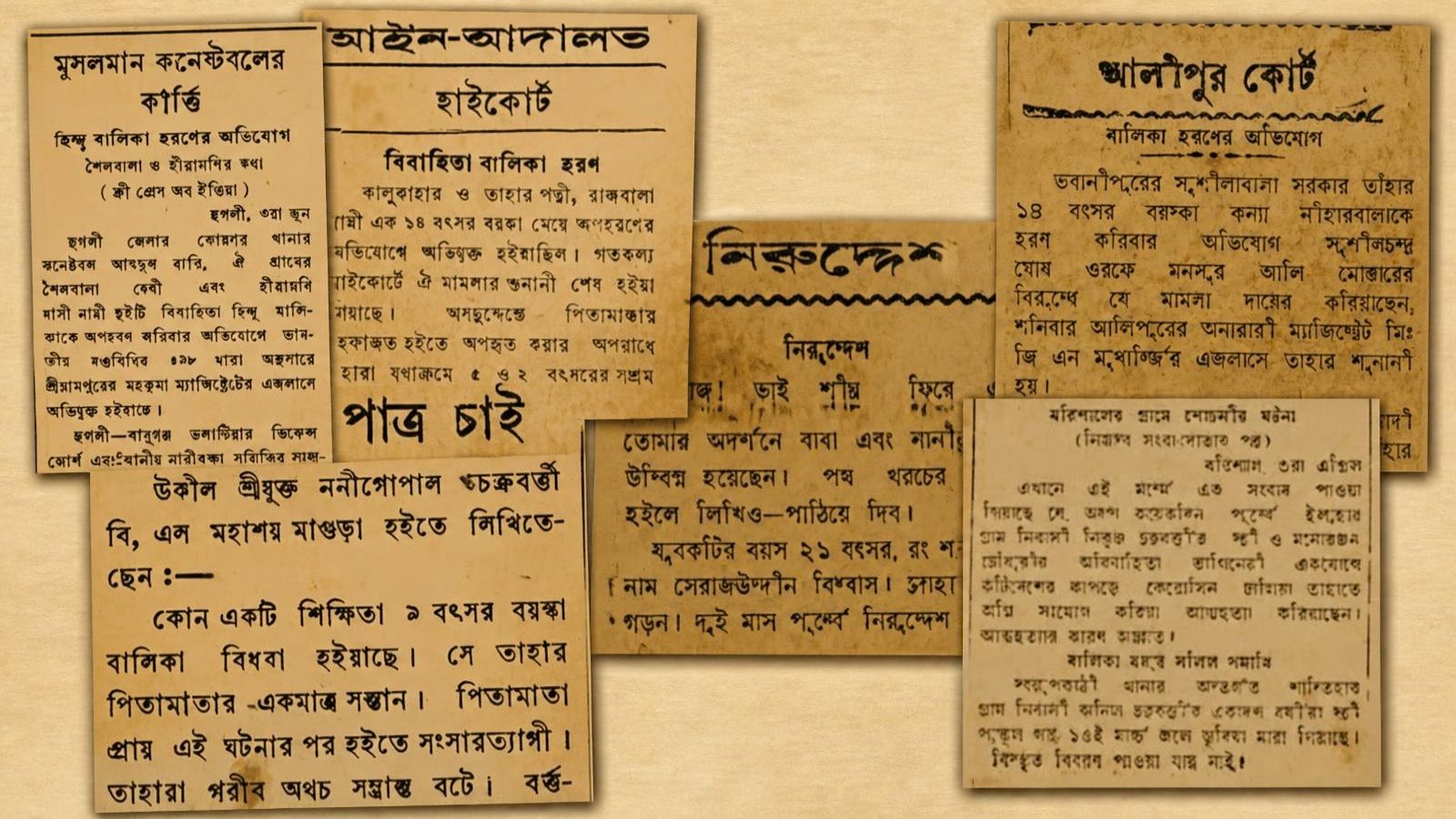
The question, then, is this: if such incidents were routinely hushed up, how can we ever learn about cases involving the sexual abuse of young girls? It seems that one important source of information in this regard is the court proceedings and legal reports published in old newspapers. I am citing one such newspaper report from 1941 as an example.
The report concerns 14-year-old Niharbala Sarkar, who had allegedly been abducted by a man known as Sushil Chandra Sarkar, whose real name was Mansur Ali Moktar. The newspaper's account of the proceedings at the Alipore Court stated:
"While the plaintiff (Sushilabala Sarkar, the mother of Niharbala) was residing in Chetla, the accused was her daughter's music teacher. It is reported that one day, taking advantage of the plaintiff's absence, the accused lured Niharbala out of the house on the pretext of buying her clothes, took her to a mosque, and there Niharbala came to know that the accused's name was Mansur Ali. It is stated that at that place, Niharbala's thumb impression was forcibly taken on a piece of paper, and she was subsequently transferred from there to the accused's house in Maheshtala and detained for 14 days. During this time, the accused subjected Niharbala to brutal atrocities four times. The police rescued her from Maheshtala."
It is not difficult to understand what the expression "brutal atrocities four times" implies in this context. I cannot help wondering whether this girl, too, might have met the same tragic fate as Phulmani. The final line of the report read: "The hearing has been adjourned after the testimonies of a few witnesses."
I do not know what punishment Magistrate G. N. Mukherjee ultimately imposed on Mansur Ali, or whether Mansur was acquitted because of insufficient evidence. It would certainly be valuable to know the outcome, as it would help us understand what punishment was imposed in the 1940s for crimes involving the sexual abuse of young girls.
It has seemed to me that, much like other historical sources, the matrimonial columns of classified advertisements from that period reveal unmistakable traces of our society's cruelty towards young girls. Alongside considerations of dowry and caste, the age of the girl for whom a groom was being sought was often prominently mentioned in these advertisements.
An advertisement from 1927 stated:
"A literate nine-year-old child widow has lost her husband; she is her parents' only child. Her parents have practically withdrawn from worldly life since this incident. They are poor but respectable. They have now agreed to arrange the remarriage of this child widow..."
(কোনএকটি শিক্ষিতা ৯ বৎসর বয়স্কাবালিকা বিধবা হইয়াছে, সে তাহার পিতামাতারএকমাত্র সন্তান। পিতামাতা প্রায় এই ঘটনার পরহইতে সংসারত্যাগী। তাহারা গরীব অথচ সম্ভ্রান্তবটে। বর্তমানে এই বাল-বিধবাটিরবিবাহে তাহারা সম্মত হইয়াছে...।)
Another advertisement from 1933 reveals that one of the two girls for whom grooms were being sought was only six years old. The advertisement was placed by Sri Padmaraj Jain, who identified himself as the secretary of the 'Hindu Abalasram', located at 10, R. G. Kar Road, Shyambazaar. It stated:
"Two Bengali bridegrooms are required. One prospective bride is a 16-year-old Bengali child widow belonging to the potter (Kumbhakar) caste. She is good-looking but illiterate. The other is an unmarried six-year-old girl belonging to the Swarna Banik caste. She is also good-looking but illiterate. Interested prospective grooms may correspond by letter at the address given below. No dowry or gifts of any kind will be provided."
(দুইজনবাঙ্গালী পাত্র আবশ্যক। একটী পাত্রী বাঙ্গালীকুম্ভকার জাতীয়া বালবিধবা বয়স ১৬ বৎসর, দেখিতে সুশ্রী লেখাপড়া জানে না। অপরটীস্বর্ণ বণিক জাতীয়া কুমারীবালিকা—‘বয়স ৬ বৎসরসুশ্রী কিন্তু লেখাপড়া জানে না। যাঁহারাপাণিপ্রার্থী তাঁহারা নিম্নঠিকানায় চিঠিপত্র ব্যবহার করিতে পারেন কোন প্রকার পণবা যৌতুকাদি দেওয়া হইবে না।)
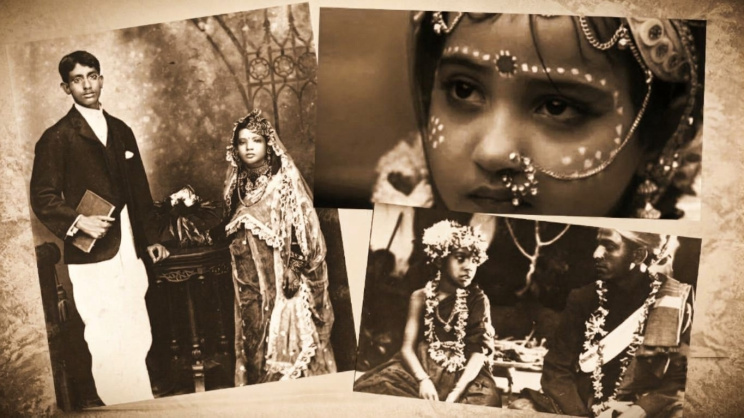
The advertisements also suggest that the prospective groom's family was particularly concerned about whether a child widow's chastity had been compromised. If she had experienced sexual intercourse or sexual assault, it could be difficult to persuade the groom's family to agree to the marriage. Consequently, some advertisements explicitly indicated that the young girl's chastity remained intact, implying that she had not had sexual intercourse.
One such advertisement from 1940 read:
"An open-minded, educated and earning groom is sought for a moderately educated, beautiful, musically talented, upper-caste Brahmin child widow from the family of a railway employee. (She has neither seen her husband's face nor undergone the customary dwiragaman ceremony following marriage.) The family is unable to provide a substantial dowry. Pandit Vidhaba Sabha, 205 Cornwallis Street, Calcutta."
(রেলকর্মচারীর মধ্যম শিক্ষিতা সুন্দরী সংগীতজ্ঞা উচ্চ ব্রাহ্মণ বংশীয়াবাল-বিধবার জন্য উদার হৃদয়শিক্ষিত উপার্জনশীল পাত্র চাই। বিবাহের পরস্বামীমুখদর্শন বা দ্বিরাগমন হয়নি। বিশেষ পণ দিতে অক্ষম।পণ্ডিত বিধবা সভা, ২০৫ কর্ণওয়ালিশস্ট্রীট, কলিকাতা।)
Since 2012, the International Day of the Girl Child has been observed annually on October 11. Several countries also observe their own dedicated days, such as January 24 in India and September 30 in Bangladesh.
Since 2012, the International Day of the Girl Child has been observed annually on October 11. Several countries also observe their own dedicated days, such as January 24 in India and September 30 in Bangladesh. While governments have their responsibilities to fulfil, as they do everywhere, the primary purpose of observing such special days is undoubtedly to raise public awareness.
What more can a healthy society possibly do? And yet, just recently, I came across reports that, in September of this year alone, 47 girls were raped in Bangladesh. Reports of these brutal crimes were also published in newspapers. Human rights organisations in Bangladesh used these reports to compile their records of victims, while also gathering information independently.
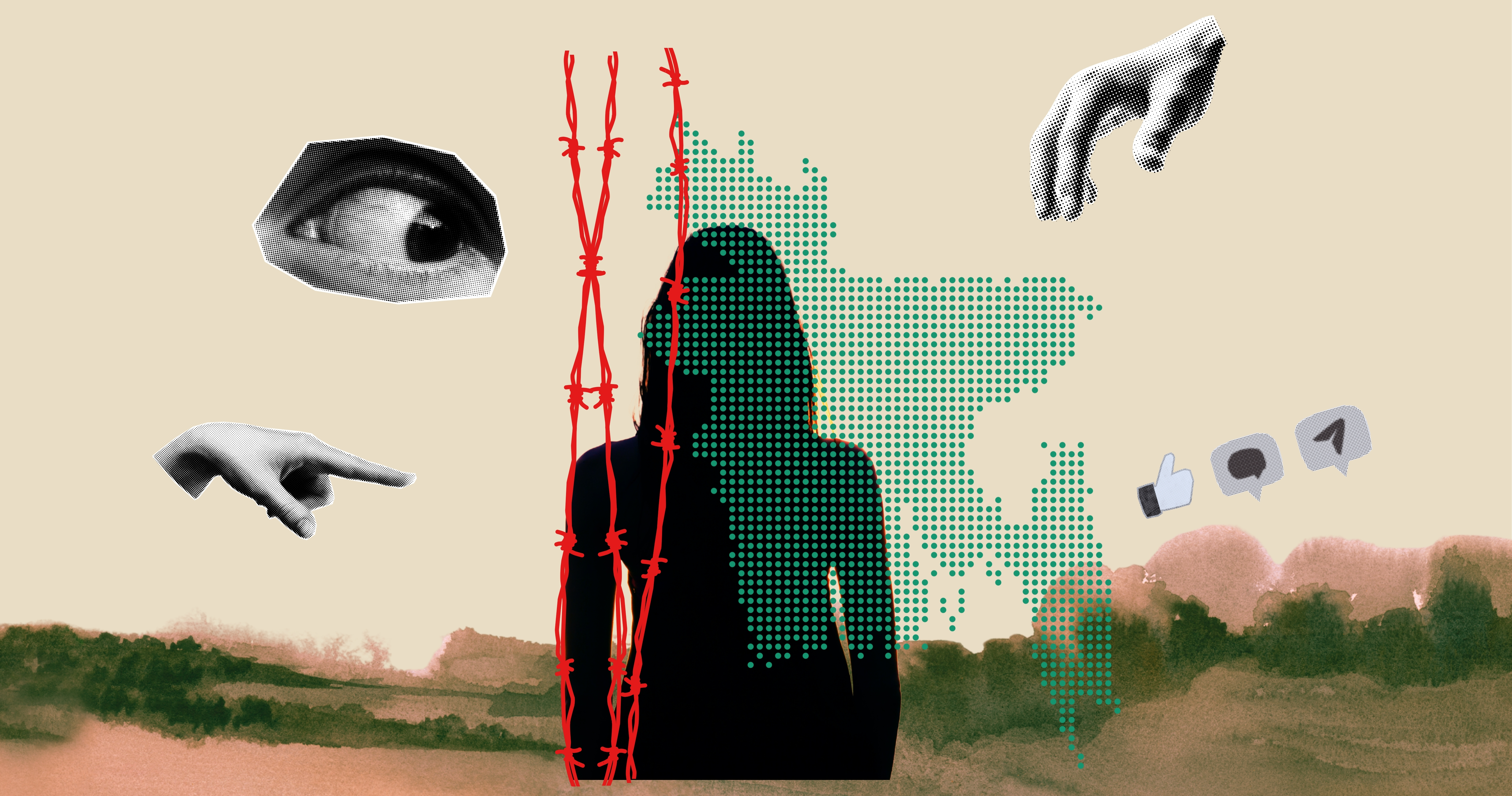
The sheer brutality of even a single incident is enough to make any sensitive person shudder. Most recently, a young girl with a speech impairment was sexually assaulted by her own father in South Bengaluru. In Gurugram, Haryana, five children were held captive and tortured for 18 hours at a construction site. In Delhi's Bawana neighbourhood, a school van driver was arrested for allegedly sexually assaulting a three-year-old child.
These are all very recent incidents. Reports of atrocities against girls continue to emerge with alarming frequency. In Pakistan, an organisation called Sahil works to protect children's rights and safety. According to statistics published by the organisation, reported cases of child abuse in Pakistan increased by eight per cent compared with the previous year.
But what difference did that make? The court proceedings and legal columns of old newspapers were still filled with numerous reports of crimes against women and girls.
Pick up a newspaper, and you will come across reports of such brutal crimes almost every day. Looking back at old newspaper reports, I cannot help wondering: what has really changed between then and now? It is true that, out of fear of social stigma, the families of victims often hushed up such incidents. But what difference did that make? The court proceedings and legal columns of old newspapers were still filled with numerous reports of crimes against women and girls.
On one occasion, I came across a report describing how Kalu Kahar and his wife were sentenced to five and two years in prison, respectively, for abducting a 14-year-old girl named Rajbala, who was described at the time as an adolescent girl.
In another newspaper report, Anand Bihari, the Arya Samaj secretary from Darbhanga, was convicted of abducting a two-and-a-half-year-old girl named Momtaz.
Abdul Bari, a constable at Konnagar police station in Hooghly district, was accused of abducting two young married girls named Shailabala Devi and Hiramani Dasi.
A drunken Anglo-Indian (Firingi) guard was dismissed from his job for sexually assaulting a boy who had been locked inside a train toilet.
A man named Rajaram and his wife, Sundari, were caught red-handed while attempting to abduct a thirteen-year-old girl.
An elderly Muslim man brutally slashed the throat of a girl, approximately fifteen years old, who was accompanying him, using a sharp sickle on the platform of Adra railway station.
Countless incidents like these! Of the incidents I have cited here, several date back to June 1927. Just imagine how many such stories we might uncover if we were to examine newspaper reports from almost any randomly selected year of that period! The incident at Adra station, however, dates back to January 20, 1940.
The unmarried young women of Goila in Barisal certainly seem to have anticipated these grim possibilities. Back in the 1940s, they held a formal public meeting and adopted a resolution declaring: "We will not marry men who demand dowry. Even if it means remaining unmarried, we will remain single for the rest of our lives."
At least these are the incidents that managed to come to public attention. And one can only imagine the consequences of those reckless attempts to marry off thousands of young girls through the matrimonial columns of newspapers! The unmarried young women of Goila in Barisal certainly seem to have anticipated these grim possibilities. Back in the 1940s, they held a formal public meeting and adopted a resolution declaring: "We will not marry men who demand dowry. Even if it means remaining unmarried, we will remain single for the rest of our lives."
In a newspaper dated April 4, 1941, I came across a report concerning the circumstances surrounding the drowning of a young girl. Perhaps she did not know how to swim. Perhaps she had taken her own life. Perhaps something even worse had happened to her. Perhaps the eleven-year-old child bride was simply unhappy in her marital home. Perhaps she had never received the love of her husband, Anil Chakraborty. Perhaps the fate of that little girl from Swarupkathi in Barisal lay behind the decision of the young women of Goila, who had vowed never to marry men who demanded dowry.
Perhaps, as usual, we will simply forget that a day called the International Day of the Girl Child even exists. Perhaps, once again, a little girl with a speech impairment will be raped. Perhaps another girl, barely three years old, will be subjected to unspeakable brutality. Perhaps so many things can happen. Perhaps anything can happen.
Sandip Dasgupta has spent nearly three decades working in the editorial offices of newspapers and news portals. He has authored several history-based books, and a subject particularly close to his heart is the illustrations created by Bengali artists.
Send your articles for Slow Reads to slowreads@thedailystar.net. Check out our submission guidelines for details.

How Nobel laureate Anne Carson discovered new possibilities within language

Dipankar Gupta speaks / The history of caste is not what we think

From al-Andalus to the Mughals: How empires become identity

From artificial intelligence to the artificial state: Is the trajectory inexorable?
157th Birth Anniversary of Mahatma Gandhi / Gandhi’s return to Noakhali
Why does Tagore still trouble Bangladesh’s idea of ‘us’?

Can Bangladesh make better use of its zakat money?

Three revolutions that reshaped the world
Paradise lost and found: Rediscovering early modern Bengal