Mohajir manuscripts: Field notes from Dhaka Aliya Madrasa
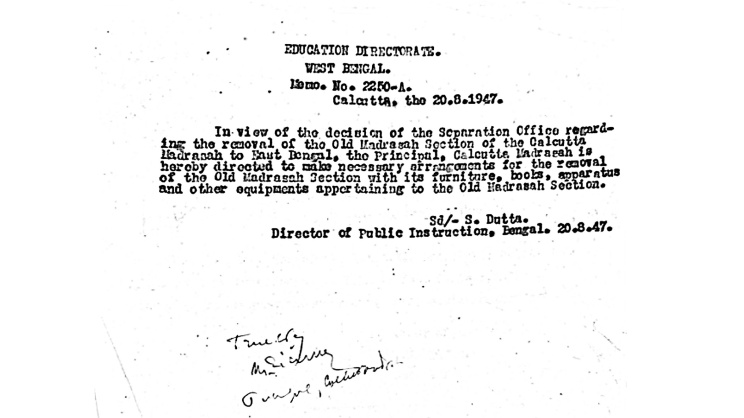
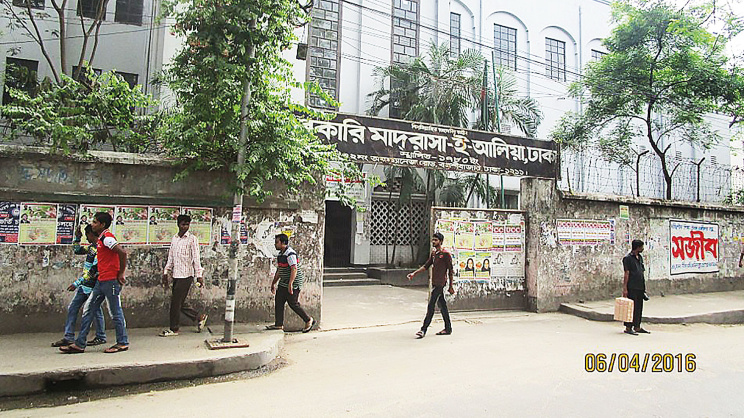
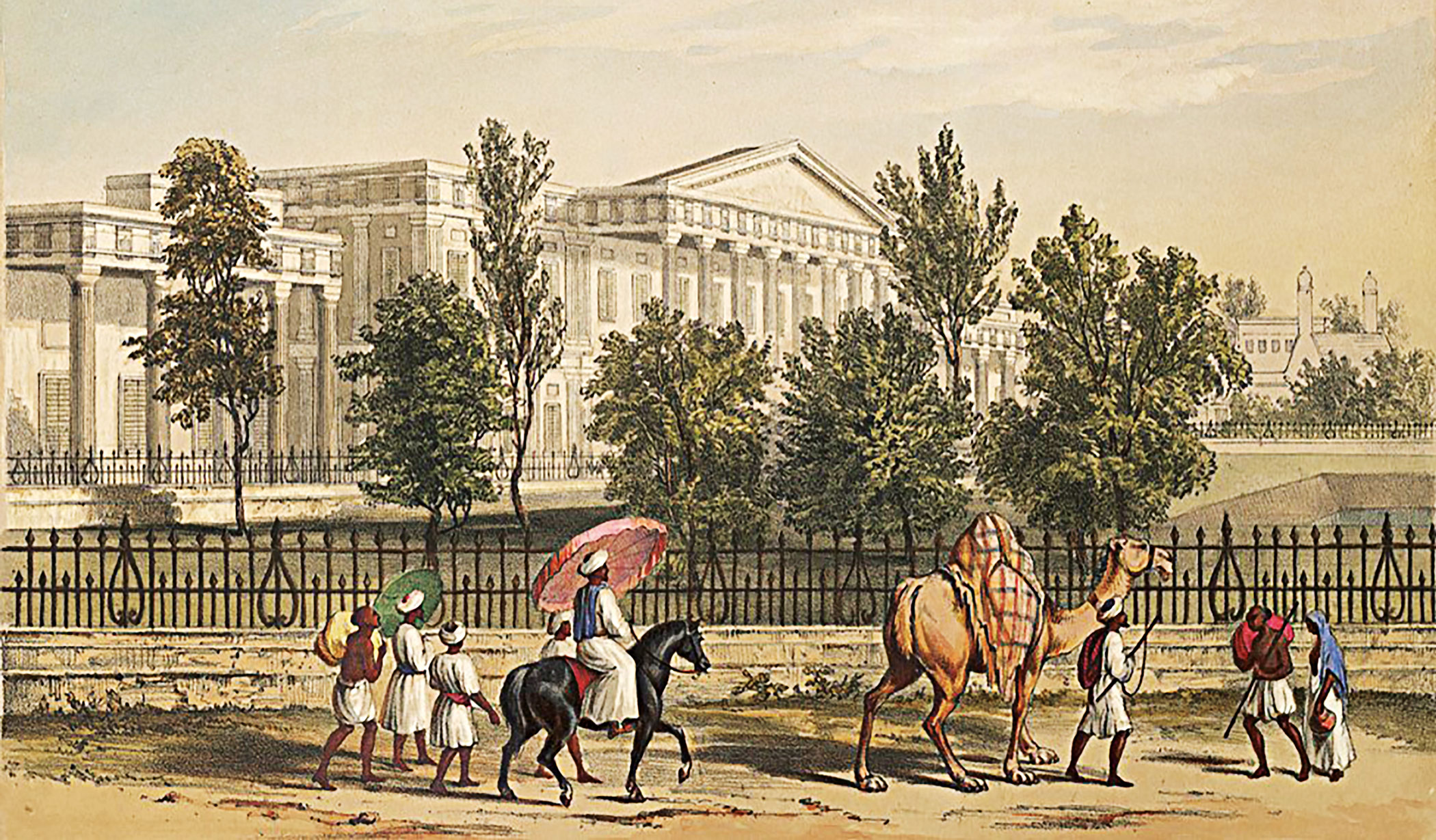
On 20 August 1947, the Director of Public Instruction for the Education Directorate of the newly created state of West Bengal, S. Dutta, issued an order—“in view of the decision of the Separation Office”—to the principal and teachers of the Kolkata Aliya Madrasa at Wellesley Square. The Madrasa and its teachers were invited to “make necessary arrangements for the removal of the Old Madrassah”, together with all the “furniture, books, apparatus and other equipment” appertaining to it, and move the whole institution to a new home: Dhaka. To date, the Madrasa and its collections remain there, though they have long since left the former Dacca Islamic Intermediate College building for a permanent home in Bakshibazar, just south of the University.
We have been able to view the Madrasa’s collections thanks to the generous permission of the principal, and here we aim to retrieve something of the remarkable history of how, in the chaotic sundering of Bengal that occurred during Partition, amidst bureaucratic turmoil, migration and communal violence, one of the subcontinent’s foremost institutions of Islamic learning came to find a new home in Dhaka, where it continues to orient generations of students towards piety and learning.
We will offer some details as to the importance of the collections and an overview of the steps being taken towards their preservation and cataloguing, which over the past year we have begun discussing with the Madrasa authorities and with our colleagues at Dhaka University, in particular the Dean of the Faculty of Arts, Prof. Abul Kalam Sarker, and Dr Sahidul Hasan, Associate Professor of History, as well as with the Ministry of Education in Dhaka. Above all, we will seek to tell the story of how the Aliya Madrasa of Kolkata came to be the Aliya Madrasa of Dhaka.
A MIGRATORY BEGINNING
The collections of the Madrasa came to Dhaka by way of an exceptional migration of manuscripts and maulanas in 1947, but it is worth recalling that the story of the Aliya Madrasa also began in equally exceptional circumstances. The Madrasa was born in another time of turmoil, in the late eighteenth century, when established political arrangements throughout the northern and eastern reaches of South Asia entered into crisis. The eighteenth century was a turbulent time for men of learning too, and many saw—with good reason—that in the rise of the East India Company and its armies lay a threat of great magnitude to the moral order of South Asian societies. Some clerics argued that it might be best to shun the rapacious Europeans, for piety and learning could not benefit from dealings with the new empire.
One prominent maulvi, Majd-ud-din, chose a different approach and worked to turn the crisis brought about by the Company’s conquering armies into an opportunity for the dissemination of knowledge. He left North India for Bengal and made his way to Kolkata, at the time an upstart boomtown with no educational institutions of any note. The British governor, Warren Hastings, recalled in a minute dated 18 April 1781 that in September 1780 he had received a petition penned by a “considerable number of Mussulmen of credit and learning” asking him to “use my influence with a stranger by the name of Muged a’Den who was lately arrived at the Presidency” in order to persuade him “to remain there for the instruction of the young students”. Hastings added that he had come to share the belief that “this was a favourable occasion to establish a madrasa or college and Muged a’Den the fittest person to form it and preside in it”.
Hastings also stated that much of what was proposed to him by the Ashraf of Bengal and Bihar was agreeable. He too knew that political philosophers had influentially opined that “the pride of every polished court and the wisdom of every well-regulated government” lay in the sponsorship of learning, and he let it be known that he too felt that, insofar as “Calcutta was already become the seat of a great empire”, it was time for it to host educational institutions of note.
In the madrasa collections, we were able to locate three beautifully handwritten manuscripts from what seems to have originally been a five-volume Persian translation of Charles Hutton’s A Course of Mathematics. This momentous undertaking from the mid-1820s was the work of one of the institution’s more dynamic teachers, Maulana Gorakhpuri “Dahri”, and may lay claim to being the earliest English-to-Persian translation of a complete English work.
The British support for the new madrasa was not born simply out of high-minded philanthropy and philosophy. Hastings and other Company officials had noticed that the terrible awe projected by the Company’s mercenary armies, rack-renting revenue officers and monopolistic commercial agents lacked the sheen that truly legitimate authority ensured. All worried that, without even a sliver of popular approbation, the Company’s government would continue to lurch from crisis to crisis. “Conciliation” – as Joshua Ehrlich’s recent study of the politics of knowledge in Company-ruled Bengal has underscored – had become a key concern and a byword for a desirable approach to governance. Perhaps, officials mused, the colonial government could try – for once – to do something more dignified than merely plunder. Within a year, a building to house Majd-ud-din’s madrasa had been built, and the career of the Aliya Madrasa had begun.
CHATGAIA PARHEEZKARS AND FARIDPUR FRUITPICKERS
Political infighting in Kolkata in time brought about both Majd-ud-din’s removal and Hastings’s ultimate impeachment and recall. But the madrasa that the unlikely collaboration of the two men had established endured and even grew. Hastings himself noted early on just how remarkably wide its appeal was: students from all across Bengal and Bihar enrolled in it alongside “sojourners from other parts … among them … some who have come from the districts of Cashmear, Guzarat and from the Carnatic”. Far from constituting the eastern margin of a Balkans-to-Bengal complex, scholars at the madrasa worked to ensure that Persian and Arabic scholarship in Bengal became globally relevant and, in so doing, effectively placed colonial Kolkata at the heart of new networks of learned exchange. The onset of the nineteenth century – an age of steam and print – made such networks denser and more heavily participated in, intensifying exchange and the circulation of texts, ideas and scholars.
Much of the madrasa’s fame had to do with the dynamism of its teachers. The arrival of the Yemeni scholar Ahmad al-Shirwānī – as we learn from Ahmed al Mesri’s recent research – revitalised the serious study of Arabic writing and grammar in Bengal and North India, and the chrestomathy he wrote for the madrasa, Nafhat al-Yaman, came to be used by madrasas across the subcontinent. Other scholars were equally celebrated. “Jurisprudence and Hadith are flowing on his tongue,” one Persophone biographer of poets noted in 1814 of another of the institution’s more celebrated teachers, Maulvi Aminullah, adding that he was a man who “in the realm of learning and letters was both the Sun and Jupiter”, and a respected poet to boot.
The knowledge produced and transmitted in the madrasa was not solely that of established curricula. Scholars at the madrasa also worked to generate new disciplinary languages in Persian and Arabic, translating and adapting scientific and mathematical texts originating in Europe and Britain and ensuring that their students could engage with new problems in knowledge, particularly in physics and algebra. In the madrasa collections, we were able to locate three beautifully handwritten manuscripts from what seems to have originally been a five-volume Persian translation of Charles Hutton’s A Course of Mathematics. This momentous undertaking from the mid-1820s was the work of one of the institution’s more dynamic teachers, Maulana Gorakhpuri “Dahri”, and may lay claim to being the earliest English-to-Persian translation of a complete English work.
Yet the madrasa did not lack adversaries. In the 1830s, a hostile crop of colonial officials, headed by the especially antagonistic Thomas Babington Macaulay (1800–1859), attempted to abolish it, dissolving it and all other institutions of traditional learning, including Kolkata’s Sanskrit College. Their efforts ultimately failed but, in the process, generated one of the earliest determined efforts at collective organising undertaken in colonial Bengal. In February 1835, more than 8,000 of Kolkata’s Muslim inhabitants submitted a petition to the government insisting that “to destroy this institution and restrain people from the acquisition of the knowledge it imparted and the moral and religious principles it instilled can only produce distress, vexation and heart-rending to all classes”. The petitioners were, as is obvious, ultimately successful, and the effort to abolish the madrasa was rolled back.
Throughout the nineteenth century, generations of Muslim students moved to Kolkata to study at the Madrasa – either in its more theologically inflected ‘Arabic’ department or in the newer ‘Anglo-Persian’ sections. While students came from all over, and some were said to have come from as far as “Badakhshan”, it is clear that ultimately the greatest numbers were Bengali Muslims, many from pious Chittagong families. Hindus were not admitted, notwithstanding the determined petitioning of one Jessore resident who hoped to continue his studies of Persian literature in the Anglo-Persian section. “The Calcutta Madrasa derives its students,” a report of 1873 stated, “chiefly from Eastern Bengal, the fame of the Madrasa and the metropolis itself being the chief attractions.” Yet it is important to remember that the attractions of the Madrasa were not solely religious or scholarly: as madrasa student-turned Urdu poet Abu Muhammad Abdul Ghafur ‘Nassakh’ – scion of an important Faridpur family – recalled in his autobiography, Khudnavisht savāniḥ hayāt-i-Nassakh, students were taken by the fruits of its gardens and would at times scale great heights to get hold of the jackfruits growing in the college grounds.
KOLKATA TO SADARGHAT: HOW A MADRASA MOVED
Students and teachers left the historic building and the tall jackfruit trees off Wellesley Square in 1947, when the Madrasa came to Dhaka. The extraordinary story of how the Madrasa moved from Kolkata to Dhaka can be found appended to the history of the Madrasa penned by Maulana Abdus Sattar, Tārīkh-i Madrasah-yi ‘Āliyah, and, of course, in Bengali in the translation of the same text by Mustafa Haroon, published in 1980. As the Tarikh states, 1947 was a confusing year. As the news of Bengal’s imminent partition spread, “everyone was plunged into anxiety and preoccupation about the division of offices, institutions and places of learning” and “in this difficult time (…) by way of a decision of the education department, an arrangement was made to shift the Madrasa to Dhaka.” By way of the efforts of the principal, Maulana Ziaul Haq, the chronicle then states, efforts to move the Madrasa got immediately underway. “All the teachers of the madrasa bar two agreed to move to Pakistan alongside the madrasa.” Eventually, it was agreed that:
“A Muslim League leader of the Bengal Legislative Council, Khwaja Nazimuddin, would be consulted and that, with him, an interim committee would prepare an inventory of the furniture, records, books and other belongings of the Madrasa. This was so that there would be no difficulty in taking the materials to East Bengal after the final decision was taken.
After the list was prepared, the expenses would have to be submitted to the central committee office. After agreeing to the proposal, the two parties of India and Pakistan signed, S. N. Roy for India and M. M. Khan for Pakistan.”
The move was a momentous undertaking: “The role of madrasa teacher Wajiullah in arranging for the moving of the large library, the books and the furniture deserves special praise. All the furniture and other things of the madrasa – including the furniture of the Eliot Hostel – were loaded onto trucks and then onto a flat-bottomed barge on the Hooghly River. The madrasa teachers Abdur Rahman al-Kashgari and Maulana Habibullah were made responsible for them.
While the madrasa furniture was being moved, the teachers moved to Dhaka and found lodging at the Islamic Intermediate College in Islampur. Later, the flat-bottomed barge anchored at Sadarghat. Initially, the furniture of the madrasa was also taken to the Islamic Intermediate College in Victoria Park.
[There,] due to a lack of space, the library was piled up. As a result, many rare books were destroyed.”
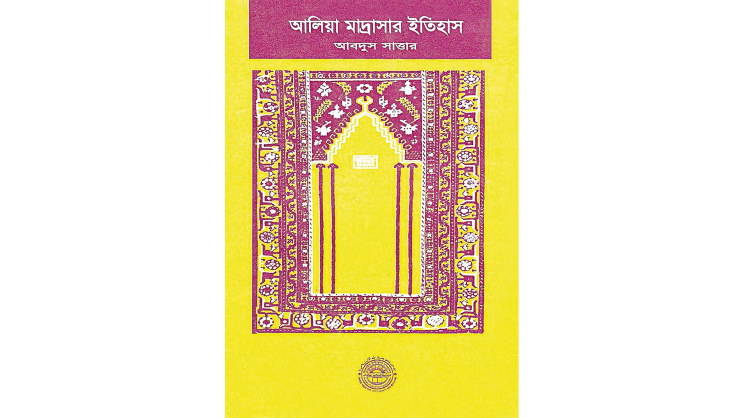
Maulana Momtaj-Uddin Ahmad’s more recent 2004 Madrasa-i-Aliya Itihas adds precious detail.
“In 1947, when Pakistan was established, under the supervision of Al Hajj Khan Bahadur Maulvi Muhammad Ziaul Haq, the Aliya Madrasa was transferred from Kolkata to Dhaka. The skill and success he demonstrated in moving from Kolkata the Madrasa’s own belongings, tables and chairs, fans, 29,000 books and other items constitute a golden chapter [svarnajjul oddhyay] in the history of the Madrasa. No other department transferred as smoothly from Kolkata to Dhaka.”
The move was, however, slightly more complex than the sources suggest. A survey of the surviving files in the Bangladesh National Archives suggests that moving things in the chaos of Partition was an especially complex matter, as the questions of who was in charge of what, and when, became increasingly unclear. On 7 or 8 August, Maulvi Ziaul Haq, the madrasa principal, opted for Pakistan, resigning his directorship of the madrasa, which had not yet been assigned to Pakistan. He was appointed principal of the Islamic Intermediate College in Dhaka and left Kolkata without knowing that the madrasa would later be assigned to Pakistan as a result of the ongoing talks between the governments of the two future states, India and Pakistan. The following day, Maulvi Hujjatullah Ansari was appointed principal. Two days later, as we know, the decision to partition the madrasa and move most of its materials to Pakistan was taken.
Five days later, on 20 August—five days after Partition and independence, and ten days after the decision had been taken to relocate the madrasa—an order to relocate the madrasa immediately from Kolkata to Dhaka was issued by the Director of Public Instruction of the newly created state of West Bengal. Principal Ziaul Haq could thus not supervise the move of the Madrasa, and so the order to move was issued to Principal Ansari. As such, the Madrasa moved with only an interim governing body supervising the process, though presumably all parties remained involved in overseeing what was being moved and how it was to be moved. Principal Ziaul Haq was reassigned to the madrasa in October 1947, once its staff and collections had reached Dhaka.
CONCLUSION
Whatever the complexities of the move may have been, it was in some ways an extraordinary success. Visitors to the Madrasa today may view, in the tidy almiras brought over from Kolkata, thousands of books—including early printed and lithographed works—and hundreds of manuscripts. Ensuring that this collection is catalogued, digitised and studied is the task towards which we have been working, alongside our colleagues in Dhaka and the authorities at the Aliya Madrasa, the Ministry of Education and Dhaka University, and we hope to keep you posted on our progress in this matter.
(The article is adapted from a talk delivered at the Centre for Manuscript and Text Cultures, University of Oxford, on 7 May 2026.)
Dr Thomas Newbold is a former Assistant Professor of History at BRAC University, Dhaka, and an incoming Andrew W. Mellon Fellow in the Humanities at AUW, Chattogram.
Dr Shaahin Pishbin is the Laming Junior Research Fellow at Queen’s College, University of Oxford.
Send your articles for Slow Reads to slowreads@thedailystar.net. Check out our submission guidelines for details.

157th Birth Anniversary of Mahatma Gandhi / Gandhi’s return to Noakhali
Why does Tagore still trouble Bangladesh’s idea of ‘us’?

Can Bangladesh make better use of its zakat money?
Three revolutions that reshaped the world
Paradise lost and found: Rediscovering early modern Bengal
Unbound Mother: The making and remaking of Kaali in Bengal

Do great leaders make history, or does history make them?
Poison and cremation: A forensic history of colonial Bengal