Kolkata's Eid, my Eid
Not everyone is born with Syed Mujtaba Ali’s luck. Certainly not. In this lifetime, will I ever sit among adda-loving Pathans, talking and talking, and savour a dawat? That too, seated like an honoured gentleman in someone’s home in Peshawar!
In front of us, a carpet would be spread out—two cubits wide, twenty or thirty cubits long. We would sit in two rows, facing one another. Smiles would pass back and forth. Low voices would carry little scraps of conversation. On medium-sized plates, there would be three platters of aloo-gosht. Three platters of seekh kebab. Three platters of chicken roast. Three platters of sina-kolija. And I would keep looking, greedily, at the three platters of pulao.
Mujtaba Sahib wrote that, unlike Bengalis, who sit down to eat from their own plates, Pathans apparently never do so. Whatever is placed before a person is enough. No one, apparently, says, “Pass me the chicken.” Or, “I feel like having some seekh kebab.”
Many, many years ago, while moving among the Pathans, Mujtaba Sahib had remembered the Pathan Kabuliwalas of Zakaria Street in Calcutta. But the Khan Sahibs of Peshawar’s streets—with attar on their moustaches and turbans grand enough to enchant the world—he could not reconcile, not even faintly, with the Pashtuns of Calcutta.
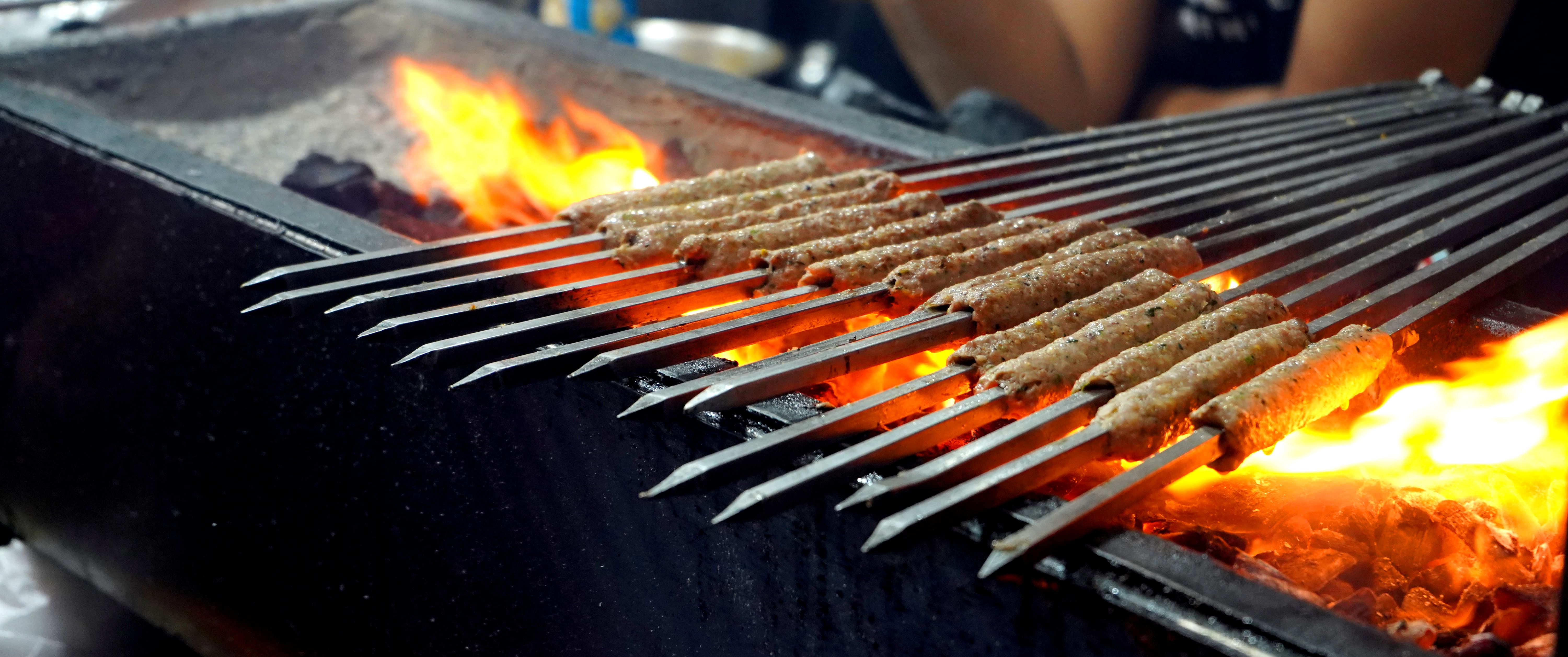
Mujtaba Sahib had written that once, before setting out to travel with mustard flowers rubbed into his feet, he had bought a pair of shorts from Chandni for nine sikis. He had told stories of the Irani hotel in Taltala. He had written of how he taught his Hindu friends the manners and codes of Mughlai food. In general, every time I have read his travel pieces, I have grown a little wistful—especially when I come across names like Zakaria Street, Chandni, Taltala. It feels as though the sweet clamour of certain lives slowly begins to fade. Mine has faded that way too.
My school was on College Street. Later, I went to college on Cornwallis Street. For a while, I also worked on Nonapukur Lane. There, not far from the tram depot, stands the Golam Rasul Mosque. And really, how far is the dargah of Moulali from there? Most of my working life passed in Chandni’s courtyard, on Prafulla Sarkar Street. These were all familiar stretches of the same city to me, places I moved through almost as a matter of habit. Even now, that office is ringed like a casuarina grove by music-filled taverns.
Not taverns, though. What drew me like a magnet was the chicken biryani at New Aliah Hotel, at the crossing of Central Avenue and Bentinck Street—the fragrant rice, the two large potatoes nestled within it, extra money if one wanted an extra potato, the salad served on a small white plate flushed red with beetroot, and, at the end, a cup of sweet, strong milk tea. Or the soft, pillowy rumali roti at Sabir Hotel, pressed close against Chandni Market, torn and dipped into mutton rezala. During our night-duty dinners, these two were our dearest menus. And for evening refreshment, there was the tikia roll from the small shop across the road from Sabir.
I had never been in the habit of going to dargahs or mosques. Not to any place of worship, really. Only curiosity about history and architecture has ever made me want to wander through such places. That is all. If this essay sounds, at times, less like a solemn account of Kolkata’s communal history than the confession of a man led by his stomach, that is because it partly is. Much of what I learned of another community, I first learned through its restaurants, invitations, smells, and plates. Perhaps that is not the highest form of knowledge. But it is one kind of beginning.
Let me say here that at our school, on Jumma Fridays, the tiffin break used to be a little longer—for the prayers of our Muslim classmates. It was a government school, after all. In our time, such things existed. We, the Dasguptas, Sens, and Ghoshes, would leave David Hare Sahib looking on and use that extra time to kick a football around like madmen.
Once or twice, though, under pressure from Firoz of Taltala, I did go on those Fridays to the Noor Bibi Mosque near Medical College. He would be praying, and I would be wandering outside, buying and eating piyaji, fuluri, sutli kebab, one after another. Firoz himself would hand me ten rupees from his wallet before going in. “Brother, eat something,” he would say.
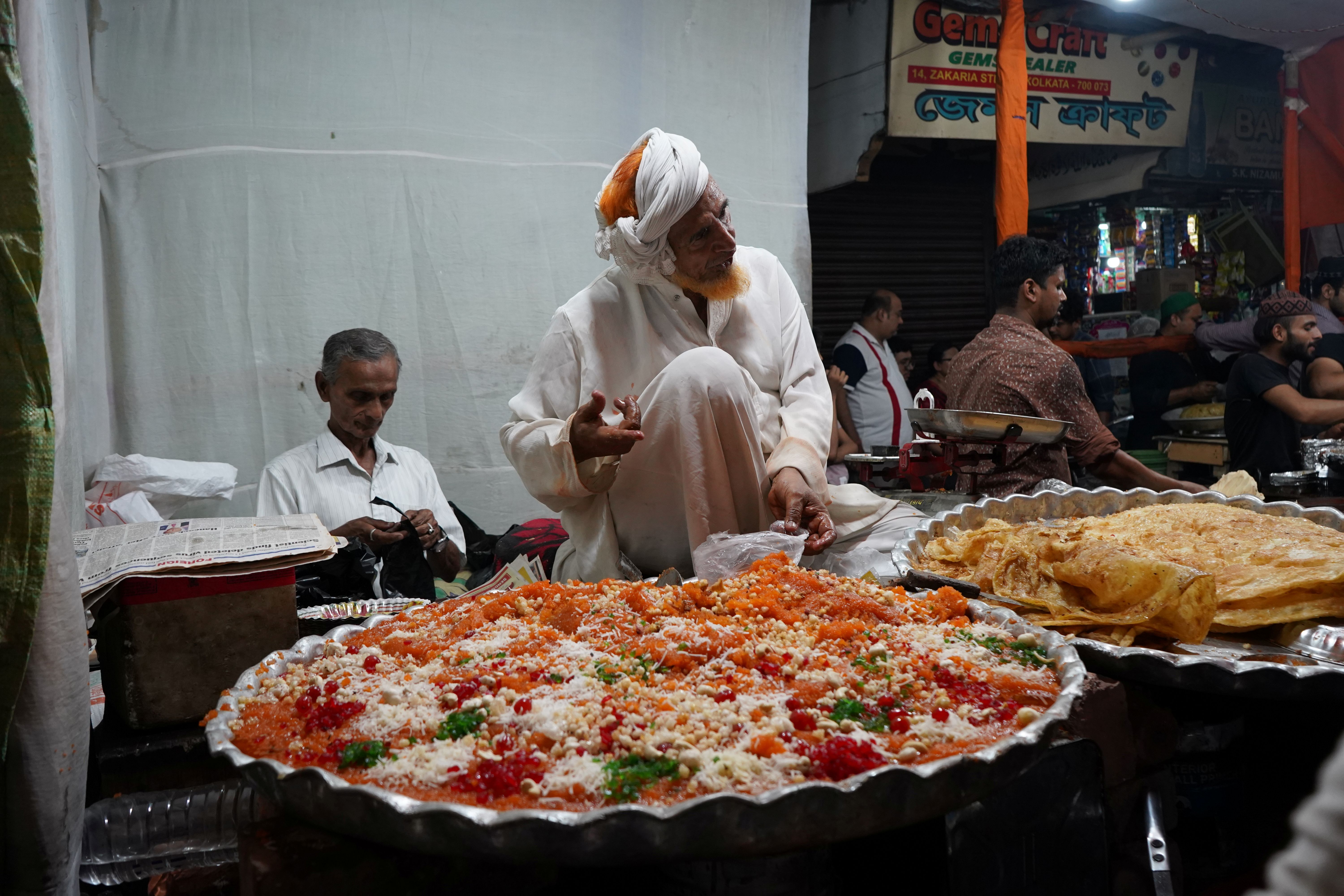
Though Firoz lived in Taltala, his family business was in East Kolkata. Leather. Perhaps that business still exists. Perhaps Firoz himself looks after it. Perhaps not. From my life, of course, Firoz has disappeared. I do not even know whether he still lives in Taltala or somewhere in Saudi Arabia. When we were in school, I went to his house. But even that was only once a year—on Eid invitation. I will not lie: keeping that invitation had less to do with honouring a friend, and far more, perhaps, with the pull of firni, korma, biryani.
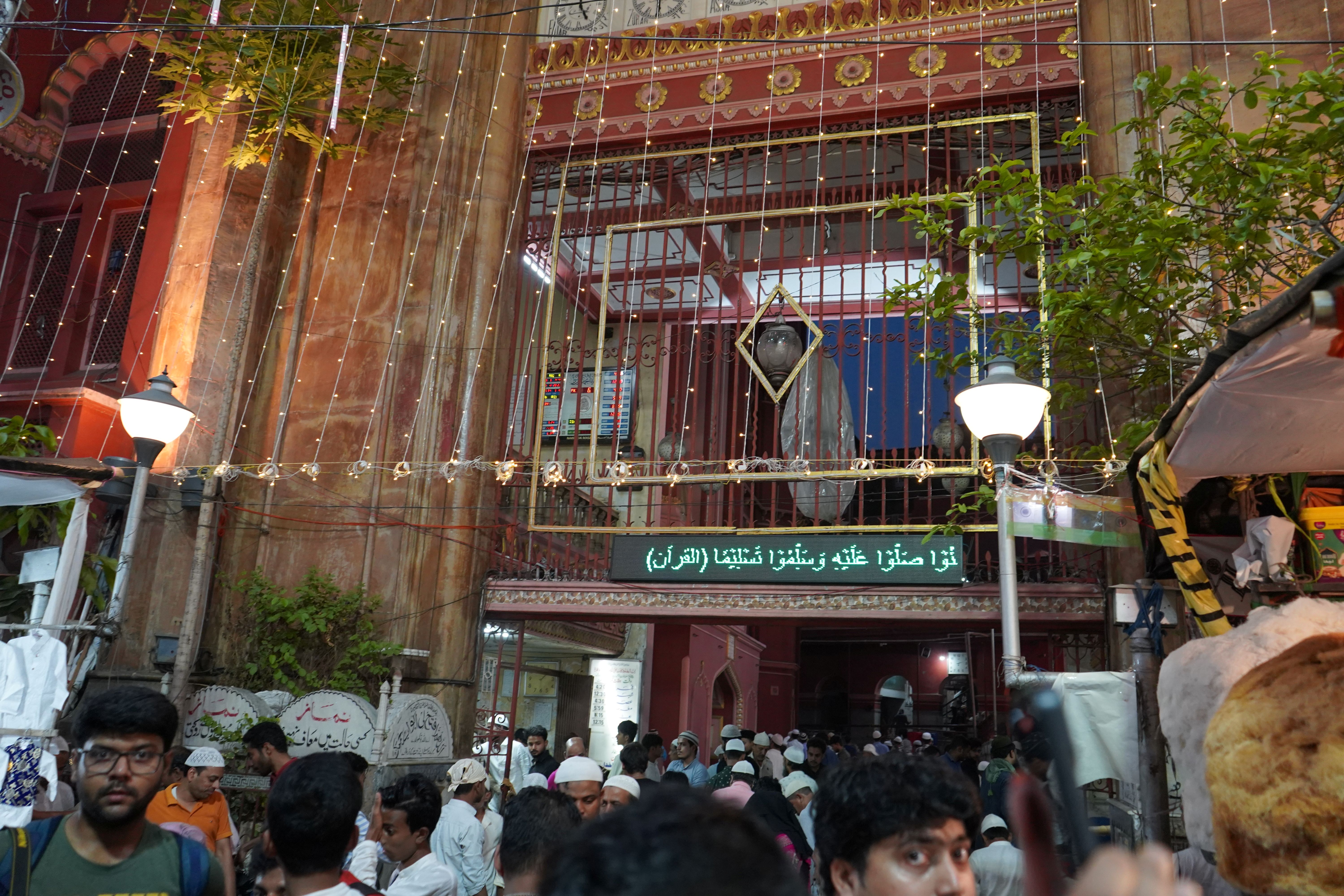
A few days ago, when a request came from the country where my desher bari once stood, asking me to write about Eid in Kolkata, I remembered Firoz. I remembered how, while my daughter was living in Delhi for her studies, she too would go with her friends to the mosque at prayer time. One of her friend’s elder sisters had a newborn child then—grown now. She wanted the child, during that time at the mosque, to find shelter in an affectionate lap. My daughter, gladly and without condition, took on that responsibility. Unlike me, she did not run to honour an invitation out of greed for firni.
I remembered how, during my years at the newspaper office, I would see the editor waiting eagerly on Eid evenings—surely editors still do—for that photograph brought in by Kolkata’s photojournalists, the one in which some tender little moment had touched the scene of congregational prayer. Perhaps a child looking at the camera with a shy, flickering smile. Or perhaps some tiny worshipper busy turning the cap on his head into a bird—something of that sort.
I remembered Mujtaba Ali. The smell of Aliah’s biryani came crashing into my nose. I remembered eating rezala at Sabir for the first time as a child with my father. I remembered how, with office friends, on Eid day, we would walk at a dangerously urgent pace along illuminated Chitpur Road. We had to reach Royal by eight. Otherwise there would be no mutton chaap left.
So much came back.
The window of the mind flew open without warning. It was as though a sea of white panjabis and netted caps had come tumbling into the city. The sharp fragrance of attar ruled the air. Along the roads, in clusters, lachha-semai waited for the love of customers. We felt like loving the exuberant children holding coloured balloons. So many eyes were dressed in surma—bright, elongated, stainless.
Two days before I began writing this piece, my poet-friend Hannan called. An Eid-day invitation. Hannan is a government employee. I told him, “I won’t be able to come on Thursday, brother. Something very urgent has come up. Shall I come on Friday then?” Not jokingly, but quite seriously, I said, “Please keep my share of the food in the fridge.”
Hannan got angry. I keep track of nothing, he said. I asked what had happened. Hannan said, “Don’t you know that from this year, our holiday for this Eid has been reduced from two days to one? I have office on Friday. How am I supposed to host you that day?”
For some people, not keeping track of the world is a kind of illness. Perhaps I have a touch of it too. I had not kept track of the news that the Eid holiday had been reduced from two days to one. Arafat, a member of the cleaning staff at our housing complex, told me that this time they would not pray at Red Road, but at the Brigade Parade Ground. In any case, prayers on the road have been stopped. Everything is now inside the mosques. If I sit down to list everything I do not know, I will only embarrass myself. Until a certain age, I did not even know that Eid comes twice a year. I knew Eid-ul-Fitr. After a month of fasting comes this Eid of joy.
Much later, I think when I was in Class Eleven, through that same Firoz, I came to know of Eid-ul-Adha. The Eid of Qurbani. The Eid of sacrifice. I learned why the dates of Eid depend so much on the movement of the moon. Compared with the ordinary English calendar, Eid moves ahead by almost eleven days every year. So, every now and then, after about thirty years, a situation arises when three Eids fall in the same English year—two Eid-ul-Fitrs and one Eid-ul-Adha, or the reverse. As happened in 2000, and, apparently, may happen again around 2030.
I live in Kolkata. My ancestors too, after leaving behind the soil and homestead of East Bengal, lived in Kolkata. Who does not live in Kolkata? Representatives of all India. So many foreigners. Chinatown. Parsi temples. Jewish synagogues. Bengali neighbourhoods formed by those who came to Kolkata from Rangoon a hundred years ago. The list cannot be exhausted. Nor is there any need to exhaust it, because everyone knows all this. They also know this: Bengalis on this side and that side, on both banks, live perfectly well loving one another and not loving one another. And the Firozes are here too. They have been here for hundreds of years. How much do we—the Dasguptas, Ghoshes, Banerjees, Pals, Sarkars—really know about them? How much do we even try to know? And yet, in this ancient city of ours, Hindus and Muslims have been present from the very beginning.
Scholars have shown this to us almost by pointing a finger at our eyes. They have said that so many places bearing Muslim names—Alipore, for instance—already existed when the English arrived. Did the Bargis ruin only the Hindus in Bengal’s villages and small towns? Muslims were not spared either. In search of work, they too began coming to Kolkata, began living here. The Nawab’s soldiers and retainers also brought Muslims to the city. Hindus had a hundred anxieties about touch and purity in cooking, and so demand grew for Muslim khansamas. Pachu Khansama Lane was not named for nothing. They showed skill in construction work. Peshawari Muslims began trading in raw materials. Muslim horse traders came. Hindus, for religious reasons, did not want to enter the leather trade. Muslims from Bihar, Uttar Pradesh, and Tamil Nadu took up that work in this city. They supplied the meat preferred by foreigners. Muslims had a cultural inheritance in stitched garments, and so, in the heart of the city, quite a few darziparas came into being.
Kolkata’s Muslim settlements grew mainly around affinities of place and language. In places like Park Circus, Topsia, Khidirpur, Metiaburuz, and Kolutola. Or scattered across the city—in Rajabazar, Narkeldanga, Parsi Bagan, Belgachia, Tangra, Entally—Muslim neighbourhoods where people perhaps still prefer to live together.
The point is that in Kolkata we all live together well enough. Just as we have countless festivals like Durga Puja, Muslims have Eid and others. And yet, ironically, we still do not seem to know one another as much as we should. For example, until I reached Class Eleven, no one at home or outside had told me why Eid comes twice a year. In almost the same way, perhaps no one had clearly explained to Firoz why Durga Thakur sometimes arrives on an elephant and sometimes on a boat. There is no certainty about which vehicle she will choose in which year. My real interest, however, lies elsewhere. That is why, at the very beginning, I lamented that I had never, like Mujtaba Sahib, been able to reach the Pathans’ own neighbourhoods and honour a dawat there.
Food lets me tell this story with deceptive ease. A plate of biryani, a bowl of haleem, a paper coupon for puja lunch—these make coexistence look simple, as if a city can settle its quarrels by feeding its people well. But shared appetite is not the same as shared understanding. It can open a door; it cannot erase history.
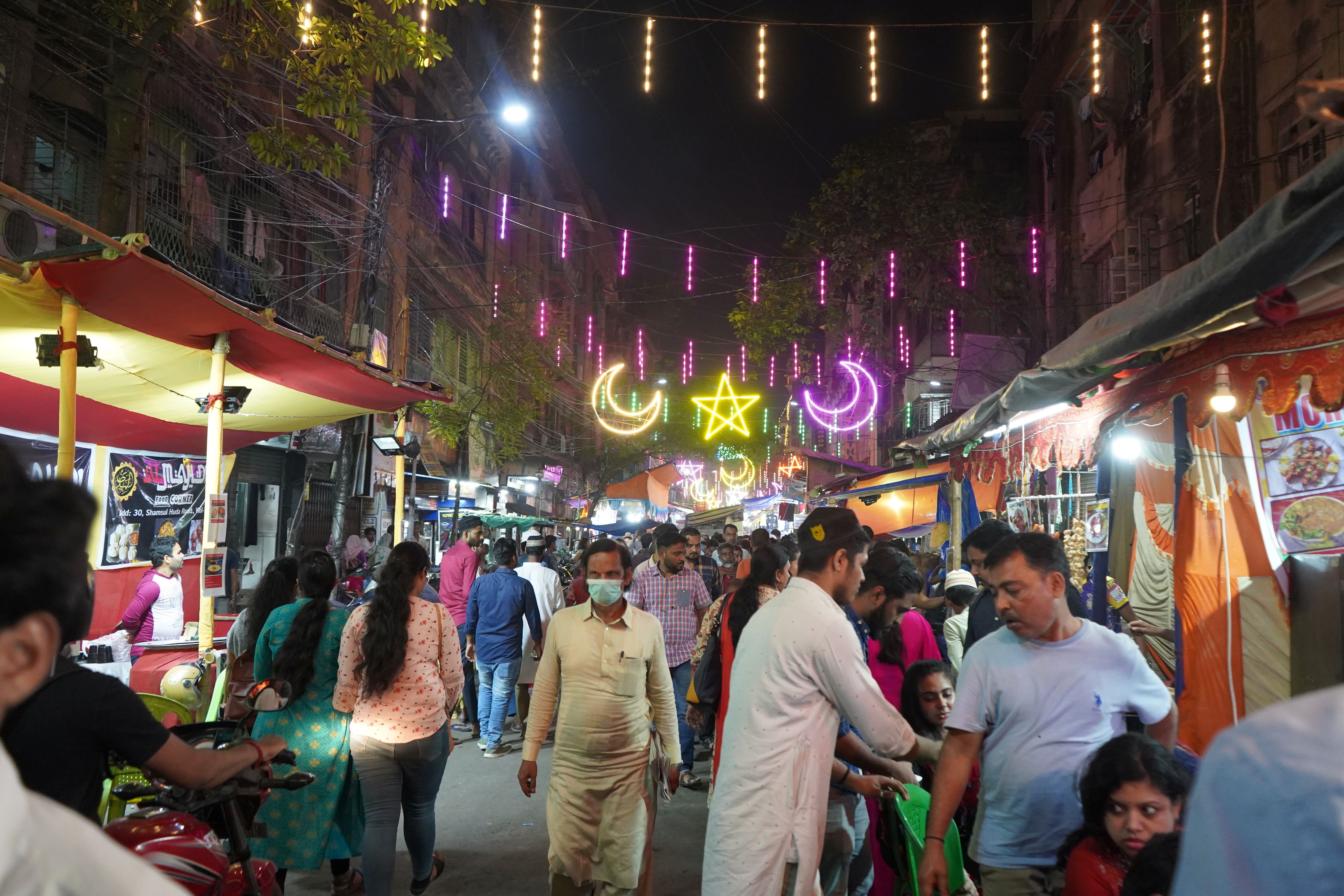
Then again, it is also true that just as I want Afghan pulao, I also want the fusion of Saraswati Puja’s khichuri, cabbage, and tomato chutney. I wait eagerly for the moment when the loudspeaker from the neighbourhood Durga Puja pandal will announce: lunch is ready, please come one by one, and do not forget to bring your coupon. We, the whole household, will run to raise to our mouths a few morsels of fine rice mixed with the hot red gravy of goat meat, knowing full well that they will say no one can be given more than two pieces. We will run nevertheless. Just as we used to run along the illuminated road of Chitpur on Eid day, afraid that Royal’s chaap would run out.
Food lets me tell this story with deceptive ease. A plate of biryani, a bowl of haleem, a paper coupon for puja lunch—these make coexistence look simple, as if a city can settle its quarrels by feeding its people well. But shared appetite is not the same as shared understanding. It can open a door; it cannot erase history. And I know that, despite the simple and easy way I have been telling it all this while, things were never really like that. Not in any Bengal since Partition. Let me speak of two incidents here. Both centre on Hindu puja.
In 1947, an expatriate Bengali living in Meerut wrote to a Kolkata periodical about his sorrow. Durga Puja was to be held there. For that, the expatriate Bengalis were holding a meeting. One expense came up: the payment for shehnai players. The secretary informed them that it was difficult to find a Hindu shehnai player. Even if one could be found, he would have to be paid a great deal
For many years before that, one man had played shehnai at that Durga Bari for the Bengalis of Meerut; three generations of his family had played there. The player was Muslim. The man—or the family—that had played the shehnai there for three decades had not been excluded all these years on religious grounds. But why, in the very first year of Independence, did the organisers feel such hesitation that the secretary had to say in that meeting, “Please consider whether we shall take a Hindu player at a higher fee, or a Muslim player for comparatively less.” At that, one member blurted out, “What need is there for a Muslim?” One by one, a few others said the same. In the end, the president put the matter to a vote. And in that vote, the Muslim shehnai player was rejected
Now let me speak of the second incident. This is from seven years before the country was split in two—that is, 1940. In a Kolkata daily, a certain Bengali, concealing his name, wrote a letter. The letter-writer’s complaint was that at Kolkata’s famous Bethune Collegiate School, the authorities always showed partiality towards Muslims. On the occasion of Saraswati Puja, the girls were eager to arrange a roshan chowki. But the authorities were not granting permission. Roshan chowki—a naubat, or a group of shehnai players—was essentially a traditional ensemble of North Indian classical musicians. In earlier days, at the courts of kings and emperors, at the gates of forts, or in aristocratic zamindar houses, this special group of musicians would be brought in to inaugurate auspicious ceremonies and festivals. So the principal of Bethune informed the girls that she could permit the roshan chowki only if they brought the signatures of the Muslim girls living in Bethune’s hostel, because their festival was taking place at the same time. Though the letter-writer blamed the authorities, he did praise the Muslim students. In the letter, he wrote, “None of the Muslim student-sisters raised any objection.”
Let contentious talk rest in this atmosphere of joy and festival. Let me only say this: just as the Muslim students of Bethune School had happily given their consent without raising any objection to the roshan chowki, the person—Abani Mukhopadhyay—who reported in Desh magazine the exclusion of the Muslim shehnai player from the Durga Puja in Meerut was also driven by nothing but human fellow-feeling. And our Bengali periodicals printed such things prominently. This too is Bengali culture: not the absence of prejudice, but the stubborn memory of people who noticed it, recorded it, and felt ashamed. So let Eid be joyful for all Bengalis. For Hindus and Muslims alike. Eid, after all, means festival. Can a festival ever be sorrowful? It cannot. Just like Durga Puja.
I am a carnivorous creature from head to toe. Even so, I do not like hearing stories of sacrifice during Puja. Nor do I like Qurbani. What can be done about that? But I love to eat—again and again I say it, what a shameful thing. For this reason too, it is true that I envy Mujtaba Sahib. Anyone who has eaten Afghan pulao while sitting in Afghanistan deserves to be envied.
Perhaps that is why Tanvir Nasreen of Bardhaman returns to this essay so naturally. Her memories are not simply scholarly additions to my hungry recollections; they show how Eid itself has travelled, gathered colour, absorbed sound, and changed form. I envy her too. She has seen Eid festivities in several parts of the world. I did not even know that Eid in the Maldives is a play of abir. Who knows how many unknown foods she has eaten on Eid? She wonders, astonished, how Eid gradually turned into a festival before her eyes. Eid gates. New films released on Eid. Special discounts in shopping malls. Special Mughlai menus for Eid. So many things of that sort.
She remembered her grandfather, Syed Siraj Ali, who had gone to Jama Masjid with a large crowd to hear Maulana Abul Kalam Azad speak. In her childhood, Eid did not have the kind of frenzy it has now. And on that special evening, most of the guests invited to their home would be non-Muslims. She felt that the Hindi songs now played over microphones in many places during Eid are actually an assimilation of Durga Puja’s barowari culture. Tanvir Nasreen is a learned person. Such thoughts befit learned people.
Tanvir Nasreen studied at Presidency College. Her recollection reminded me, inevitably, of Aliah’s haleem. And I made a vow that, by whatever means, I must remember the next month of Ramadan. A thoroughly rustic vow. So what if my days at the Chandni office are over? Aliah is still there. And as long as Aliah is there, Eid has haleem. With a little lemon squeezed over it, with beresta scattered on top, I shall somehow reach there and plunge into the jannat of meat and lentils. I shall go even with this frail body. Like Yudhishthira, even if alone, I must reach that “heaven.” I must also go and wish Anwar Chacha, the khidmatgar there, Eid Mubarak once.
Sandip Dasgupta has spent nearly three decades working in the editorial offices of newspapers and news portals. He has authored several history-based books, and a subject particularly close to his heart is the illustrations created by Bengali artists.
Send your articles for Slow Reads to slowreads@thedailystar.net. Check out our submission guidelines for details.

157th Birth Anniversary of Mahatma Gandhi / Gandhi’s return to Noakhali
Why does Tagore still trouble Bangladesh’s idea of ‘us’?

Can Bangladesh make better use of its zakat money?
Three revolutions that reshaped the world
Paradise lost and found: Rediscovering early modern Bengal
Unbound Mother: The making and remaking of Kaali in Bengal

Do great leaders make history, or does history make them?
Poison and cremation: A forensic history of colonial Bengal