Bangladesh’s renewable policy: Still too little but not too late
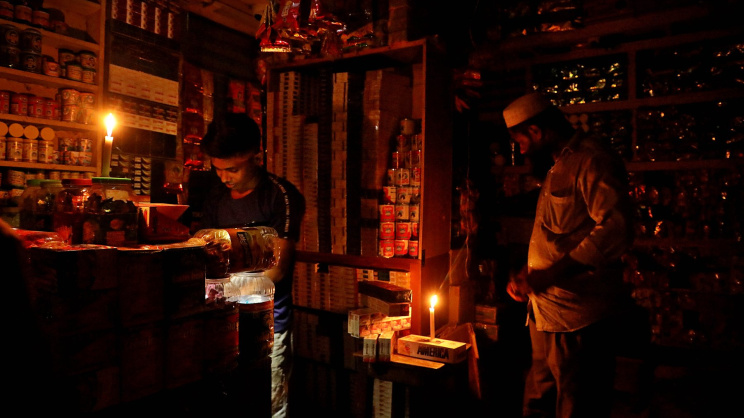
Bangladesh’s future hangs in the balance as we find ourselves at an energy crossroads; what we do at this critical juncture will determine our trajectory. The current situation might have been triggered by a disruption to floating LNG units, but the energy crisis has been a long time in the making. Because we import most of our fuel, our power supply is vulnerable to dips in the domestic dollar reserve and to unexpected mishaps, as well as to international fuel price rises and supply chain disruption caused by wars abroad.
The past year has seen power outages disrupt not only our industry and thereby our economy but also essentials such as healthcare and food supply. This year, rice production suffered during the Boro season from a lack of diesel for irrigation, and factories were forced to halt production because of power cuts and a shortage of diesel for backup generators. As factories struggle to meet orders and are forced to reduce operations, workers face layoffs. A lack of diversification has left us tied to a garments-based export economy, so ensuring reliable power is now a necessity.
In 2020, the Quick Enhancement of Electricity and Energy Supply (Special Provisions) Act was enacted as an emergency stopgap measure to expand power generation. But it was allowed to continue for years, ensnaring the country further in import-based fossil fuel dependency, alongside an expansion of coal- and gas-fired power plants.
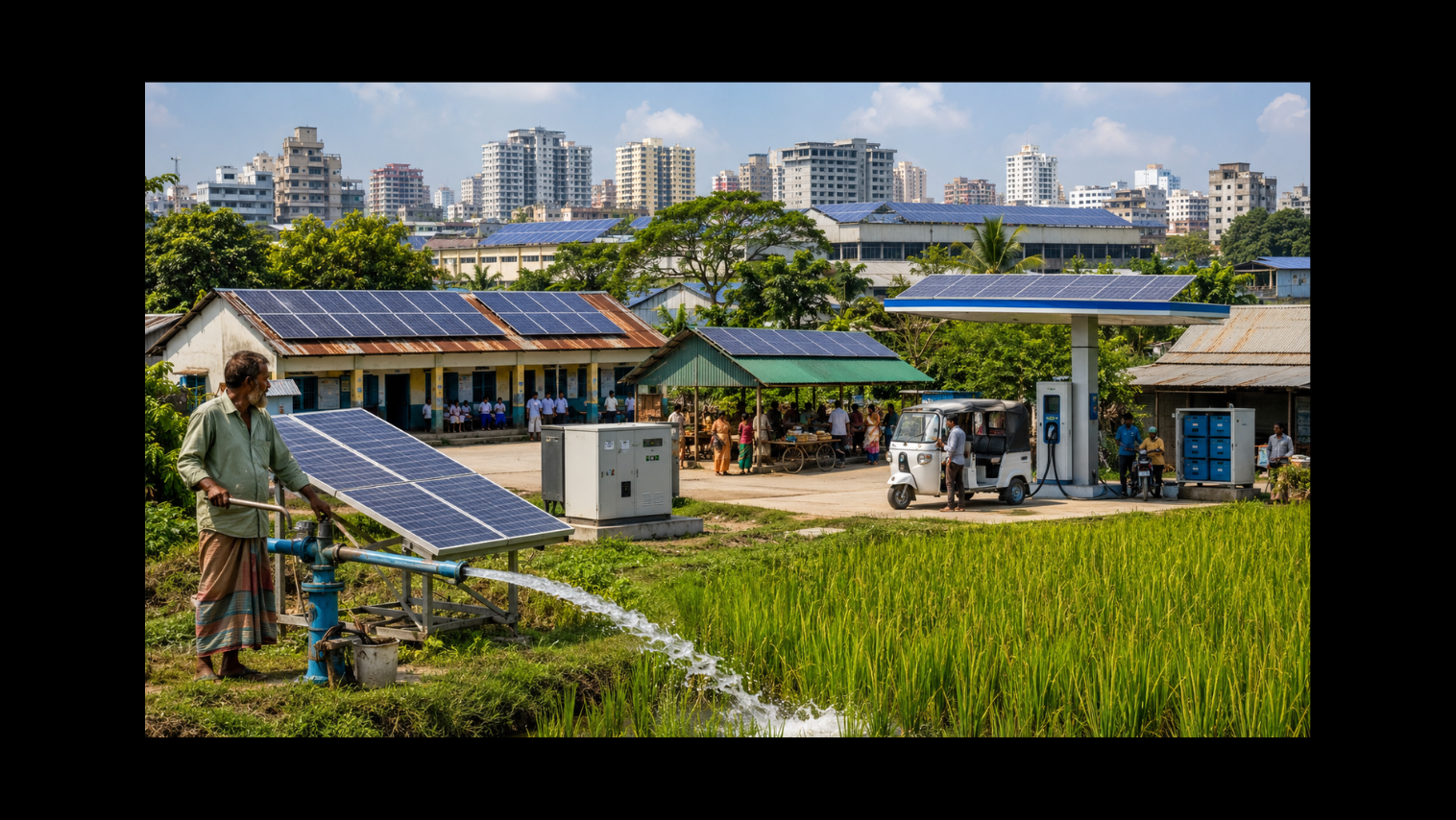
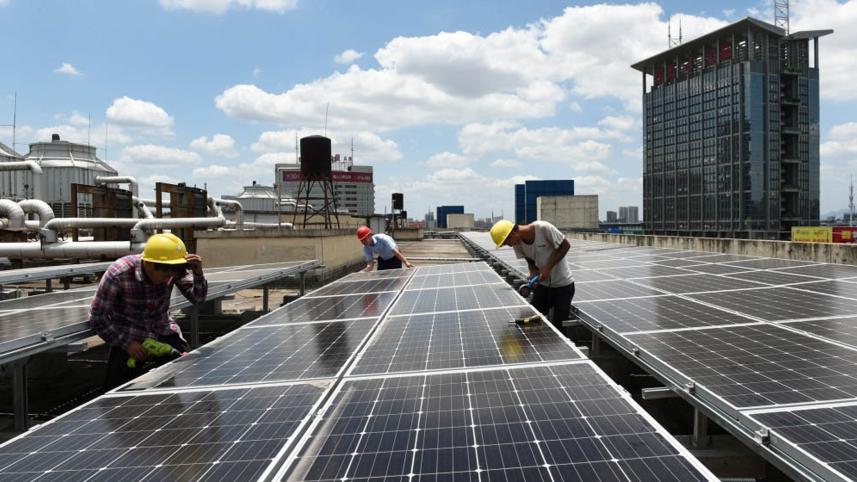
Domestic gas reserves have been steadily dwindling over the years, and new exploration would need almost a decade to translate into supply. Coal extraction in Bangladesh’s soft soil has proved risky and expensive. In this situation, expanding solar power, Bangladesh’s most feasible renewable source, has become a national energy security priority, quite apart from concerns about carbon emissions. However, solar power has a lower capacity factor than gas and requires more land per unit of power output. Rooftop solar, while a crucial part of the solution, can supply only a limited portion of industrial energy requirements.
In a land-constrained country like Bangladesh, land acquisition has emerged as one of the stumbling blocks for expanding solar. Bangladeshi law prohibits the use of agricultural land for power generation: most households still depend on agriculture for part of their livelihood, and food security is a national priority. The current model of power generation requires a solar company to acquire land, including the land for the transmission line, before receiving a letter of intent (LoI). But in a country where there is hardly any land that is unused or uncontested, this becomes an added challenge for power developers and a source of delay for investors.
The Bangladesh government has proposed the use of government-owned khas land for solar power expansion. But khas land is often used by local communities for agriculture, or forms part of the catchment areas of Bangladesh’s floodplains, and more often than not is contested by multiple ownership claims. In a study with the University of Cambridge, BIGD at BRAC University has found that more than 11 of the existing solar projects are mired in land conflict. They are built on land that was previously used for agriculture in the dry season, or that formed part of water bodies in the monsoon. These lowlands are usually filled with sand to make way for solar projects. That impedes water flow during the monsoon, harming both fishing in the wet season and crop production in winter. With increased flooding risks in a changing climate, the need to protect floodplains becomes crucial.
There is also a need to protect food production and agricultural work, one of the sectors most vulnerable to climate change. A macroeconomic BIGD study showed how a shift in land use from agriculture to non-agricultural activity disproportionately affects women. Solar expansion under the current model of land acquisition, using a conventional photovoltaic design, will increase land conflict and livelihood loss, and will threaten food security. Filling floodplains with sand and displacing agriculture will also deepen our climate vulnerability.
Solar power differs from other power sources in that the land under the panels producing power remains mostly available. Therefore, the original use of land for agriculture or aquaculture can be maintained.
A promising alternative is dual land use under solar panels. Solar power differs from other power sources in that the land under the panels producing power remains mostly available. Therefore, the original use of land for agriculture or aquaculture can be maintained. Indeed, BIGD’s proof-of-concept pilot shows that agrivoltaics (growing crops under solar panels) allows a range of crops to be grown beneath the array, with only minor adjustments to the standard panel design.
BIGD, in collaboration with BRAC University’s Electrical and Electronic Engineering department and the Bright Green Energy Foundation, and with funding from the H&M Foundation, has built a 98 kW agrivoltaic system in Manikganj. The project, completed in June 2026, presents three solar panel designs that cast varying degrees of shade below, compared on cost and revenue. Under the panels, a range of crops is being tested against an uncovered control plot, which provides reference yield data. The crops include both shade-tolerant varieties and those with high sunlight requirements, and are compared in terms of yield, plant health, and annual cost and revenue for the farmers.
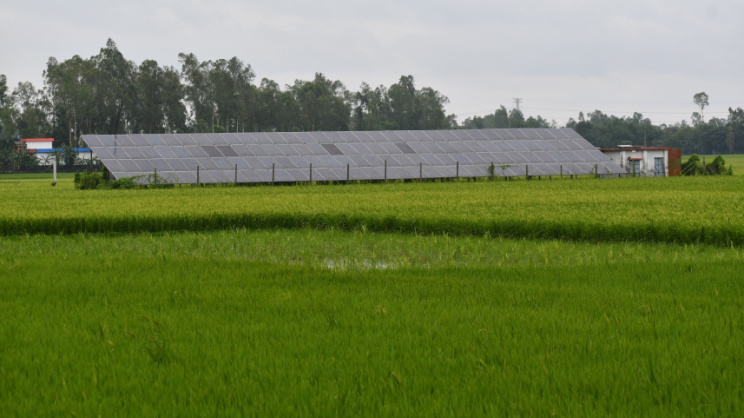
The project is also tracking climatic conditions such as cloud cover and rainfall, along with microclimatic differences under the panels and outside them. Both matter for crops and for power generation. This will feed into a dual optimisation model that can be used to build agrivoltaic systems elsewhere in the country and for different crops.
The project was designed and built in consultation with local households. In many places across Bangladesh, households prefer to grow at least one rice crop a year: grain is easy to store and transport, local market demand is reliable, and the harvest meets household consumption needs. Our agrivoltaic system is therefore designed to accommodate rice production, allowing machinery to move under the panels and between the supporting columns. Alongside the usual varieties, the project is testing a shade-tolerant rice developed by the geneticist Dr Abed Chaudhury.
The first harvest, completed in May 2026 shows promising results. Besides rice, many other shade-tolerant varieties are known to grow well under panels and are being tested. With increased heat stress, cash crops such as tea, dragon fruit, tomatoes, strawberries, onions, garlic, coriander, and leafy greens may do better under the panels. An underexplored aspect is the potential health benefit to agricultural workers, who in Manikganj have reported that working under the panels is more comfortable in summer.
The project currently supplies power for irrigation and to the grid. During the fuel crisis that affected rice irrigation in the last Boro season, farmers in the area said the solar project was a lifesaver, because it does not depend on fuel. However, irrigation is needed for only one season; the panels are connected to the grid for the rest of the year. This not only eases pressure on a grid that is overwhelmingly dependent on fuel, but also provides a more consistent income stream for the solar producer. Installation costs are far harder to recover if the electricity is generated and sold for irrigation alone. While reduced import duties on solar panels and associated equipment are a step in the right direction, batteries still attract a high duty. Ground-mounted panels are subject to a high demand charge based on the sanctioned load under the net metering system. The recent wheeling charge and fixed tariff rate for solar projects under the Merchant Power Purchase Policy also discourage renewable expansion by the industry.
BIGD is testing alternative models at two other sites, where land beside a factory supplies solar power directly to that factory. One of them is a tea factory. Tea plants are shade-loving, and tea production would gain twice over from an alternative power source, since tea processing is suffering under the current power crisis. However, current land classification policies for tea gardens bar the installation of ground-mounted solar panels. Through this project, BIGD aims to provide guidelines on crop type, the tariffs needed to make the model feasible, the land-sharing model, farmer contracts, and land lease amounts. For crops with different light requirements and marketability, a range of panel designs will be presented, along with the corresponding investment each requires. That would give the industry a pathway to use adjacent land as an alternative power source.
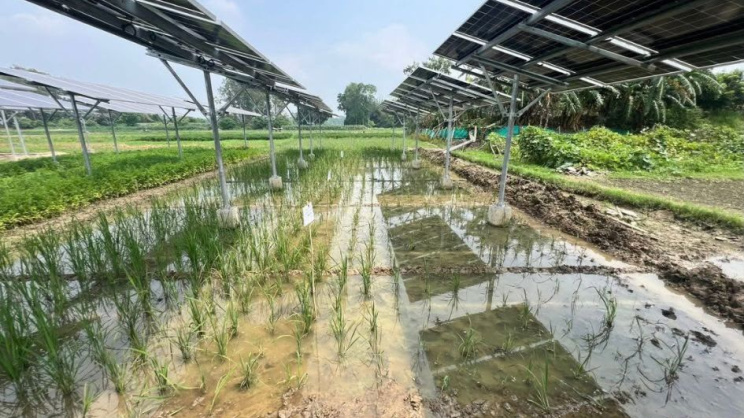
Perhaps most importantly, this model would allow us to move from a land-acquisition system to a land-sharing one. For large-scale solar projects, multiple landowners and disputes over acquisition create long delays and increase the risk for investors. A land-sharing model, on the other hand, would allow the original use to be preserved, with a coordinating agent, such as the government, aggregating the land use for 20 years. Agribusinesses in Bangladesh have successfully coordinated thousands of farmers for a single use of land. The land lease amount, or profit-sharing model, would be based on the effect on yield relative to the control plot, and financing options for power producers could reflect the higher structural costs. The agrivoltaic project could additionally be financed through carbon credits. Revenue per unit of area may fall, because the panels are spaced further apart than in a conventional array, but that must be weighed against the cost of delays under the conventional land acquisition process.
From a just transition perspective, this model conserves the livelihoods of women farmers, among the groups most vulnerable to climate change; it protects food security; and it preserves floodplains against rising flood risk. Current policy remains insufficient and disjointed when it comes to supporting renewable expansion, and without enabling policies, we are headed towards a future of continued power disruption. At this crucial juncture, as the government proposes to expand solar, we urge it to support an alternative agrivoltaic design for large-scale projects, rather than the existing model, which is mired in conflict and which damages not just food security but the livelihoods of agricultural households.
Rohini Kamal, PhD, is an assistant professor and research fellow at the BRAC Institute of Governance and Development (BIGD), BRAC University.
Send your articles for Slow Reads to slowreads@thedailystar.net. Check out our submission guidelines for details.
Prabhat Patnaik speaks / Why the Global South must rethink export-led growth
Bhotekoshi flood: Another warning from the Himalayas. Are we listening?
Renewing the Ganges Water Sharing Treaty: What should Bangladesh do?
What it really costs to live in Dhaka
Why Nepal’s devastating floods should no longer surprise us

What kind of doctors does Bangladesh need?
Why aren’t we talking about the health risks of battery rickshaws?
What six South Asian economists taught the world about development
Can Dhaka’s Pink Bus break a four-decade pattern?