


The future of work and the need for humans and AI to grow together
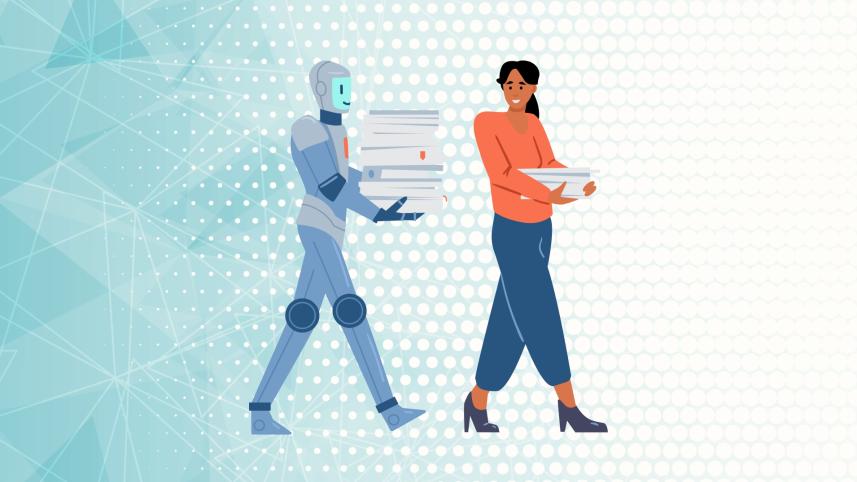
"Hey AI, write me a career plan that won't be obsolete in five years."
This is not a joke; it's the kind of prompt many people are half-seriously typing into chatbots today. As artificial intelligence reshapes industries at lightning speed, a sense of both awe and anxiety fills the workplace. When a machine can write, paint, and even code, what happens to your career? Every innovation promises progress until it threatens your paycheck.

The relationship between technology and work has always been one of transformation. But AI feels different. It's not just automating tasks; it's starting to think, learn, and create alongside us.
The paradox of AI's progress ominously looms above us as AI is redefining what's possible. For instance, in logistics, machine learning is optimising global supply chains. In education, AI tutors are personalising lesson plans tailored to every individual student's pace. AI now also threatens to replace both coders and content creators.
These advancements accelerate productivity, curb costs, and open up entirely new industries. The World Economic Forum estimates that AI could contribute over USD 15 trillion to the global economy by 2030. Yet, the same systems that optimise operations can also shrink payrolls, causing potential professionals to rethink their career choices.
On the brighter side, befriending AI can allow some professionals to thrive. A visual designer, for example, can use AI to further polish and elevate their content.
But it does not take long for AI assistance to turn into AI dependence. According to PwC's Global AI Jobs Barometer, roles in AI-exposed industries experienced a 38 percent growth between 2019 and 2024, with workers possessing AI skills earning a 56 percent wage premium in 2024. As PwC notes, "AI is not taking away the value of work — it is enhancing it. People who can work effectively with AI are becoming even more valuable."
However, for many people, the uncertainty lingers. If AI can make some industries four times more productive, human labour starts to look like a comparative liability. The advantage may be slipping away from those whose work can be easily automated—or even done better—by machines.
A deeper, human-centric divide is emerging. The jobs least at risk are those that require high-level emotional intelligence, creativity, and social interaction. This includes roles like nurse practitioners, mental health counsellors, and physical therapists.
In essence, the market is placing an increasing demand on the unique human skills that algorithms cannot replicate. It is safe to say AI is coercing us to be more humane.
Today, many tech giants are adopting, developing, and integrating AI within their product suites and cloud platforms, be it Google or Microsoft. Financial services, automotive, software, etc., are quickly catching up, too. In this new landscape, integration is either the cutting edge or the only way to survive and thrive.
The future isn't humans or machines; it's synergistic performance. The key is intentional adaptation. Change is inevitable, but progress is what we choose to create or maybe co-create.
 For all latest news, follow The Daily Star's Google News channel.
Comments