


Are we not forgetting the genocide of the Palestinians?

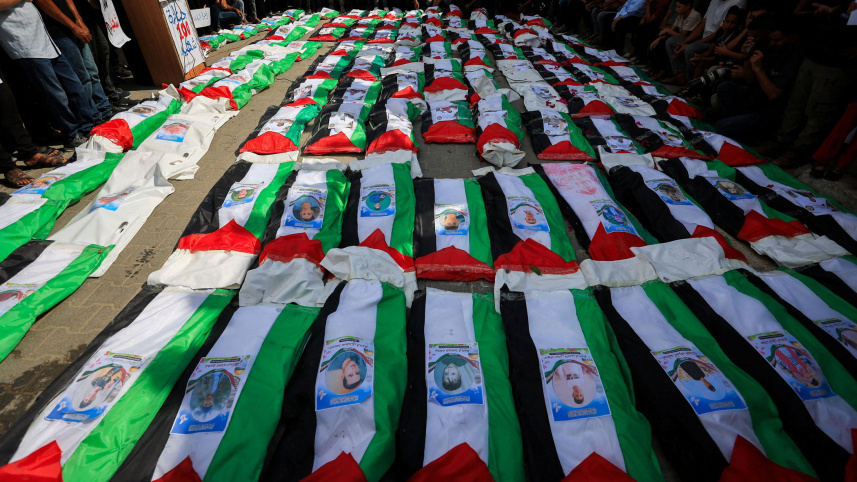
What the Nazis did to the Jews, Israel is now doing to the Palestinians. It has turned Gaza and the West Bank into de facto concentration camps. Instead of gas chambers, it bombs helpless Palestinians as a near-daily routine. What an irony. The Nazis and their collaborators murdered millions of Jews across Europe, and the world was sympathetic to their plight and wanted justice, which, unfortunately, has come at the cost of the Palestinians.
Israel’s relentless bombing has reduced Gaza to piles of rubble, and those who have survived the devastation have nowhere to live except in tents, without food and the minimum facilities for a livelihood. Their hospitals have been bombed, their sources of electricity decimated. They have even been deprived of water and, for weeks if not months, have been forced to drink seawater. Nearly 80,000 Palestinians have already been killed, including over 20,000 children. Subject to an arrest warrant issued by the International Criminal Court, Israeli Prime Minister Benjamin Netanyahu, along with his diabolical team, has thus committed the most inhuman and barbaric crime under the pretext of eliminating Hamas. For those still alive, each day is a survival without any hope for the future. The Israelis are trying to starve Gazans into extinction. This is genocide unfolding right before the eyes of the world, and it is not condemning it enough.

The tragedy of the moment is that world attention currently stands diverted because of the US-Israeli war on Iran. It has already been revealed that it was an Israeli ploy that dragged the US into this war. The resulting disarray in global supply chains, rising energy costs, and other troubles have served to largely shift focus away from the Palestine situation. Although many had hoped that the war would end quickly, its prolongation has kept global attention diverted, allowing Israel to use the opportunity to continue its killings and territorial expansion in Palestine.
Meanwhile, Israeli attacks on southern Lebanon have killed more than 4,300 people since March 2. About 12,400 have been wounded, while hundreds of thousands have been displaced. Moreover, there have been 179 attacks on Lebanese ambulance crews, killing 135 healthcare workers.
In Gaza, more than 1,300 Palestinians have been killed since the US-brokered ceasefire last October. Even though much of Gaza has been razed to the ground, the bombing continues. For Israel, killing Palestinians seems to have become a sort of an “entertainment” item, for which justification can always be engineered. The new cause for concern is the attacks by Israeli settlers in the West Bank, with 76 Palestinians reportedly killed as of August 10 in 2026. Many have been displaced due to settler violence, demolitions, and evictions.
Whatever Israel is doing, the secret plan is to realise the idea of “Greater Israel”. It is a political, religious and nationalist vision that the present ultra-right-wing government wants to implement. They want a territory far larger than present-day Israel. The so-called biblical version—as interpreted by the orthodox Jews—of the concept of Greater Israel extends from the Nile to the Euphrates. Another version refers to territory stretching from the Mediterranean Sea to the Jordan River. A more practical version, advocated by many Zionists, involves the permanent control of the West Bank and Gaza, while Israel has already taken over East Jerusalem and the Golan Heights.
The outcome of the Six-Day War of 1967, in which Israel’s victory was something nobody had imagined, made Israeli leaders more confident. They concluded that their ambition of implementing the Greater Israel plan was possible. When Menachem Begin and his Likud party assumed power in 1977—10 years after the war—the idea of Greater Israel, the ideology of Likud and the Israeli right, started to be implemented more rapidly. Over the years, the idea grew and more and more Zionists took it up as their plan. And if the plan was to be realised, the Israeli military had to grow. This triggered its expansion and the creation of right-wing militias in various parts of Israel. The US, knowingly or unknowingly, became an integral part of the plan.
So the aim became clear—expand Jewish settlements in the West Bank and make them as permanent as possible so that it becomes difficult, in fact impossible, to remove them if the situation were to change due to international pressure.
After the 1967 war, Israel started the settlement process. By 1972, there were 14 settlements, and within four years, this became 20, with 3,200 settlers. The argument grew stronger that Judea and Samaria were not only strategically useful but also religiously ordained to be part of Greater Israel. Following Begin’s coming to power, the number of settlers rose from 3,200 to 17,400, and the number of settlements increased substantially. By 1983, there were 22,800 settlers and 76 recognised settlements. According to an estimate, the number of settlers in the West Bank now exceeds 5,00,000 in 2026. In the initial phase, from 1967-1977, the settlements were largely justified from a security perspective; from 1977 to 1992, it became more ideological; and from 1993 to 2009, settlement expansion became far more intensive. Finally, from 2009 to 2026, what happened was de facto annexation.
The only serious attempt at a peaceful solution during this time was the Oslo Accords. It began secretly in 1992 and progressed into direct negotiations between Israel and the PLO. In 1993, the Oslo Accords were formally signed between Yitzhak Rabin and Yasser Arafat in the presence of US President Bill Clinton. This was followed by the Gaza-Jericho Agreement in 1994, which implemented the first major agreement on Palestinian self-rule. In 1995, the second Oslo Agreement was signed, dividing the West Bank into Areas A, B and C. The idea was to expand Palestinian self-rule, but it ended up with greater Israeli control of the territory. Today, the West Bank, with its intensive infrastructure, military outposts, roads, municipal jurisdictions and economic integration, can be said to have practically become integrated with Israel.
In the face of the above, the recent joint statement by the foreign ministers of Canada, Denmark, Finland, France, Iceland, Ireland, Norway, Poland, Portugal, Spain, Sweden and the UK comes as a very timely collective action towards the two-state solution, which remains the only way forward for permanent peace in the Middle East. The joint statement categorically said that Israel’s actions in the West Bank “are undermining the possibility of a two-state solution. The situation is rapidly deteriorating amid unprecedented levels of settler violence and settlement expansion.” It called for an immediate stop to the expansion of settlements and civilian administrative powers. The countries also declared that they are determined to take action in pursuit of a just and lasting peace. The statement reads: “We are unequivocally committed to the two-state solution, in accordance with relevant UN Security Council resolutions, that enables Israel and a sovereign, democratic and viable Palestinian state to live side by side in peace, security…”
Netanyahu and his far-right cabinet have never hidden their aim to eliminate the Palestinians and have thoroughly opposed the two-state solution. So, for these Western countries to strongly support its revival is a very important development. Israel has not faced such a unified Western stance before. A year earlier, Saudi Arabia and France moved for wider recognition of a Palestinian state, which resulted in more countries doing so. The latest initiative should lead to greater international support for the two-state solution. All Arab countries should endorse it fully, and so should the international community.
This should be done not only for the Palestinians but also for the future of a law-abiding international order that will create a better world for us all. Otherwise, we will become a civilisation devoid of values, ethics, justice and, most importantly, peace.
Mahfuz Anam is the editor and publisher of The Daily Star.
Views expressed in this article are the author's own.
Follow The Daily Star Opinion on Facebook for the latest opinions, commentaries, and analyses by experts and professionals. To contribute your article or letter to The Daily Star Opinion, see our guidelines for submission.
 For all latest news, follow The Daily Star's Google News channel.
Comments