


Why small businesses remain invisible to traditional credit ratings

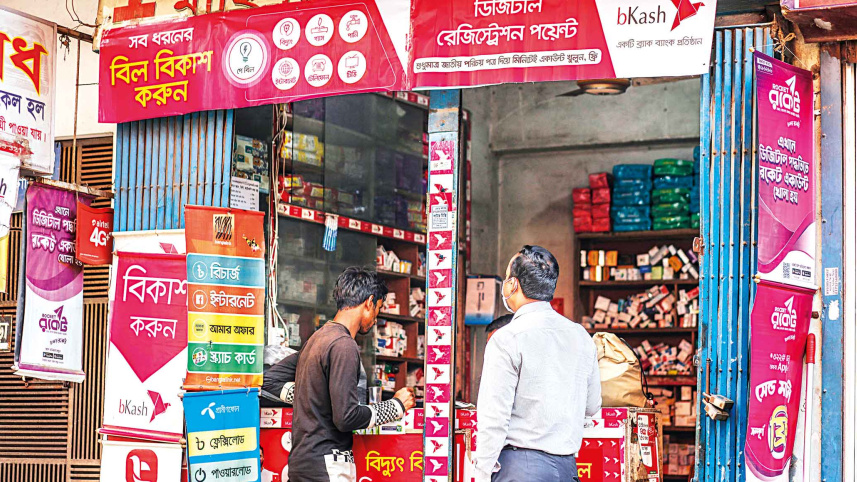
A retail store owner in any part of the country processes dozens of bKash or Nagad transactions an hour, pays suppliers every week by digital transfer, and never misses a utility bill. Yet when this merchant asks a commercial bank for a Tk 5 lakh loan to expand inventory, he is almost always politely refused.
The Cottage, Micro, Small, and Medium Enterprise (CMSME) sector accounts for nearly a quarter of Bangladesh’s GDP and an estimated 87 percent of the active labour force. Bangladesh Bank (BB) last year set a target of 27 percent of total loan portfolios for CMSMEs by 2029. But despite circulars, refinancing schemes, and low-interest quotas, the financing gap persists—estimated by the International Finance Corporation (IFC) to be $2.8 billion. At the heart of this disconnect sits a credit rating framework that has been built to evaluate a factory, not a shop on the side of a footpath.

Credit risk evaluation in Bangladesh leans on two mechanisms: the central bank’s Internal Credit Risk Rating (ICRR) framework and evaluations by external agencies under Basel III guidelines. Under the ICRR, 60 percent of a borrower’s score is built on quantitative financial data: audited balance sheets, profit-and-loss statements, tax receipts, formal leverage ratios. The central bank exempts the smallest borrowers—including micro-credit and small enterprises below Tk 50 lakh—from ICRR. Even so, as per BB’s March 2025 master circular, which formally recognised informal enterprises for the first time, cottage and micro borrowers need to present a Credit Information Bureau (CIB) report and collateral proof before a loan is cleared.
For a mid-sized manufacturing plant, these requirements make sense, but for a cottage or micro entrepreneur, they become a wall. An estimated 80 percent of CMSMEs operate informally, which typically means they do not work with a professional accountant and do not produce an audited statement. When given an informal ledger from such a business, the rating system only sees an entity it is unable to rate.
Of course, collateral is not even the first hurdle for the smallest borrowers. Bangladesh Bank’s master circular requires banks to lend up to Tk 5 lakh collateral-free to every CMSME borrower, and up to Tk 25 lakh and beyond for specific cases, especially for women entrepreneurs. But collateral-free never means paperwork-free. Banks still need to see a business’s trade license, sales history, and CIB report, and once a loan grows bigger, collateral requirements stack up as well.
Bank officials themselves admit the problem. Regulations already permit assets other than land as collateral, but lending practice has yet to catch up, particularly in manufacturing. A micro-merchant’s wealth sits in inventory, receivables, and daily cash flow. But the value of these only counts once documented, and an informal ledger does not produce such documentation.
These merchants do leave a continuous, verifiable digital footprint in the form of payments through Bangla QR, invoices settled by mobile financial services (MFS), and utility bills paid on time. Because Bangla QR, recently made mandatory, is interoperable across banks and wallets, this data is technically poolable in a way it never was before. A business clearing Tk 15,000 a day in MFS transactions shows real liquidity and steady demand, a meaningful signal, though it speaks more to cash flow than to margin or true debt-service capacity, which any scoring model would still need to estimate rather than read off transaction volume. Traditional credit ratings offer a static snapshot of the past; digital transaction data, imperfect as it is, comes closer to real time.
Handing lending decisions to algorithmic models built on MFS and merchant data raises questions. Who audits the models for bias? What happens to a borrower’s transaction history if a fintech platform folds or is breached? How does BB supervise scoring systems it does not build itself? These need to be resolved up front, rather than being an afterthought once a model goes live.
Two policy moves could help close this gap. First, BB should open a regulatory sandbox for Alternative Credit Scoring (ACS), letting fintech platforms and commercial banks jointly build scoring models based on MFS transaction volumes, utility payments, and digital merchant records, with oversight and data protection rules built in. Paired with this, the Credit Guarantee Scheme (CGS) should be wired directly into validated digital scores. Branch managers hesitate to extend uncollateralised loans because a non-performing loan reflects on their own career record. In contrast, a CGS backing loans cleared through audited digital scoring gives them cover to lend.
The central bank has already pointed towards part of the answer. Its March 2025 master circular created a new informal-enterprise category built around the Digital Business Identification (DBID) and Personal Retail Account (PRA) systems, capped at Tk 5 lakh in credit. What’s needed now is the follow-through. Banks remain reluctant to accept a DBID or UBID registration in place of a trade license, so the reform sits half-used.
What Bangladesh needs is a scoring framework built for how the smallest businesses operate and the oversight to use that data responsibly. With these factors in place, the financing gap has a real chance of closing. But only upgrading the technology while skipping the safeguards means swapping one flawed gatekeeper for another. The retail store owner on a side street is not necessarily a good credit risk, but they have also never had the chance to be measured in terms which would help determine where they stand.
Md Rakibul Hasan is credit officer at Bangladesh Small and Cottage Industries Corporation (BSCIC). He can be reached at rakib4457@gmail.com.
Views expressed in this article are the author's own.
Follow The Daily Star Opinion on Facebook for the latest opinions, commentaries, and analyses by experts and professionals. To contribute your article or letter to The Daily Star Opinion, see our guidelines for submission.
 For all latest news, follow The Daily Star's Google News channel.
Comments