


Why does Biman keep fixing problems the hard way?

Reading the news of Biman Bangladesh Airlines flying engineers and spare parts about 7,000 kilometres from Dhaka to fix a Dreamliner stranded at Rome Fiumicino Airport, one cannot help but wonder: does this make any sense at all?
Flight BG306 touched down in Rome on the morning of August 7, halfway through its journey from Toronto to Dhaka. What was meant to be a brief refuelling stop turned into a grounding after the Dreamliner reported a fault in its cabin pressure control system. For around eight hours, 259 passengers, including at least 174 Bangladeshi passport holders, sat trapped on board with the air conditioning not functioning, leaving some children and elderly passengers visibly distressed.

The remedy came in the form of a two-member engineering team and spare parts sent from Dhaka on the next scheduled service, which reached Rome on the evening of August 8. As a result, the outbound flight scheduled to use the same aircraft had been delayed by a day. Once the two engineers reached the aircraft, the fault was fixed in about two hours. But by then, the disruption had already caused an ordeal, as passengers had been stranded in Rome for nearly 40 hours before BG306 reached Dhaka. All this is because the expertise and parts needed for a repair had to be brought in from another continent, and this should never have been the case.
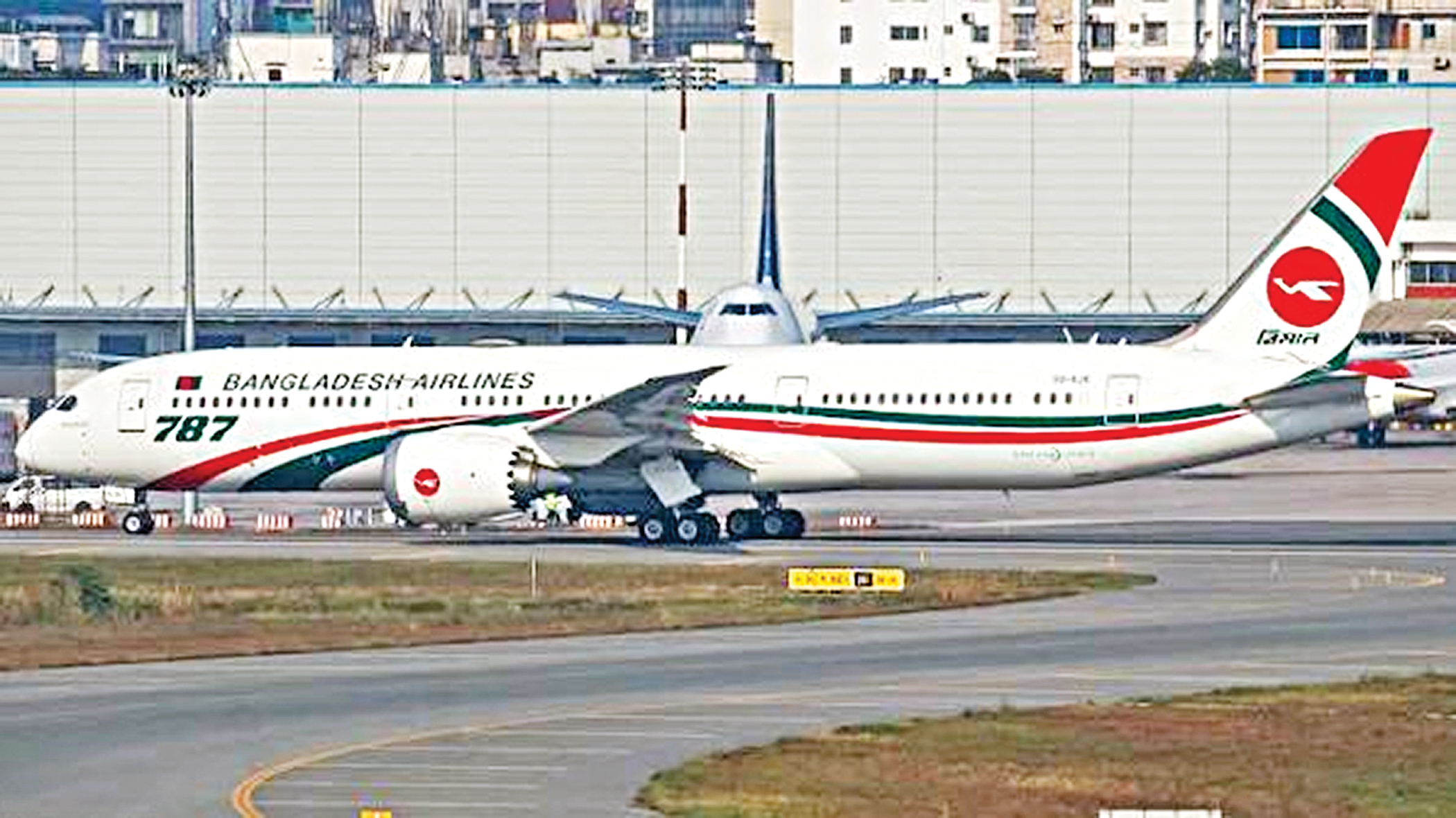
Since 1948, global airlines have shared an arrangement designed to avoid exactly such a scenario. The International Airlines Technical Pool (IATP) allows member carriers to share parts, equipment, and line maintenance labour across roughly 890 stations, so that a carrier can borrow local resources from on-site member airlines for a modest fee. Notably, Biman is an IATP member and so is ITA Airways, whose home base is Fiumicino, alongside Neos, another Italian carrier sharing the same terminals.
In the case of flight BG306, ground engineers at Fiumicino reportedly initially serviced the aircraft, replacing a vacuum control unit according to Boeing’s standard procedures. When that fix failed, they advised Biman to deploy its own technical team, highlighting the critical difference between a reactionary decision and a pre-arranged line maintenance agreement. For the flight in question, Rome is a scheduled destination, not a diversion. The issue was the lack of a fully authorised on-site representative rather than a shortage of local labour at seven in the morning.
We have seen such failures in Rome in the past. On August 10, 2025, a Biman Boeing 787 was grounded at Rome Fiumicino Airport with a faulty flap. Some 262 passengers were moved into hotels, components came from London, and five engineers were sent from Dhaka two days later. The aircraft remained grounded for three full days. This was one of at least 10 technical incidents logged by the carrier during a six-week window that summer.
The institutional response following the incident consisted of a four-member inquiry committee, punitive staff transfers, show-cause notices, and a directive to stock spare tires at six Gulf stations. Rome was not among them. Almost exactly a year later, at the same airport, the same aircraft model had to be rescued. Repeating the same failure at a known location isn’t bad luck, but a signal of an unfinished job and a lesson not learned.
There is a compounding cost to these delays that goes unrecorded. Because Flight BG306 was scheduled to depart from a European Union airport, EU Regulation 261/2004 should apply, setting compensation at 600 euros per passenger for long-haul delays beyond 3,500 kilometres. The standard defence in such cases, framing a technical breakdown as an extraordinary circumstance, was legally dismantled years ago. In the landmark Wallentin-Hermann v Alitalia ruling of 2008, the European Court of Justice decreed that technical problems arising during normal aircraft operations do not qualify for exemption. Crucially, the facts mirrored this incident: a grounding that needed parts and technicians to be flown in from a distant headquarters.
With 259 passengers onboard, Biman’s exposure runs near 155,000 euros, or close to Tk 2 crore, apart from the revenue a grounded wide-body aircraft fails to earn. This figure excludes the costs of hotels and meals for passengers through a prolonged delay under regulatory obligations. Yet, at least 170 passengers still spent the night in airport lounges. While most passengers remain uninformed of their rights and may never claim compensation, this liability remains a real risk.
This kind of systemic issue extends beyond aviation. Bangladesh Railway (BR), for instance, spent around Tk 88,000 crore across 121 projects between 2009 and 2024 laying 948 km of new track. Over the same 15 years, BR bought only 40 locomotives. By mid-September 2025, 94 of its 281 engines were out of service, which officials blamed on delayed imports and neglected maintenance.
The underlying tendency is similar across the country’s public services sectors. The purchase of a physical asset is visible and easy to justify. Paying an annual premium to maintain it is a less visible, recurrent cost that is difficult to justify to an auditor, especially when it covers a breakdown that may never happen. So, the aircraft is purchased, but the arrangement that keeps it flying safely is often skipped. When it develops a fault or breaks down, flying emergency help across continents is celebrated as devotion to duty. Improvisation has thus become the standard, while basic planning looks like a deviation.
What should be done, then? The remedies are usually simplistic, which is why they work. Establishing a standing technical handling agreement at every station, with the global pool Biman already pays into as the fallback, may ease a crisis in time. Station engineers need a mandate and a spending ceiling to buy certified local labour on the spot, without an approval chain staggered back to Balaka. Biman must also learn from other global best practices to pre-empt such incidents.
It was only the other day that hundreds of Umrah pilgrims were stranded in Sylhet, and consequently in Jeddah, because of another technical fault at Osmani International Airport. Clearly, Biman’s repair and maintenance issue needs critical scrutiny. Biman, let’s not forget, reported a net profit of Tk 785.21 crore in FY2024-25. So, money is not a problem. The engineers sent to Rome did their work well. The failure was not theirs, but of those responsible for making sure that such issues do not arise in the first place.
Dr Sabbir Ahmad is CEO of Silicon Array Ltd. He can be reached at sabbir@ieee.org.
Views expressed in this article are the author's own.
Follow The Daily Star Opinion on Facebook for the latest opinions, commentaries, and analyses by experts and professionals. To contribute your article or letter to The Daily Star Opinion, see our guidelines for submission.
 For all latest news, follow The Daily Star's Google News channel.
Comments