


Inflation falls to eight-month low of 8.32% in July

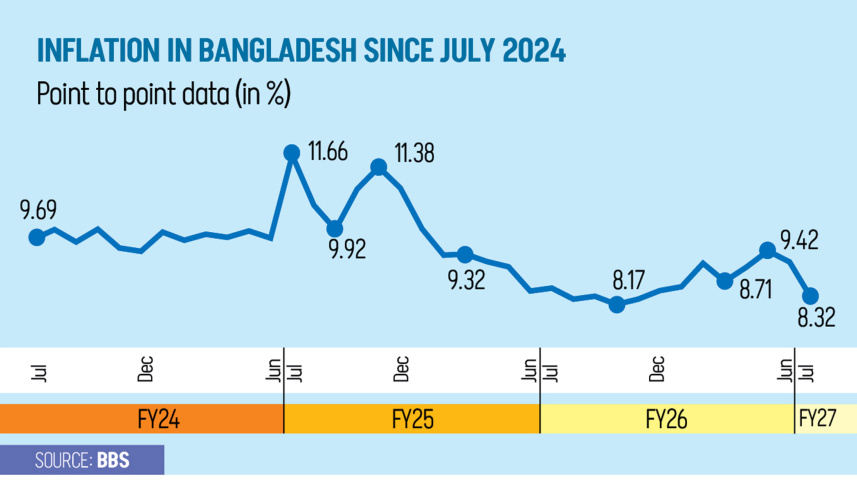
Inflation in July fell to its lowest level in eight months, driven by a sharp decline in food prices, according to official data, though economists said the easing may reflect normal fluctuations rather than a sustained cooling of price pressures.
Overall inflation fell to 8.32 percent last month from 9.16 percent in June, according to data released by the Bangladesh Bureau of Statistics (BBS) yesterday.

It was the lowest rate since November last year, when inflation stood at 8.29 percent.
In July, food inflation dropped to 7.16 percent from 8.60 percent in June, offering some relief to households struggling with the rising cost of essentials. Non-food inflation also eased, to 9.28 percent from 9.61 percent, according to data by the state-run statistical agency.
The latest figures come as households continue to grapple with higher fuel and electricity prices amid inflation hovering over the 8 percent mark for more than three years.
Fahmida Khatun, executive director of local think tank Centre for Policy Dialogue (CPD), said the decline is a positive sign but should be interpreted cautiously.
“The moderation reflects declines in both food and non-food inflation. However, electricity tariffs were increased last month, and the full impact of the higher tariffs may not yet have been reflected in July’s inflation,” she said.
“I think the full impact of higher electricity prices may not yet have been reflected in July’s inflation, as energy costs often pass through gradually to production, transport and other goods and services,” Fahmida said.
“Therefore, one month’s decline in inflation should not be seen as a decisive easing of price pressures. The trend needs to be observed over the next few months to get a clearer picture,” added the economist.
Food prices are particularly important for household budgets in the country, as a large share of household income goes towards food. The sharp fall in food inflation could therefore provide some immediate relief to consumers.
However, non-food inflation remained relatively high, indicating that price pressures persisted in areas such as housing, transport, clothing, healthcare and other services.
Moreover, the BSS reported rural inflation at 8.36 percent in July, down from 9.23 percent in the previous month. Inflation in urban areas stood at 8.24 percent, down from 9.01 percent in June.
Despite the latest decline, inflationary pressures remain elevated, particularly for non-food items, said Mustafa K Mujeri, executive director of the Institute for Inclusive Finance and Development (InM).
“Non-food inflation is still at 9.28 percent, so price pressures on people’s living costs remain quite high,” he said.
Mujeri cautioned against interpreting the latest figures as evidence of a sustained downward trend. “We have seen inflation move up and down in recent months without establishing a clear downward trend.”
He said, “We would like to see the moderation continue for several months before concluding that inflation is on a sustained downward trajectory.”
Seasonal factors and the base effect may also have contributed to the decline, Mujeri added.
He said that since point-to-point inflation compares prices in July this year with those in July last year, temporary factors and the base effect need to be considered when interpreting the latest figures.
“The latest decline can certainly be seen as a beginning or a positive sign. But it would be premature to conclude from one month’s data that the fundamental drivers of inflation have been brought under control. We may have to wait and see,” he said.
 For all latest news, follow The Daily Star's Google News channel.
Comments