


Extreme heat costs workers Tk 77,000cr a year: study


For Abdur Rahim, there is little escape from the heat. The construction worker spends long hours toiling under the open sky in Dhaka, where the intense summer heat leaves him exhausted and drenched in sweat.
His shirt sticks to his skin. There is no ceiling above him, let alone a fan.

Day off is not always an option for Rahim, who works in Adarshanagar area. His family depends entirely on his daily wages, so staying home means losing a day’s income.
Yet there are days when the heat becomes unbearable, and Rahim has no choice but to stop working. When he cannot work, he earns nothing.
He is among millions of workers affected by extreme heat in Bangladesh. Each year, heat-related wage losses cost workers as much as Tk 77,000 crore in income, with medical expenses adding to the burden.
The wage loss is equivalent to around 1.4 percent of GDP and could finance about 2.5 Dhaka metro rail projects each year.
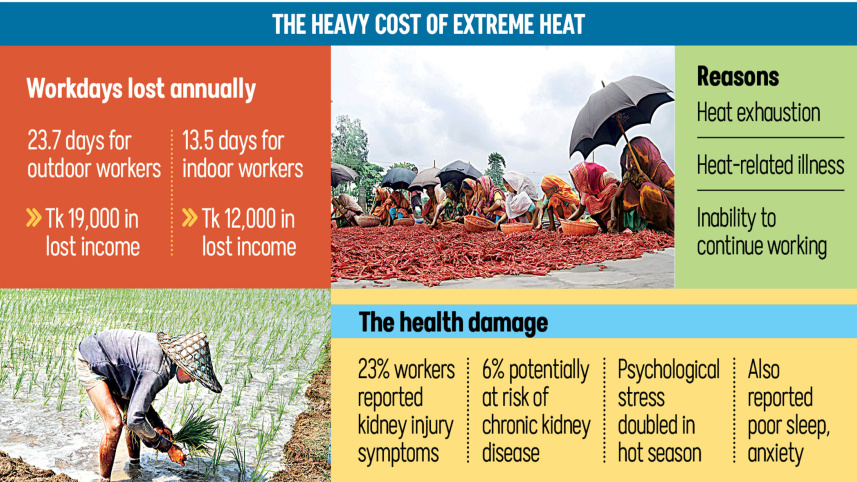
A recent study, titled “No escaping the heat: Health and economic impacts of heat stress on informal workers in urban Bangladesh”, found that workers exposed to extreme heat outdoors lose an average of 23.7 working days a year.
On the other hand, those working indoors lose 13.5 days.
The study was conducted between 2024 and 2026 by the UK-based International Institute for Environment and Development (IIED) and non-governmental organisation Ovibashi Karmi Unnayan Program (OKUP).
Researchers interviewed 175 households in Dhaka whose members were engaged in informal work, including construction, rickshaw pulling and garment manufacturing. Such workers account for 85 percent of the country’s workforce.
Of the interviewed households, 122 families were engaged in outdoor work such as construction, road work and rickshaw-pulling, while 53 were involved in indoor work, mainly in the garment industry.
Researchers also observed workers during work and rest periods and held group discussions, interviews and family case studies. A panel of three physicians reviewed the health findings.
The researchers combined the study findings with data from the National Labour Force Survey and regional temperature levels to estimate the national economic losses.
HEAVY TOLL ON INCOME AND HEALTH
The study found that increasingly severe heatwaves, driven by climate change, are taking a toll not only on worker income but also on their health and future livelihoods. Poor working-class families face the greatest burden because they depend on daily earnings to get by.
Many of these workers are construction labourers, rickshaw pullers and garment workers, with little or no opportunity to avoid working in extreme heat.
Workers in the outdoor and indoor groups said extreme heat had forced them to miss 24 and 14 days, respectively, of work a year.
Therefore, outdoor workers lost about 8.5 percent of their annual income, or Tk 19,000, while indoor workers lost 4.5 percent, or Tk 12,000, the survey found.
It said they could ill afford to lose those days because their earnings were already well below Dhaka’s living wage.
Moreover, nearly a quarter, or 23 percent, of respondents reported symptoms of kidney injury linked to repeated dehydration. Psychological stress doubled during the hot season. Workers also reported low mood, anxiety, irritability, sleep problems and making more mistakes at work.
 For all latest news, follow The Daily Star's Google News channel.
 Take for Rehana Akhter, a garment worker in Pallabi area of the capital. She said many workers suffer from kidney problems but hide their conditions for fear of losing their jobs.
“We cannot drink as much water as our bodies need in hot weather. During working hours, we usually limit our water intake because drinking enough water means frequent urgency to go to the toilet, which disrupts our work,” said Rehana.
“We also cannot sleep properly at night because of the oppressive heat,” she added.
The study found that heatwaves are deepening poverty.
Dhaka’s living wage is around $2,997 a year, but families of outdoor workers earn an average of just $1,756. Indoor workers earn $1,985 on average.
That leaves them 34 percent to 41 percent below the living wage even before accounting for heat-related losses.
After lost income is taken into account, their earnings fall to $1,607 and $1,896 respectively, widening the gap to 46.4 percent and 36.8 percent.
WHAT CAN BE DONE?
Ritu Bharadwaj, director of climate resilience, finance, and loss and damage at IIED, told The Daily Star that for these workers, heat exposure does not end when their shift ends.
They leave a hot workplace for a home with a tin roof, one fan and frequent power cuts, leaving them with little opportunity to recover, she said.
Working indoors offers no escape. Garment workers reported heat exhaustion at nearly the same rate as outdoor workers. The consequences included wage loss, kidney damage and sleep deprivation, and almost none of this is officially recorded, she said.
The researchers recommend integrating heat-related support into existing social protection schemes, including small daily cash transfers through mobile financial services targeted using national identification numbers.
Such measures would probably cost less than $100 million even in a record year, far below the economic cost of extreme heat.
They also propose seasonal mobile health camps because existing government health schemes do not adequately reach urban informal workers.
The study calls for mandatory protections against workplace heat.
Bangladesh’s Labour Act sets no safe temperature threshold and does not recognise heatstroke or kidney disease as occupational illnesses eligible for compensation.
Fahmida Khatun, executive director of local think tank Centre for Policy Dialogue (CPD), said Bangladesh must stop treating heat resilience merely as a welfare issue.
She said labour regulations should establish enforceable standards for drinking water, shade, ventilation and adequate rest during extreme heat, while recognising heat-related illnesses as occupational risks.
Climate-responsive social protection should provide temporary income support to informal and daily-wage workers when extreme heat disrupts their livelihoods, she said.
“The cost of inaction is likely to exceed the cost of adaptation,” said Fahmida.
Apart from Ritu Bharadwaj, N Karthikeyan, Swati Chaliha, Shakirul Islam and Urmi Jahan Tanni were also involved in the research. The findings are scheduled to be disclosed officially today.
Comments