


When did violence become so normal in Bangladesh?

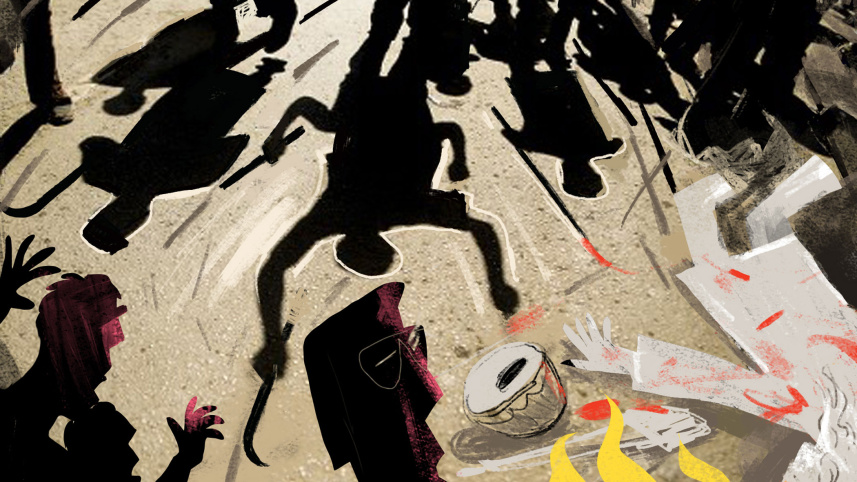
These days, opening Facebook can feel grim. Before you have properly taken in one horrible story, another is already there. A seven-year-old child in Jamalpur was raped and murdered, police say. At a madrasa in Savar, another seven-year-old was allegedly sexually abused for months. In Rangpur, retired schoolteacher Ganapati Chakrabarty, his wife and their two children were killed. In Khulna, a university student was beaten over an allegation of theft and later died. These are not stories from somewhere far away. They are from Bangladesh, and they have all come within weeks of one another.
Ishiat Shahriar Oprotim’s death last week is especially hard to process. The 13-year-old son of a Comilla University teacher went out carrying his mother’s iPhone. His body was later found in Lalmai Hill. Police say there had been a plan to take the phone and he was attacked when he resisted.

The government cannot avoid its responsibility here. The BNP-led government took office on February 17, 2026. More than six months have passed. The home minister says law and order has visibly improved. Yet that is not quite how the situation looks from the street. A Prothom Alo review published on August 19 found that the sense of security people expected after six months of the new government had still not fully returned. The state cannot define success only through official crime data, or how quickly it arrests someone after a killing. The more basic job is to create a country where, for instance, a child can leave home and be expected to return safely.
The security concerns, however, predate the current government. During the interim government, Tofazzal Hossain was beaten to death at Fazlul Huq Muslim Hall of Dhaka University after students suspected him of stealing mobile phones. He was beaten, fed, and then beaten again. In 2025, it was Nurul Haque’s case (also known as Nural Pagla); his grave was dug up and the body was burned. Later that year, garment worker Dipu Chandra Das was beaten to death after being accused of insulting religion. RAB later said it had found no evidence that he had made such remarks.
The same pattern of crime can be found going back further, to the Awami League years. And I do not think crimes like mob violence suddenly appeared after August 5. They did not. But something did change after August 5, and simply calling what we are seeing a “law-and-order problem” does not quite capture it.
The question bothering me is more basic. How does a society arrive at a point where 20 people can beat one person while another 50 stand around watching? Some film it. Some encourage it. And once the person is dead, somebody still finds a way to say: he was a thief, he said something about religion, he must have done something.
That, to me, begins to look like dystopia.
I do not mean dystopia in the cinematic sense, with burning streets and a collapsed state. It can be much quieter than that. It begins when things that should horrify us start becoming routine. One rape story is followed by another. Before one mob-killing video has disappeared from the feed, another arrives. We are horrified for a while, perhaps angry, and then we scroll down. Something that should trouble a society for months survives for a day in the news cycle.
Michel Foucault’s idea of governmentality—how governance over time can shape people to willingly self-govern and control their behaviour—can somewhat explain the change. No society has a police officer standing beside every citizen. Most of us don’t base our decision to hurt someone on whether the police are watching. There are boundaries inside us as well. Family, school, teachers, religion, neighbourhood, culture, journalism and politics all have some role in drawing those boundaries.
If I suspect somebody of stealing, I may want that person handed to the police. That is very different from believing I am entitled to beat him to death. Somewhere between those two responses sits a social limit. A functioning society depends on millions of such limits. And I think that part of our social life has weakened.
If 10 people in a neighbourhood believe that even a thief cannot be beaten to death, the 11th person will find it harder to gather a mob. If teachers and administrators at a madrasa understand that hiding child sexual abuse protects the abuser rather than religion or the institution, the space available to an offender becomes smaller. The law matters, of course. But so do the brakes people carry inside themselves.
French sociologist Émile Durkheim had a word that helps explain another part of this shift: anomie. People obey rules partly because punishment exists, but also because those rules make sense to them and carry some moral authority. Trouble begins when the old rules have lost that authority and nothing broadly trusted has taken their place. The rules still exist, but people simply stop being sure who has the right to enforce them, or even where the limits really are.
Bangladesh over the past several years often looks like that to me. During the long Awami League period, state institutions, particularly the security apparatus, became deeply politicised. When people watch power bend rules for too long, the outcome does not stay inside ministries and police stations. It travels.
Then came the rupture of 2024. The old order was gone, but that did not mean a new one had suddenly taken root. Institutions were unsettled, the police were weak, and politics remained intensely charged. In that gap, the problem became much harder to ignore. The interim government failed, in my view, to cool that atmosphere quickly enough. Mob violence needed to be treated from the beginning as something politically, legally and morally unacceptable. Yet Tofazzal happened. Nural Pagla happened. Dipu happened. And the interim’s response was often slow.
When the elected BNP government took office in February 2026, it inherited a weakened police force, political instability and a serious mob problem. That inheritance is real, but after more than seven months, it cannot be used as an explanation for everything. The government now controls the administration and the coercive power of the state. Public safety is therefore its responsibility.
There is another part of the problem that bothers me just as much. We do not merely witness violence. We often build stories around it that make it easier to live with. Someone is killed on suspicion of theft, and somebody says, “He was a thief anyway.” A rape happens, and attention shifts to the victim’s family, clothing, or behaviour. Abuse is alleged inside a religious education institution, and some people worry first about the reputation of the institution. If the accused belongs to a political camp, a “but” suddenly appears, and that “but” matters.
One person commits the violence. The society creates the language that excuses the crime. And once the excuse becomes familiar, the barrier to the next act of violence is lowered, making it easier to happen again.
So, when I ask how we became this kind of society, I keep returning to three ideas: governmentality, anomie and dystopia. They are connected in a fairly simple way. Society depends partly on people governing themselves and recognising limits. When confidence in those limits weakens, anomie grows. And when violence, distrust, revenge and the cheapening of human life settle into everyday life, dystopia no longer feels like a fictional word.
It is not only the state failing. Society is failing too. The state is struggling to protect vulnerable people. At the same time, parts of society are finding ways to explain why the vulnerable somehow deserved what happened to them.
Perhaps we need to look up from the individual headlines for a moment and look at the society producing them. Dystopia does not begin simply because people are being killed. It begins when the state cannot keep them safe, society loses the instinct to protect them, and after seeing enough death, we slowly stop finding death unusual.
 For all latest news, follow The Daily Star's Google News channel.
 Asif Bin Ali is a doctoral fellow at Georgia State University in the US. He can be reached at abinali2@gsu.edu.
Views expressed in this article are the author's own.
Follow The Daily Star Opinion on Facebook for the latest opinions, commentaries, and analyses by experts and professionals. To contribute your article or letter to The Daily Star Opinion, see our guidelines for submission.
Comments