


‘A strong Bangladesh needs social cohesion and a shared vision beyond politics’

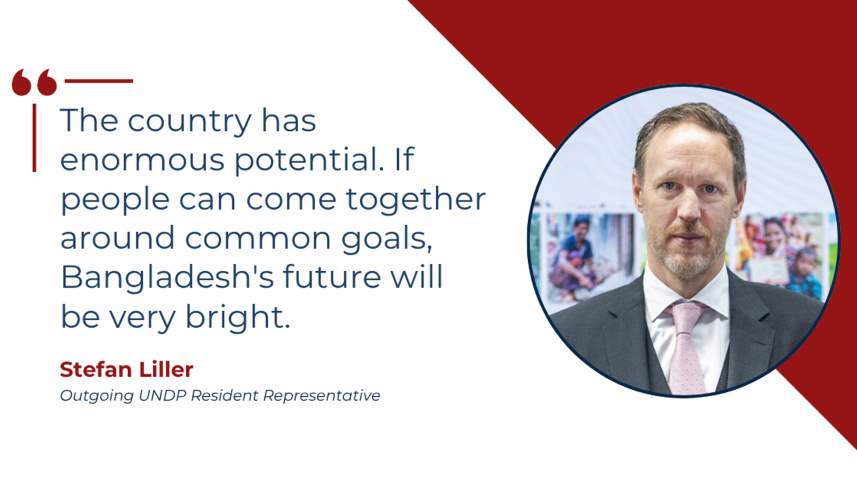
Outgoing UNDP Resident Representative Stefan Liller has been in Bangladesh for the last four years. In an interview with Porimol Palma of The Daily Star, he talks about Bangladesh’s political transition, development trajectory, and renewed aspirations for reform.
What is your overall impression of Bangladesh as you complete your tenure?
 For all latest news, follow The Daily Star's Google News channel.
 The UNDP has been present in Bangladesh since its independence, and our work has evolved alongside the country’s needs. Initially, our focus was on rehabilitation and institution-building, which has now evolved to climate action, digital transformation, governance, and economic development.
As time passed, we saw a growing sense of concern regarding civic space, accountability, and governance. These tensions eventually culminated in the July uprising and subsequent political transition. The aspirations expressed by young people were incorporated into the interim government’s reform agenda, and at its request, the UNDP provided support in areas such as electoral reform, judicial reform, and anti-corruption initiatives. Over the past two years, we have worked closely with national institutions to advance these reforms.
How is the reform drive progressing?
There has been meaningful progress, particularly in governance-related areas. We have seen advances in judicial independence and efforts to improve efficiency within the justice system. Work is also underway to strengthen institutions such as the National Human Rights Commission and the Anti-Corruption Commission, and to promote merit-based recruitment within the civil service.
What is particularly encouraging is the strong public demand for accountability and fairness, especially among young people. Through the consensus-building process, political parties demonstrated support for a number of core governance reforms. However, responsibility for carrying these reforms forward now rests with the elected government, which must determine how best to institutionalise and sustain them.
The government is busy dealing with immediate crises rather than pursuing deeper reforms. Also, poverty and inequality are on the rise. How should these priorities be balanced?
Bangladesh’s development story over the last four decades or so has been remarkable. The country became a global example of how poverty reduction and economic growth can be achieved despite significant challenges. However, recent years have been difficult. The effects of the Covid-19 pandemic, global inflation, supply chain disruptions, and rising fuel prices have created a challenging environment. Economic growth slowed, inflation increased, and many vulnerable households have faced additional pressures.
The government is, therefore, dealing with a “perfect storm” of economic and social challenges. Issues such as food security, energy supply, and inflation understandably require immediate attention. Addressing these urgent concerns, however, does not mean abandoning long-term reforms. Rather, governments must pursue both tracks simultaneously. Initiatives such as digital support systems for farmers demonstrate how immediate challenges can be addressed while also laying the groundwork for longer-term transformation.
Bangladesh is currently preparing for LDC graduation (regardless of any deferment) while development assistance is declining. How can the country navigate this transition?
Bangladesh is graduating from the Least Developed Country (LDC) status because of its success, and that should be recognised as a major achievement. However, graduation also presents new challenges. As preferential trade benefits gradually decline, Bangladeshi products will face increased competition in international markets. This means the private sector must become more productive, innovative, and diversified. Competing solely on low costs will no longer be sufficient. The government has already developed a smooth transition strategy, which is encouraging. The risk lies in not implementing these preparations effectively and quickly enough.
At the same time, development assistance globally has declined significantly. Funding reductions have affected sectors such as climate adaptation, health, and development cooperation. For Bangladesh to sustain its progress, domestic resource mobilisation will become increasingly important. The country’s tax-to-GDP ratio remains among the lowest in the world, limiting the government’s ability to invest in critical sectors such as health, education, and social protection. Greater private investment, stronger regional trade partnerships, and increased economic diversification will be essential to future growth.
Youth unemployment remains a serious concern. What solutions do you see?
The challenge is not simply creating jobs, but creating decent, productive, and sustainable jobs. A significant proportion of university graduates remain unemployed, while a large share of the economy continues to operate informally. The private sector must remain the primary engine of job creation. To support this, Bangladesh needs policies that encourage entrepreneurship, attract foreign investment, and reduce unnecessary barriers to business. At the same time, there is currently a clear mismatch between the skills many graduates possess and the skills employers require. Closing this gap requires substantial investment in education, training, and lifelong learning.
How can the international community continue supporting Bangladesh if aid is declining?
International cooperation remains important, even as funding levels change. Our role is not simply to provide financial resources but also to share global experience, technical expertise, and innovative solutions. Ultimately, neither the UN nor the government can create jobs on their own. Sustainable employment comes from a vibrant private sector operating within a supportive policy environment. Our role is to help governments strengthen institutions and create conditions that enable inclusive growth.
Bangladesh is highly vulnerable to climate change, yet climate finance remains inadequate. Why?
Bangladesh contributes less than one percent of global greenhouse gas emissions, yet it is among the countries most exposed to climate impacts. During my travels across the country, particularly in coastal districts such as Satkhira, I have witnessed first-hand how climate change is affecting livelihoods, homes, and entire communities. The financing gap remains enormous. Bangladesh is already investing billions of dollars in adaptation measures, but the scale of future needs is much greater. Closing this gap will require a combination of international climate finance, private investment, green financing instruments, and innovative blended-finance mechanisms.
Is there any realistic prospect of Rohingya repatriation in the near future?
The people of Bangladesh have shown remarkable generosity in hosting the Rohingya population. However, the burden on local communities, particularly in Cox’s Bazar, remains substantial. Unfortunately, funding reductions and ongoing instability in Myanmar have made the situation even more difficult. The only durable solution remains a political one that allows for safe, voluntary, and dignified repatriation.
In the meantime, the international community must continue sharing responsibility. Development efforts should focus not only on refugees but also on the wider host communities. Investments in infrastructure, climate resilience, education, and livelihoods can benefit the entire district while reducing pressure on local resources.
What would you recommend as you leave Bangladesh?
Continue pursuing reforms while promoting inclusion, transparency, and sustainability. A strong and prosperous Bangladesh will require social cohesion and a shared national vision that extends beyond political cycles. The country has enormous potential. If people can come together around common goals, Bangladesh’s future will be very bright.
Follow The Daily Star Opinion on Facebook for the latest opinions, commentaries, and analyses by experts and professionals. To contribute your article or letter to The Daily Star Opinion, see our guidelines for submission.
Comments