


Policing cannot replace the community safety net our children need

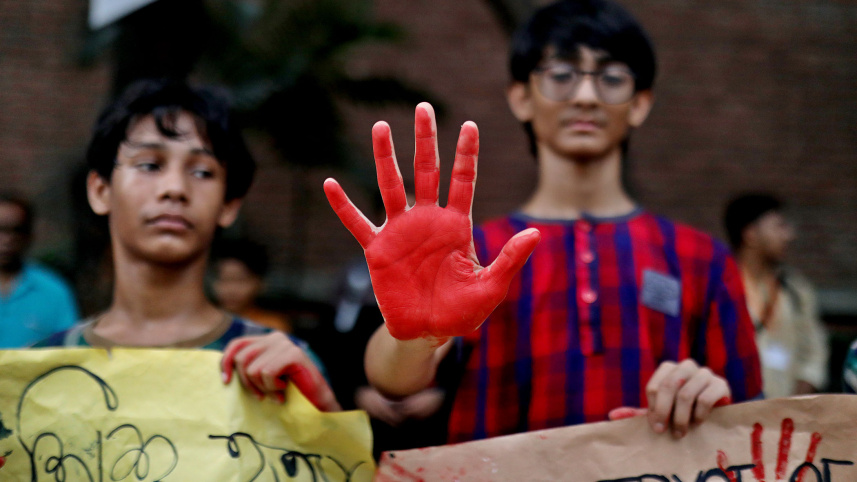
The tragic death of a Comilla University teacher’s 13-year-old missing son, Ishiat Shahriar Opratim, is one among a series of similar cases that occurred in recent times. What we are essentially witnessing is a profound structural shift in our society. According to data from the Police Headquarters, 15,717 children were reported missing between January and July this year, of whom 13,679 were rescued and/or returned to their families.
Given the alleged involvement of teenagers in Opratim’s case, juvenile delinquency has become a widely discussed topic over the past couple of days. The disappearance of teens in particular is seen to stem from emotional distress, academic pressures, family disputes, peer influence, and fear of consequences after engaging in unethical behaviour. These factors are further compounded by their desire for unrestrained independence, manipulative attempts to exact concessions from families, and a breakdown in core societal and moral values. Public discourse routinely focuses on law-enforcement failures, which is valid. But there is also a more systemic crisis that has resulted from the breakdown of traditional, endogenous security systems, under pressure from the push to practise neoliberal modernity, individualism, and aggressive consumerism.

To understand why our society is growing progressively more vulnerable, we must examine how security was historically maintained in Bangladesh. For generations, our communities relied on an endogenous security framework—an organic system built on mutual surveillance, shared social responsibility, and deep-seated empathy. In traditional rural and semi-urban neighbourhoods (para and mahalla), people knew one another well. An unfamiliar face or an unusual gathering of teenagers would immediately draw the collective eye of the community. People actively looked out for one another’s children, providing a built-in safety net grounded in shared values. Security was not an external commodity bought from private agencies or provided exclusively by the state. It was rather generated internally within the social fabric of a neighbourhood.
However, rapid urbanisation and neoliberal economic structures have dismantled this form of internal resilience. Neoliberalism emphasises individual achievement, market competition, and self-interest over collective well-being. As a result, Bangladesh has collectively shifted away from community-centric living and towards extreme individualism. The modern social landscape is increasingly defined by hyper-competition, displays of social status, and a relentless race for increasing one’s purchasing power.
This cultural shift has severely eroded our collective empathy. In urban high-rises and dense neighbourhoods, the traditional social eye has been replaced by indifference. People no longer intervene when they see a neighbour’s child in distress or surrounded by suspicious individuals, viewing such situations through the lens of “not my business.” This atomisation creates an ideal environment for criminals, local gangs, and kidnappers to exploit the absence of community-based vigilance.
Further compounding this social fragmentation is intense political division and economic polarisation. Political patronage and factionalism have deeply fractured local communities, making collective action and mutual trust hard to establish. Meanwhile, the desperate competition over material status and consumption drives young people into precarious situations, thus fuelling instances of juvenile delinquency, extortion, and violence.
As the traditional endogenous security mechanism crumbles, society is forced to rely on an exogenous security system—formal policing, state surveillance, and legal frameworks introduced or modelled after those of foreign institutions. However, this exogenous system is profoundly mismatched with the structural reality in Bangladeshi communities.
In many Western or advanced East Asian urban spaces, exogenous security operates through massive technological infrastructure, ubiquitous CCTV networks, rapid response systems, and well-equipped police forces. Most importantly, law enforcement agencies in these countries are highly skilled and can work without political interference. But in a densely populated, resource-constrained developing nation like Bangladesh, the state machinery simply lacks the capacity, technology, and manpower to monitor every alleyway or protect every citizen.
Consequently, Bangladesh finds itself trapped in a dangerous hybrid security paradox. We have largely abandoned our traditional, community-based endogenous security practices for the sake of assimilating into a more modern societal structure, but our formal exogenous security apparatus is not equipped to fill the void left behind by the new lack of community vigilance. Thus, we are caught between a lost tradition of mutual care and incomplete infrastructures of state protection.
The violence inflicted on our youth of late is a crude reminder that technology and state policing alone cannot replace the protective mechanisms of a close-knit community. If we continue to embrace unchecked consumerism, political polarisation, and social indifference we will leave our future generations exposed to this growing vulnerability, without an adequate formal protection system to turn to.
Relying solely on a basic Base Transceiver Station (BTS) mobile tower address is insufficient for locating missing individuals. Analysing passive location data, such as cell updates, data sessions, and handover logs, helps narrow down search zones much faster. The tragic outcome of the recent missing child’s case in Cumilla underscores the urgent need for a technical post-action review and sophisticated investigation methods. Considering the contextual reality and responding effectively, the government should employ a specialised, 24/7 missing child response unit of law enforcement, equipped with telecom analysts, digital forensics experts, and field teams. Integrating real-time network tracking with CCTV footage analysis and cross-agency coordination is necessary to save lives during the vital initial hours after a child goes missing.
However, reclaiming our security requires more than just equipping law enforcement with special tools and technology. A conscious effort to rebuild our social fabric is needed. We must foster civic engagement, encourage neighbourhood cohesion, and reintegrate values of mutual accountability into our urban planning and social life. Only by combining modern law enforcement capabilities with the empathetic, community-driven vigilance of our past can we begin to build a society where our children will be safer.
Dr Sazzad Siddiqui is professor and chairman at the Department of Peace and Conflict Studies in the University of Dhaka. He can be reached at sazzadhsiddiqui@du.ac.bd.
Views expressed in this article are the author's own.
Follow The Daily Star Opinion on Facebook for the latest opinions, commentaries, and analyses by experts and professionals. To contribute your article or letter to The Daily Star Opinion, see our guidelines for submission.
 For all latest news, follow The Daily Star's Google News channel.
Comments