


Oprotim's killing and the growing fear for our children’s safety

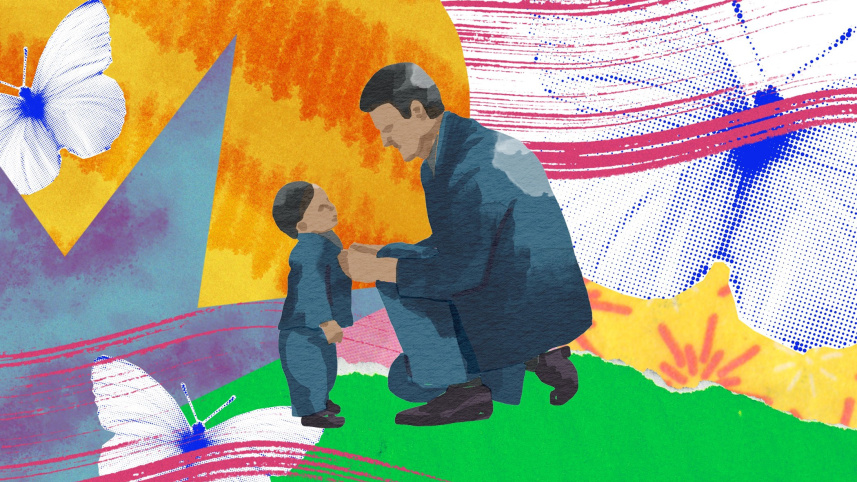
My three-and-a-half-year-old son has recently started going to school. There, as children his age do, he draws, sings, recites, plays and, importantly for his parents, eats his breakfast. Since I am temporarily living more than 8,000 miles away, I encounter these small events through a screen. I ask what he drew or sang that day. Sometimes he answers; sometimes he takes our conversation somewhere else. One day, however, he told me that he had drawn a ghost. He likes cartoons with ghost-like characters. They frighten him, but he still watches, partly covering his eyes and peeking through his fingers. He now often tells me that he has drawn a ghost, whether or not he has. It is one of his ways of playfully teasing me.
In recent days, however, another ghost has entered our conversations. It is not imaginary, and it cannot be made to disappear by closing one’s eyes. The killing of Oprotim in Cumilla has unsettled parents across Bangladesh. Oprotim, a seventh-grade student, went missing after leaving home and was later found dead in a secluded area of Lalmai. According to the police account, he was taken there as part of a plan to steal the phone he was carrying and was killed when he resisted. For a parent living abroad, such details collapse the distance between a news report and one’s own child. To live far from one’s young child is to experience parenthood in a peculiar form. Love remains immediate, but the ability to act becomes remote. I can see my son eating, drawing, or playing on a video call. I can remind him to listen to his mother or be careful. But I cannot hold his hand on the way to school. If he becomes sick, frightened, or endangered, every mile between us suddenly becomes visible. Digital communication allows an expatriate parent to witness family life, but witnessing is not the same as being present.

That distance also distributes the burdens of parenting unequally. My wife is a working mother with professional, household, and parental responsibilities. Yet she must arrange her day around taking our child to school and bringing him home. What might look like a routine logistical problem has become a question of safety. Can someone else be trusted to accompany him? What if she is delayed at work? From abroad, I share the anxiety but cannot share enough of the physical work it creates. I can call, advise, and worry. She must make the daily arrangements and bear the pressure. The other day, my wife told me that her elder sister had forwarded her a voice message. In it, a woman described how someone had allegedly tried to snatch her child at a hospital while she was speaking to a doctor. We do not know whether the account was true. The recording came with no identifiable source, supporting evidence, or link to a reliable report. Yet such stories move rapidly across social media, passed from one anxious parent to another. Their uncertainty does not make their psychological effects unreal. Once an actual tragedy has shown that the unthinkable can occur, even an unverified warning sounds plausible.
This places parents in a difficult position. They know that social media can spread rumours and fabricated stories. They also know that dismissing a genuine warning could carry an unbearable cost. Parenthood changes how risk is calculated. When the possible harm is the loss of a child, even a low-probability claim commands attention. Parents become afraid to look away, allow a child to travel with another person, or trust an ordinary public setting. One might describe this as private anxiety and advise parents not to panic. There is some truth in this response. But it assumes a degree of confidence in public institutions that many parents no longer have. A parent can disregard a rumour only when she has reason to believe that, if the danger is real, the police, the school, the hospital, or the news media will provide reliable information in time. When that confidence is absent, even a doubtful voice message acquires practical importance. It may not count as evidence, but it becomes a warning that a parent feels unable to ignore.
The experience of expatriate parents deserves particular attention within this wider climate of uncertainty. Bangladesh understandably celebrates remittances as a pillar of its economy. Bangladesh Bank’s figures show that workers abroad continue to send billions of dollars home, supporting families and strengthening the country’s external position. But public discussion often reduces expatriates to their economic function. We are praised as remittance earners, while the emotional cost of expatriate life remains largely invisible.
This does not mean that the children of expatriates possess a greater claim to protection because their parents send money home. Every child has an equal right to safety, regardless of a family’s contribution to the economy. Nor can any government guarantee that no crime will occur. The relevant demand is more precise. A state must create conditions in which parents can reasonably send their children to school, allow them to travel, take them to hospitals, and let them move through their neighbourhoods without constant fear. Schools need clear arrival and departure protocols. Police need rapid and accessible mechanisms for reporting a missing child and communicating verified information. Public authorities and responsible media must address dangerous rumours quickly, neither amplifying them nor dismissing the anxieties that make them credible. Ultimately, the question is whether parents can still treat ordinary life as ordinary.
When my son next tells me that he drew a ghost, I hope I can laugh and ask what colour it was. Beneath that laughter, the fear may remain. But I will still have his voice. I will still wait for our next video call, ask what he drew at school, and look forward to the day when I can hold his hand again. Oprotim’s parents have been robbed of every such “next.” For them, fear is no longer the possibility of a telephone call carrying terrible news; it is the permanent silence that follows it. The child whose presence shaped their ordinary days will not return home. No account of an arrest, investigation, or punishment can fully contain that loss.
Dr Kazi ASM Nurul Huda is associate professor of philosophy at Dhaka University and Zuzana Simoniova Cmelikova Visiting International Scholar in Leadership and Ethics at Jepson School of Leadership Studies in the University of Richmond, US. He can be reached at huda@du.ac.bd.
Views expressed in this article are the author's own.
Follow The Daily Star Opinion on Facebook for the latest opinions, commentaries, and analyses by experts and professionals. To contribute your article or letter to The Daily Star Opinion, see our guidelines for submission.
 For all latest news, follow The Daily Star's Google News channel.
Comments