


We tell women to speak up, but who defends them when they do?

Within a little over two weeks, three women died under circumstances that harshly exposed a familiar failure: our inability to protect women from violence within marriage. Before Mukta Islam died on September 3, a video showed her chained to a bed and beaten with a belt. Her husband had sent the footage to her brother. Two days before Al Maida Akter died on September 10, she sent her cousin a photograph of her injured face and said her husband had beaten her again. On September 20, 19-year-old Mariam Khatun was found hanging in a flat in Dhaka. Her father has accused her husband, Satkhira-4 MP Gazi Nazrul Islam, his first wife, and another relative of abetting her suicide. At the time of writing this article, Nazrul Islam was on a four-day remand.
Domestic violence in Bangladesh is hardly an undocumented problem. The latest national Violence Against Women Survey, conducted in 2024 and published in 2025, found that more than 70 percent of women had experienced some form of intimate-partner violence in their lifetime, of whom some 64 percent of survivors told no one. Among the surveyed survivors, only 7.4 percent had taken legal action. This gap between abuse and action, as presented by the data, should worry us as much as the prevalence of the practice itself, but silence is only part of the story. Between January and August this year, the national emergency service 999 received 27,911 complaints concerning violence against women. Of them, 17,196—nearly 62 percent—were against husbands. This translated to roughly 115 complaints a day. Of these, around 71 concerned abuse by husbands. The numbers also show that women do speak up. The families know, at times the relatives know, and sometimes neighbours know as well. There are photographs and videos available as evidence. Sometimes there has already been a salish involved for private mediation. Sometimes the police have also been notified. But, what happens after that?

While the usual awareness action call is to urge women to speak up against domestic abuse, it is not necessarily an effective or complete one. The BBS national survey itself tells us why many women stay silent: fear, stigma, family honour, children, economic dependence, and the normalisation of violence within marriage. But even when a woman does speak up, that does not mean she is safe. The family would get involved for a time. Police may intervene in an escalated incident. A hospital may treat an injured woman. A helpline may advise her. Children might be used as bait to make her return to the husband. She may even go back to her abusive husband. And then the cycle begins, with all the previous enabling conditions of domestic abuse still in place.
Bangladesh has laws and institutions for these vulnerable women too, at least on paper. The Domestic Violence (Prevention and Protection) Act, 2010 provides for interim protection orders, protection orders, residence-related relief, and compensation. Applications can also be brought by an enforcement officer, service provider, or another person on behalf of the survivor. There is also the National Emergency Service 999 and the 109 national helpline for violence against women and children. There are police, legal aid services, One-Stop Crisis Centres, and crisis cells. On the surface, there are multiple channels a victim of domestic abuse might seek protection. In fact, the very fragmentation of the wider system often becomes a bottleneck in the effective intervention mechanism.
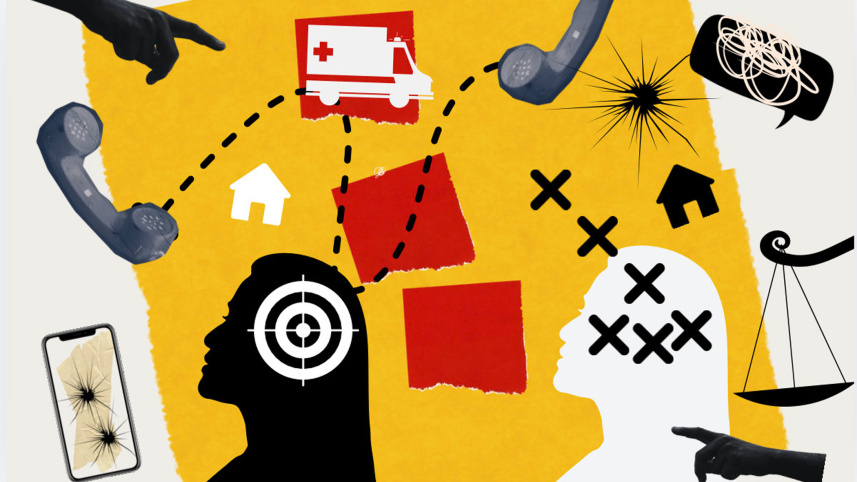
Repeated domestic violence is not usually a single event, it develops as a pattern. But institutions and authorities often encounter these as isolated episodes. A hospital treats one injury. Police responds to one complaint. A helpline answers one call. A family takes the woman back home for the time being. But the problem is that no single authority visibly owns the entire safeguarding chain—from the first signs of abuse to ensuring a woman’s long-term safety. This matters because risk does not end when the ongoing incident does. Threats become more serious. A woman may be returning to the same home, the same abuser, the same conditions that produced the first complaint.
The systemic weakness becomes even harder to ignore once cases enter the courts. As of December 31, 2025, at least 132,107 cases were reportedly pending before the country’s 99 Women and Children Repression Prevention Tribunals. More than 30,000 had been pending for over five years. These are not domestic-violence-only cases, but they show what the wider justice machinery looks like for women whose cases do reach that stage. A joint Supreme Court-Brac study, examining 4,040 disposed cases, found that proceedings took an average of 1,370 days, about 3.7 years, and were scheduled for an average of 22 hearings. Only 3 percent ended in conviction. The study identified delayed investigations, repeated adjournments, evidentiary weaknesses, and the absence of complainants and witnesses as major obstacles to successful prosecution, alongside inadequate witness protection.
There has been some progress. The 2024 Violence Against Women Survey, conducted by the Bangladesh Bureau of Statistics (BBS) in collaboration with UNFPA, found that 41 percent of women had experienced intimate-partner violence in the previous 12 months, down from 55 percent in 2015.
But we must treat this number with caution. It should not make us less demanding about what happens to a woman once abuse is reported or shared. Mukta’s video was information, so was Maida’s photograph. The allegations that have come to light now surrounding Mariam’s death were symptoms of the domestic abuse she was enduring. Whether different interventions would have prevented any of these deaths, we would never know. But the point remains: no one intervened.
What women need is simple. They need to be assured of the authorities accountability and their responsibilities, scopes, and remits once an abuse incident is escalated. They need to know clearly what support they have access to if they fall victim to domestic abuse. When a woman says she is being beaten, when there is evidence that the violence has taken place, who becomes responsible for what happens to her next?
An escalation is not protection, as we have seen so many times before. On the contrary, more often than not, it is a heightened risk for the victim and her family from the abusers’ and their enablers. An arrest after a woman has died is certainly not the solution.
For years, Bangladesh has promulgated laws, built helplines, and launched specialised services to respond to violence against women. What we have not done is test their efficacy, build an effective safeguarding system, and developed accountability around these frameworks. That is a systemic governance failure. What should worry us is the absence of ownership once abuse is reported or escalated and the fragmentation in the safeguarding mechanism. Too often, responsibility is overlapped between the family, police, hospitals, and courts, while the woman herself remains exposed to the same danger. If that gap is not fixed, the system will continue to enable domestic violence rather than safeguard the abused.
Tasneem Tayeb works for The Daily Star. Her X handle is @tasneem_tayeb.
Views expressed in this article are the author's own.
Follow The Daily Star Opinion on Facebook for the latest opinions, commentaries, and analyses by experts and professionals. To contribute your article or letter to The Daily Star Opinion, see our guidelines for submission.
 For all latest news, follow The Daily Star's Google News channel.
Comments