


Keeping the July uprising’s promise alive needs a vigilant public

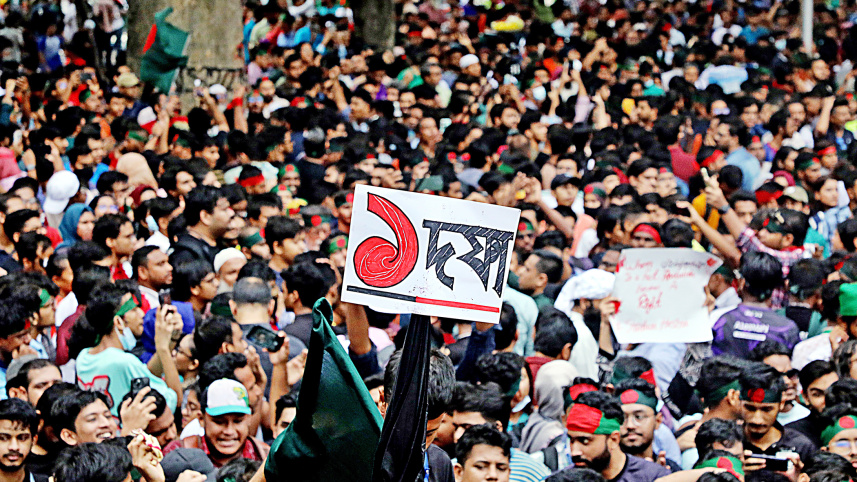
There is no doubt that the July Mass Uprising marked the beginning of a new chapter in Bangladesh, representing a powerful expression of the people’s enduring capacity for resistance.
Before it came the 1969 mass uprising, followed by the 1990 mass uprising. In the years leading up to each of these moments, we repeatedly heard claims of development from the ruling regimes. Yet, just as Ayub Khan’s “Decade of Development” ended with the 1969 uprising, and Ershad’s development decade ended with the 1990 one, Sheikh Hasina’s extended era of economic and infrastructural achievements also came to an end through another uprising. Why, one may wonder, did such progress fail to secure lasting public support for any of these regimes?

The answer is simple. In all three cases, the so-called progress was accompanied by the erosion of democratic rights and increasingly authoritarian rule. Over time, this produced anger, resentment, and a growing determination to resist deprivation and oppression. As a result, the development narrative gradually lost its credibility. It was this disconnect between material development and political repression that ultimately gave rise to popular resistance.
We have previously discussed the background to the 2024 uprising. Prolonged rule without fair elections, combined with the plundering of public wealth, corruption, capital flight, and widespread repression across society, created a reservoir of collective anger, resentment, and despair. That ultimately exploded in the form of a mass uprising, especially when the government responded to peaceful protests with mass killings. Once again, it became an expression of the people’s collective strength.
At the same time, the uprising created a new public consciousness and raised expectations. People started to believe that the injustice, oppression, corruption, looting of public wealth, and marginalisation of citizens, as witnessed during the Hasina era, would not be repeated. They hoped that a democratic system would emerge and that the country would move towards a more inclusive society, free from injustice and discrimination. These aspirations defined the aftermath of the uprising. An interim government remained in office for a relatively long period, and we now have an elected government.
However, two years after the July uprising, we can see that much of the enthusiasm, emotion, and hope associated with it has faded. We also hear of growing disappointment and frustration from many who participated in the movement. The reasons behind this are identifiable.
First, after the July 2024 uprising, we came to see the alarming rise of a new form of fascistic dominance. Both online and offline, there has been increasing intolerance and violence, including public death threats, abuse of children, threats and attacks against religious minorities and dissenting voices, violence against women, and attacks on people of diverse gender identities. We have also continued to see false cases, arbitrary arrests, detention without trial, torture by state agencies in different places, and deaths in police custody.
Second, during the interim government’s tenure and even afterwards, we witnessed mob attacks on shrines, temples, bauls, and Liberation War murals and sculptures, the cancellation of musical performances, the banning of plays, and even the killing of people in the name of religion. There were also attacks on Prothom Alo, The Daily Star, Udichi, and Chhayanaut. Yet, there has been no comprehensive investigation into these incidents, nor any meaningful effort to bring the perpetrators and those who incited them to justice.
Third, another issue that has raised serious public concern—continuing an earlier pattern—is the signing of international agreements which are contrary to the public’s best interest. During the interim government’s tenure, several agreements were concluded in a largely non-transparent and unjustifiable manner, allegedly compromising national security and interests. Among them, the port agreement is particularly significant. Other examples include agreements with Starlink, LNG import agreements, and the trade agreement with Japan. All of these were concluded with very little transparency, keeping the public in the dark. Perhaps the most concerning was the reciprocal trade agreement with the United States, signed just three days before the February 12 national election.
The manner in which these deals were concluded also raised questions about the role of major political stakeholders. Since the elected government took office in February, we have seen that every party represented in parliament has remained conspicuously silent on these issues. This is one area where the government and the opposition seem to be in complete agreement, despite their disagreements on almost every other issue. Such consensus over agreements perceived to be contrary to the national interest has further deepened public disappointment and reinforced the sense that the aspirations of the uprising have been betrayed.
Fourth, we are witnessing decisions on megaprojects being taken without public consent, meaningful public participation, or adequate review of past experiences. We have heard of the government making clear commitments regarding the Teesta Master Plan and the Padma Barrage. But what we have not seen is any serious effort to examine the concerns previously raised about such megaprojects or to conduct the necessary evaluations that should precede them. Before proceeding with the Padma Barrage, for example, the experience of the Farakka Barrage should be carefully reviewed. The experiences of the Teesta Barrage and the Ganges-Kobadak Irrigation Project should likewise be taken into consideration. Additionally, the concerns raised so far by experts deserve careful attention and substantive responses.
Under previous governments, we repeatedly saw authorities ignore the opinions of responsible experts and dismiss public concerns while continuing to undertake one disastrous megaproject after another, including Rampal and Rooppur. We do not want to see that pattern repeated again.
Fifth, during the 2024 mass uprising, we saw graffiti highlighting many forms of discrimination, including class, religious, ethnic, and gender discrimination. However, the positions adopted by both the government and the opposition do not suggest any serious commitment to addressing these inequalities.
These, in short, are the developments that concern us and make us apprehensive about the eventual legacy of the uprising. The primary responsibility for finding a way out of this situation rests with the party in power and, by extension, with all major political stakeholders. At the same time, citizens must continue to play an active and vocal role. Without sustained civic engagement, it will not be possible to build the political strength necessary to realise the aspirations of a Bangladesh totally free from discrimination and authoritarianism.
Anu Muhammad is former professor of economics at Jahangirnagar University.
Views expressed in this article are the author's own.
Follow The Daily Star Opinion on Facebook for the latest opinions, commentaries, and analyses by experts and professionals. To contribute your article or letter to The Daily Star Opinion, see our guidelines for submission.
 For all latest news, follow The Daily Star's Google News channel.
Comments