


Fixing public hospitals could start with making leaders rely on them

“Every year, around $5 billion flows out of the country as thousands of our people travel abroad for medical treatment. As a result, we also lose valuable foreign exchange.” Prime Minister Tarique Rahman made this remark earlier this month at a programme held to mark the 80th anniversary of Dhaka Medical College (DMC). This raises an important question: Bangladesh has 665 public hospitals and 6,047 registered private hospitals and clinics, as per data from the Directorate General of Health Services (DGHS), so why do so many people still choose to seek treatment abroad?
The answer lies, to a great extent, in the quality of care these facilities provide. A country that aspires to become an upper middle-income nation by 2031 and a developed country by 2041 should be able to provide quality healthcare for its own people. Yet every year, many leaders and influential citizens, including top government leaders, ministers, MPs, senior officials, and wealthy urbanites, receive treatment overseas. While seeking medical treatment abroad is a personal choice, it becomes concerning when the country’s leaders and policymakers do that on a regular basis. This underscores a deeper problem: when those responsible for making policies and allocating resources do not have to depend on the country’s own healthcare system, it contributes to a diminished sense of urgency for improving that system.

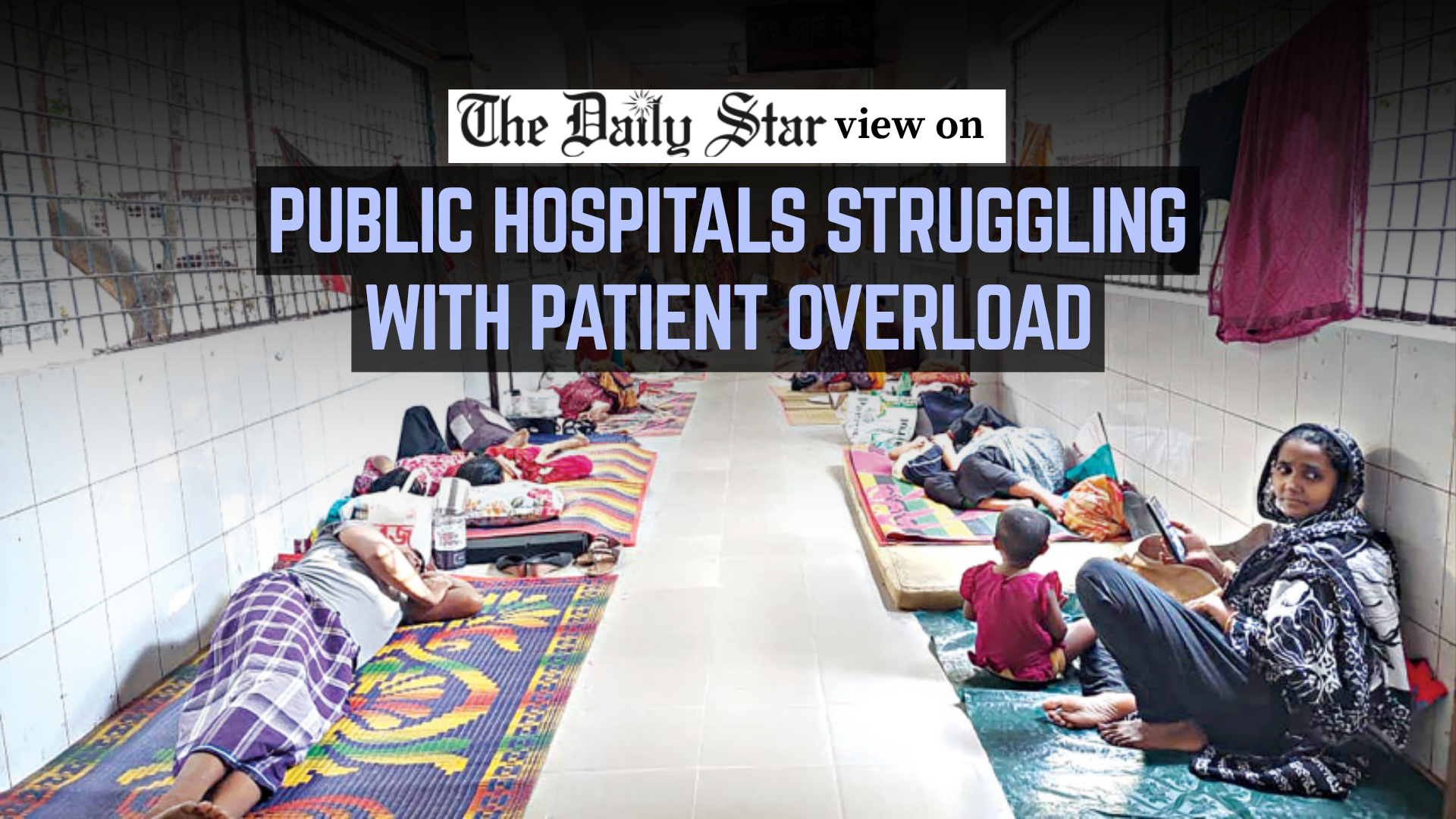
The consequences are most visible in public hospitals. Hospitals are meant to provide care and relief, but ironically, in many of these facilities, patients often become sicker because of overcrowding, poor hygiene, and the shortage of medical staff and equipment. According to a report published by this daily earlier this week, most public hospitals are operating under enormous pressure. With patient numbers close to double their intended capacity, too few doctors and nurses, and inadequate equipment, many hospitals are struggling to provide even basic care. Meanwhile, patients often have to wait for hours, sometimes even days, before seeing a doctor or undergoing important diagnostic tests.
In fact, another recent report, highlighting the findings of a study, has revealed that diagnostic services in more than one-third of public hospitals surveyed between last August and October were disrupted due to non-functional equipment or lack of reagents. Besides, in many rural areas, specialist doctors are unavailable, forcing patients to travel long distances to divisional cities. According to the World Bank and the World Health Organization, Bangladesh has only about 0.7 physicians and 0.61 nurses for every 1,000 people, among the lowest in South Asia. Simply put, there are not enough trained healthcare professionals to meet the needs of a population of more than 17.5 crore.
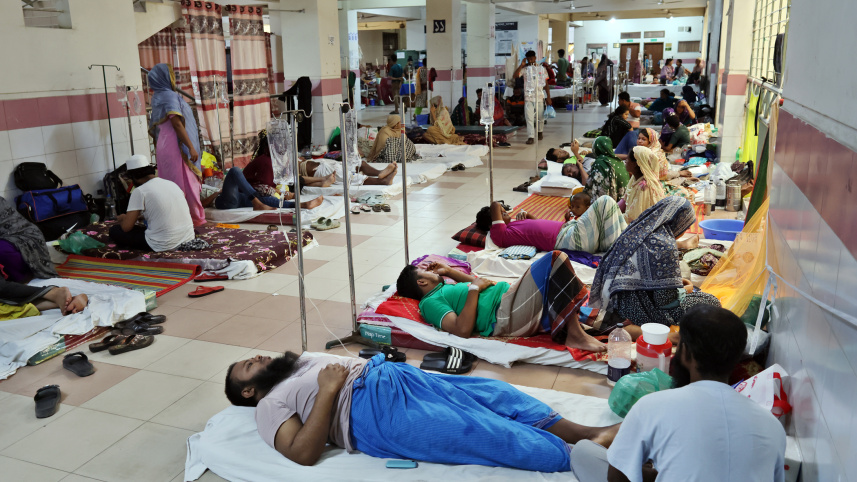
What’s more, patients are often seen lying on the floors of overcrowded wards and hospital corridors because no beds are available. Last month, the prime minister acknowledged this reality during a parliamentary session, saying, “It has been estimated that roughly 40 lakh people across Bangladesh’s hospitals end up lying on the floor because beds cannot be provided.” Indeed, as per official data, in 2024, the average bed occupancy rate in 59 district hospitals was 178 percent. In other words, a hospital designed for 100 patients had to accommodate about 178. Public medical college hospitals faced similar pressure, with an average bed occupancy rate of 164 percent. These figures show that overcrowding is no longer an occasional problem but a daily reality across much of the public healthcare system.
This dire state did not emerge overnight. It is the cumulative result of decades of neglect, chronic underinvestment, weak governance, and the persistent relegation of health within national priorities. For many years, government spending on health has remained below 1 percent of GDP, one of the lowest in South Asia. As a result, much of the financial burden related to health falls directly on ordinary people. Out-of-pocket spending—including payments for consultations, medicines, diagnostic tests, and treatment—accounts for around 79.3 percent of total health expenditure, the highest in South Asia. For many low-income families, a serious illness can mean selling land, borrowing money at high interest, or delaying treatment because they simply cannot afford it.
Thankfully, the present government has given greater priority to healthcare in the 2026-27 national budget by almost doubling the health ADP allocation and setting a long-term target of increasing total health spending to 5 percent of GDP. This is an encouraging beginning. However, increased funding alone will not solve the problem. It must be accompanied by better planning, efficient management, greater transparency, stronger accountability, investment in modern equipment, improved nursing standards, and better healthcare services across the country. Most importantly, real healthcare reform begins when those who make policies also rely on the system that they are responsible for improving. When top leaders and officials themselves obtain service from public healthcare regularly, the chances of it working as planned get significantly higher.
They can learn from Malaysia’s experience. In 1989, Prime Minister Mahathir Mohamad suffered a heart attack. Although he was advised to seek treatment in the United States, he chose to undergo treatment at a hospital in Kuala Lumpur instead. His decision sent a powerful message. It encouraged greater confidence in local healthcare and helped strengthen the country’s commitment to improving hospitals, medical education, nursing standards, and specialist training. Today, Malaysia has become one of Asia’s leading medical tourism destinations, attracting patients from around the world, including many from Bangladesh.
If the BNP government truly wishes to restore public trust in the healthcare system, it must focus on building efficient, reliable, and accessible public hospitals that serve everyone equally. Quality healthcare is a basic right, not a privilege reserved for those with wealth or influence. Social safety programmes such as family cards or health cards can provide temporary relief, but they cannot replace long-term reforms. Bangladesh does not lack talented doctors or dedicated healthcare workers. What it needs is sustained political commitment, effective management, and leadership by example. The day our leaders place the same trust in our hospitals that they ask ordinary citizens to place in them will be the day real reform begins. Only then can we perhaps have a healthcare system worthy of the people’s trust.
Abu Afsarul Haider is an entrepreneur. He can be reached at afsarulhaider@gmail.com.
Views expressed in this article are the author's own.
Follow The Daily Star Opinion on Facebook for the latest opinions, commentaries, and analyses by experts and professionals. To contribute your article or letter to The Daily Star Opinion, see our guidelines for submission.
 For all latest news, follow The Daily Star's Google News channel.
Comments