


Don’t leave Kaiputras to bear the cost of highways

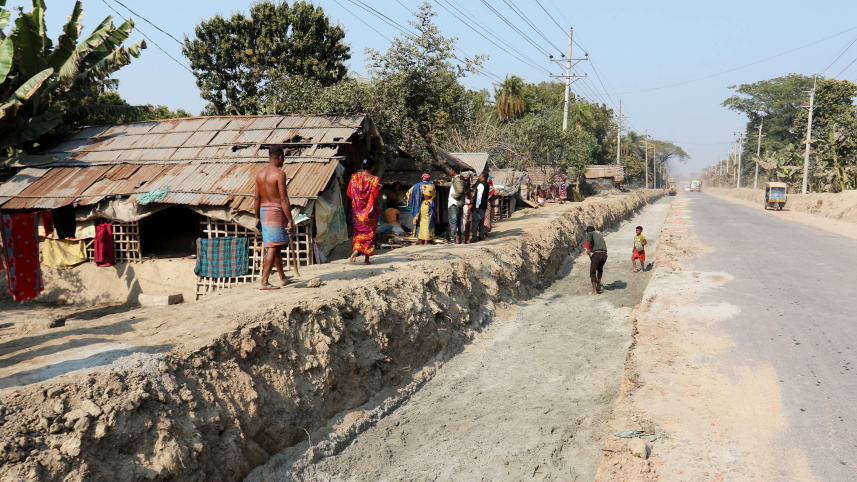
In Dakshin Alipur of Satkhira Sadar upazila, a tragedy largely invisible to the wider public is unfolding. It’s taking place not in some remote char or forest but beside an important highway. There, 46 Kaiputra families are watching their world crumble right before their eyes. According to eyewitness accounts, on February 6, 2026, when the Roads and Highways Department (RHD) began expanding the Satkhira-Shyamnagar highway through Dakshin Alipur, the roadside houses of five Kaiputra families collapsed. Families that had lived there for decades have since found themselves sleeping under sheets of polythene beneath the sky, with the remaining households in constant fear of meeting the same fate at any moment.
Although no written eviction notice has reportedly been served, local residents, members of the Kaiputra community, and journalists say the RHD has been making loudspeaker announcements instructing people living on RHD land to leave the area by June 24 or 25, or risk having their homes and other structures demolished. This is not simply another eviction story; it is a test of Bangladesh’s humanity, because these landless families have nowhere else to go.
 For all latest news, follow The Daily Star's Google News channel.
 The Kaiputras, known for their traditional occupation of rearing pigs in open fields, are one of the most marginalised communities in Bangladesh who face severe social exclusion and untouchability due to their profession. They are concentrated in about 75 villages across Satkhira, Khulna, and Jashore districts, with an estimated population of around 12,000. Until recently, many people and even institutions, including the Ministry of Social Welfare in its official documents, referred to them as “Kawara”, a term that carries strong derogatory connotations. The community now increasingly identifies itself as “Kaiputra”, seeking dignity through a name free from humiliation. But changing a name alone cannot erase deeply entrenched prejudice formed over generations.
The Kaiputras occupy an uncomfortable place in our social hierarchy. In a Muslim-majority country where pigs are considered unclean and their consumption is forbidden in Islam, they are often looked down upon by the majority population. At the same time, they have historically been regarded as “untouchables” within sections of Hindu society. There may be no other community in south-western Bangladesh that experiences such profound isolation, ostracism, and exclusion. The people of Dakshin Alipur carry this burden every day.
Their settlement stands on government khas land under Khatian No. 2, which is controlled by the RHD. Many elderly residents say they have been living there since before the country’s independence. Entire generations have been born and raised there. Some even trace their residence back to the Ayub Khan era. Their poverty remains severe.
Many homes are little more than jhupris built from nipa palm leaves, rusted tin, and polythene. There is no proper sanitation. The 46 families still practise open defecation because no toilet facilities exist. Many women, elderly people, and widows survive through begging. Even those with disabilities do not receive government allowances despite being eligible. Perhaps what is most disturbing is that their poverty is the result of an exclusion that is all but institutionalised by now.
During a visit, a woman named Shefali Mondol said she is rarely called for day labour anymore because people regard them as a “low caste” community. Many women openly speak about social humiliation, that in markets and tea stalls, they are often treated differently from others simply because their men work with pigs. This is despite the fact that there is a relatively sizeable market for pork that serves the economy. Pork produced through the labour of the Kaiputras and other means is consumed by non-Muslim communities, supplied to hotels, and sold in some urban markets, particularly in Dhaka. But the people who help sustain this economy remain invisible and often unwanted.
Their livelihood, moreover, is increasingly under threat. Traditional pig rearing is declining rapidly. Many grazing lands have been lost to fish enclosures. Many Kaiputras have already abandoned their ancestral occupation and moved into fishing to escape stigma. Researchers say that traditional pig rearing may disappear within a generation. Against this backdrop, the Dakshin Alipur eviction threatens to erase one of their last physical footholds.
Yes, Bangladesh needs roads. Improved infrastructure is essential for economic growth, regional connectivity, and public welfare. But development cannot mean rendering the poorest citizens homeless. The RHD argues that the land legally belongs to them and that rehabilitation is not their responsibility but rather that of the district administration. Technically, this may be correct. The land was reportedly acquired between 1962 and 1964, and the present plan is to expand the existing 18-foot road into a 34-foot two-lane highway. But legality is not the issue here. When one state institution demolishes homes while another is expected to rehabilitate the displaced, the most vulnerable among them risk falling through the gap between bureaucratic mandates.
The Kaiputras are not resisting development. They have proposed a practical solution: behind their current settlement lies additional khas land, and they are asking to be relocated there and provided permanent housing under the government’s rehabilitation programme. They are not demanding private land, monetary compensation, or special privileges—only a place to live. Their request is modest, and the state should listen.
There is a border policy context beyond the RHD move that underlies the present situation: the government under Sheikh Hasina previously declared various upazilas in Satkhira to be free from landlessness and homelessness. But the existence of Dakshin Alipur clearly contradicts such claims. If these Kaiputra families are recognised as citizens, then Satkhira Sadar cannot be described as free of homelessness. This crisis demands an immediate course correction—all evictions must be suspended until rehabilitation is guaranteed; the district administration should allocate nearby khas land for the affected families; all households should be brought under the government’s rehabilitation programme; and eligible residents must be included in social protection schemes, including family cards and widow, old-age, and disability allowances. Highly marginalised occupational communities such as the Kaiputras must also be recognised and protected.
This is a moral question about the kind of country we aspire to build: a country that widens roads while protecting the dignity of its most vulnerable citizens, or one that allows highways to be built over the lives of those who have remained invisible for generations. The people of Dakshin Alipur are not encroachers; they are citizens who have been left with nowhere else to go because society has never really made room for them. The moral burden is on us as a society. The Kaiputras have lived at the edge of society for generations. The state must not push them over the edge altogether.
He acknowledges the support of SEHD research staff Rabiullah, Fahmida Rahman, and Fahmida Afroze Nadia in gathering information from Dakshin Alipur.
Philip Gain is a researcher and director at the Society for Environment and Human Development (SEHD).
Views expressed in this article are the author's own.
Follow The Daily Star Opinion on Facebook for the latest opinions, commentaries, and analyses by experts and professionals. To contribute your article or letter to The Daily Star Opinion, see our guidelines for submission.


Comments