


Businesses can help close the public toilet gap, but oversight is key

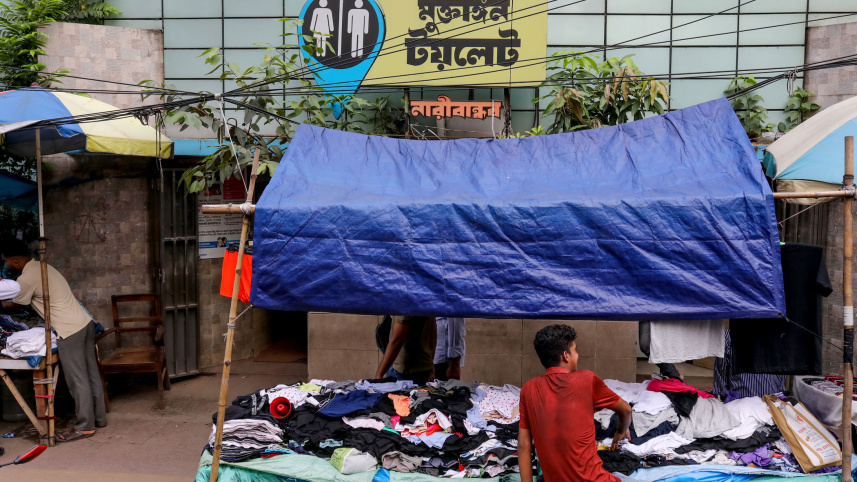
In Bangladesh’s cities, the gross insufficiency of sanitary facilities leads to a number of problems, including women purposely dehydrating themselves and suffering from urinary tract infections; extreme discomfort and exposure to danger from those needing to relieve themselves; and the omnipresent stench of urine in parts of cities due to the lack of facilities.
Reportedly, Dhaka has only 131 permanent facilities and 17 mobile toilets against a requirement of 1,500. So, considering the sheer size of the problem, it is not feasible to expect the government to make up for the shortage entirely using public resources. Some innovative solutions are in order here.

I lived in Guatemala, where I was surprised to discover that restaurant bathrooms were often unusable due to a lack of water, but the bathrooms in parks and bus stations were clean. There were barrels of water available for use as well as attendants to ensure decent conditions. In the United States, I would normally avoid bathrooms in both parks and bus stations; it was good to see that elsewhere they can be made attractive and safe. In Viet Nam, I was amazed at the good quality of some of the public toilets. They charged a small fee, were widely used, and were surprisingly clean. Too often, the ones that were free were also locked or in unusable conditions.
One solution to improve the public sanitation situation in Bangladesh’s urban centres could be to require—or, better yet, incentivise—businesses to allow access to their toilets to anyone in need. In Mexico City, some stores offer use of their facilities for $0.25 (31 taka). Pay toilets are also common in many countries. In Istanbul, these are easily available throughout the city. For a tiny sum, one can access a clean facility. In Latin America and elsewhere, there are facilities managed by attendants who provide access and toilet paper for a small fee, or who work for tips.
It is important to ensure that the fee charged for using these facilities remains small enough not to be a disincentive. Public toilets should be a common and accessible urban feature, and there needs to be a better effort to create accessible toilets for people with disabilities.
Markets and shopping malls should be required to provide toilets, and there should be a well-publicised phone number to call to register complaints if the toilets are not usable, clean, or safe. The market or mall should then be fined by mobile courts to ensure they clean the facility regularly.
Public-private partnerships could also help reduce the shortage of public toilets, as long as the contracts are well-monitored. There are NGOs working on sanitation who could help provide and ensure the proper maintenance of public toilets.
Much as I personally object to the idea of making people pay for the use of a bathroom, it is important to remember that, too often, the alternative is no facility at all. It is vastly better and healthier to have to pay a small amount to access a bathroom than to have no access at all. Nevertheless, a flexible system would allow those who genuinely cannot pay to use the facilities in any case.
I once heard a fascinating anecdote in a talk by Gil Peñalosa, formerly in charge of parks and recreation in Bogotá, Colombia and founder and chair of 8 to 80 Cities. Upon visiting a public bathroom, I don’t recall in which city, he was surprised to see a vase of fresh flowers inside. When he asked the attendant to explain the presence of this unusual amenity, the attendant explained that people respect the space when they see the flowers, making the job of cleaning the bathroom far easier.
People indeed respond according to the environment in which they find themselves. Streets that stink of urine, combined with the lack of public toilets, are an invitation to urinate outdoors. A shabby, poorly maintained toilet is an invitation to incivility. I fondly recall a bus stop in southern India which had sparkling bathrooms lined with bright green tiles. The attractiveness of the bathroom no doubt elicited better behaviour in users.
When we provide decent facilities and make sure that someone is responsible for their upkeep, we can dramatically reduce misuse and abuse. When we accept that public toilets are not simply an important urban asset but a basic right and necessity, we will also explore solutions for adequate provision. This is not an insuperable problem; it is one that requires sufficient will to address appropriately.
Debra Efroymson is executive director of the Institute of Wellbeing, Bangladesh.
Views expressed in this article are the author's own.
Follow The Daily Star Opinion on Facebook for the latest opinions, commentaries, and analyses by experts and professionals. To contribute your article or letter to The Daily Star Opinion, see our guidelines for submission.
 For all latest news, follow The Daily Star's Google News channel.
Comments