


Bangladesh must confront its failing research culture
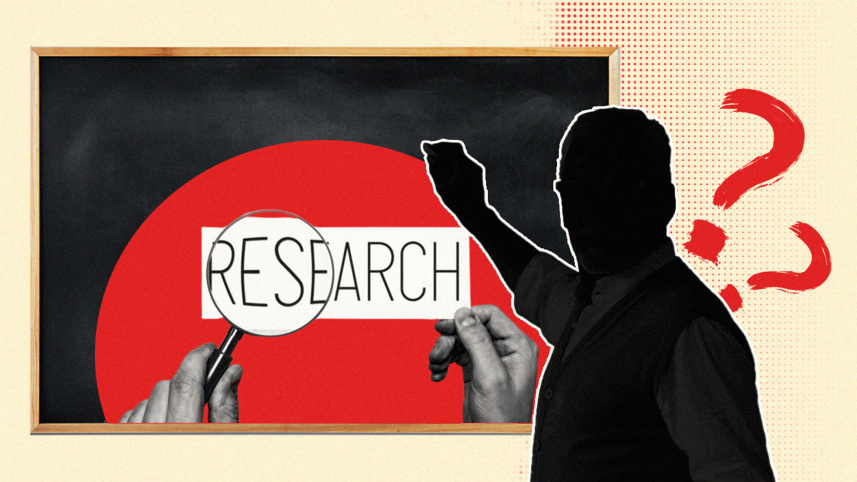
The recent revelation of the retraction of at least 325 research papers (by Bangladeshi researchers) from international journals between 2019 and June 2026 is a cause of concern for the entire country, not just for the academic community. Although the initial reaction might be of embarrassment, the larger issue is what this news tells us about the condition of research, accountability, and higher education in Bangladesh.
An extensive search of Retraction Watch (a website that maintains a global database of withdrawn research papers) showed that retracted papers cover range of fields, from nanomedicine and cancer to the environment. Researchers from reputed public universities such as Dhaka University, Rajshahi University, Chittagong University, and Noakhali Science and Technology University, as well as from private universities, were involved with the retracted papers.

The main reasons behind the retractions are data fabrication, extensive plagiarism, manipulation of the peer review process, duplicate submissions, and dependence on commercial “paper mills” that sell authorship for money. But at the root of this issue is the prevailing academic culture in Bangladesh, which runs on a “publish or perish” mentality. The determinants for promotion and administrative incentives in many universities are strictly based on the number of published papers, without any consideration for the overall quality of research, methodology, or ethics.
It is generally difficult for lecturers and assistant professors to keep up their publication count and obtain speedy promotions, study leaves, or grants. This encourages them to use shortcuts, which often translates to reliance on ghostwriting networks and unchecked international collaborations in which no ethical safeguards are provided.
Scientific advancement and effective policymaking depend on the academic integrity of the research that informs them. If the data used in local studies of public health, environmental protection, or economic policies is falsified, national development plans become jeopardised. Moreover, such massive retractions will likely impact the international academic community’s view of Bangladesh’s academia. Students may face doubts and be subjected to greater obstacles when submitting and presenting their work to global journals. Degrees earned from the local institutions involved may also lose their credibility internationally.
Changes in the structure on both administrative and institutional levels are also needed urgently to restore integrity to Bangladeshi higher education. The UGC should step up from its observatory role and put in place detailed national guidelines to ensure research integrity at all universities. The policies should address plagiarism, data fabrication, authorship, conflicts of interest, peer review, and ethics of using AI in research. Universities, in turn, should be required to establish functional, independent research ethics committees which can audit manuscripts, verify raw data, and hold the authority to investigate allegations of academic misconduct impartially.
Promotion and tenuring procedures also need a complete overhaul. Research quality, determined by rigorous peer review and a study’s impact on society, should be the target of the institutional reward systems rather than the quantity of research. All institutional funding and degree dissertations should be subject to automated plagiarism detection software and data verification procedures. There is a need to incorporate mandatory research methodology, publication ethics, and responsible use of AI into undergraduate and postgraduate courses. Students should be educated about the serious professional and legal implications of scientific misconduct.
Bangladesh is striving to establish a knowledge-based economy, but it is impossible to construct this on faulty knowledge. Unless the country makes serious efforts towards ensuring accountability and fosters a genuine research culture, its academic development will be weak and unreliable. Universities, policymakers, and the scientific community must take action to protect the intellectual future of the country.
Md. Noor Hamza Peash is LLB student at World University of Bangladesh.
Views expressed in this article are the author's own.
Follow The Daily Star Opinion on Facebook for the latest opinions, commentaries, and analyses by experts and professionals. To contribute your article or letter to The Daily Star Opinion, see our guidelines for submission.
 For all latest news, follow The Daily Star's Google News channel.
Comments