


How the FY27 budget reinforces an unequal tax structure

One of the most serious weaknesses in Bangladesh’s economy is that its tax collection, relative to the economy size, remains among the lowest in the world; the country ranks only slightly above war-ravaged Yemen and Sudan. In FY2024-25, its tax-GDP ratio was below seven percent. There is, therefore, little doubt that tax collection must be increased in order to build a welfare-oriented state. The real question is how this additional tax will be collected: through indirect taxes such as VAT and customs duties paid by ordinary citizens, or through direct taxes on the income and profits of wealthy and capable individuals? Will revenue be increased by curbing tax evasion among the rich, or by extracting more from the existing taxpayers?
 For all latest news, follow The Daily Star's Google News channel.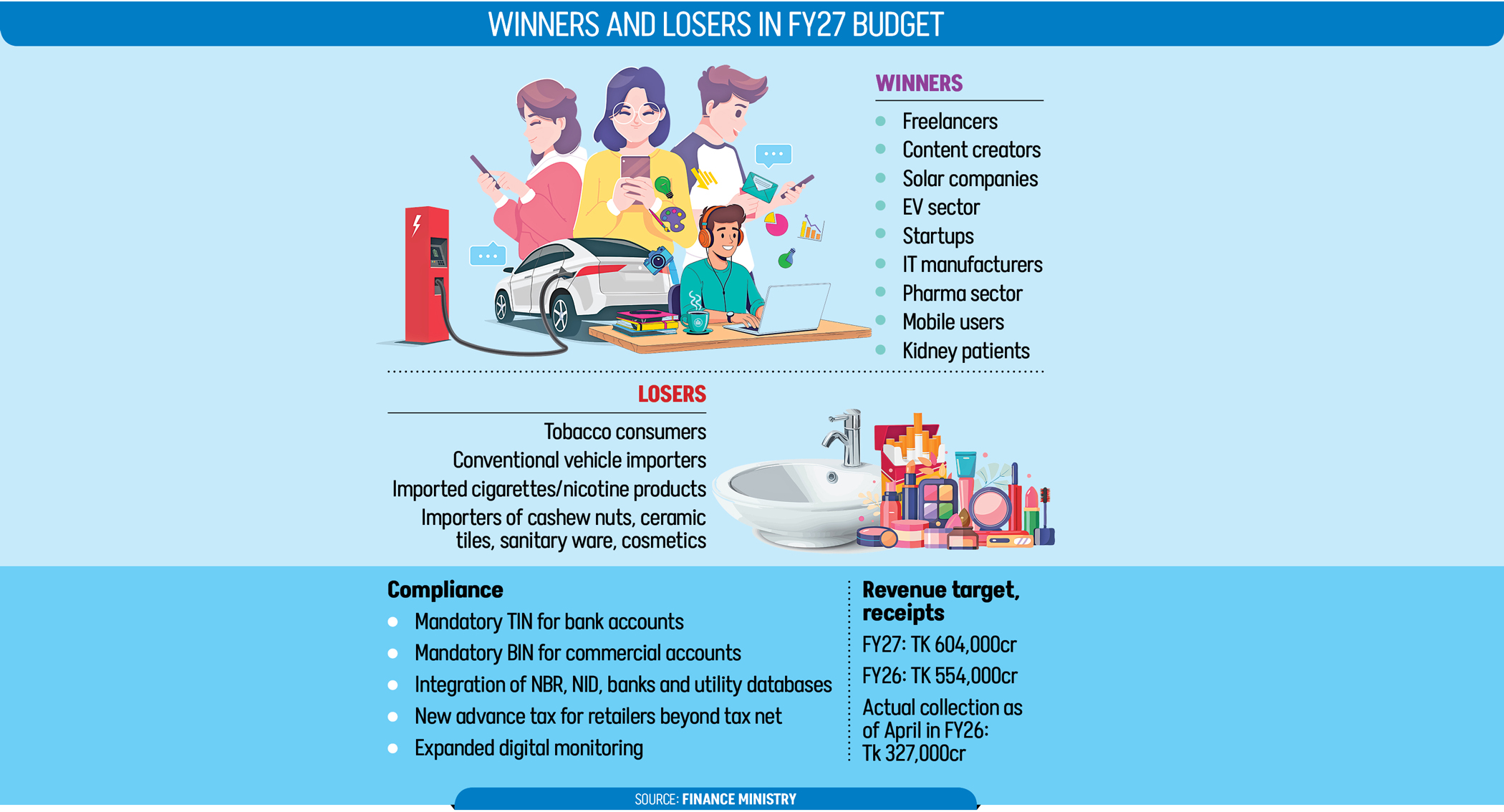
As the BNP stated in its election manifesto, Bangladesh’s revenue crisis is not primarily a technical problem but the result of a discriminatory political economy. The party pledged to dismantle this structure and expand the revenue base by making the income tax and VAT systems fairer, more universal, and technology-driven. It also promised to bring high-income individuals, professionals, businesspeople, and property owners into the tax net, while combating tax evasion through digital systems, information sharing, and risk-based audits.
Let’s examine how much these promises have been reflected in the tax structure in the proposed budget for FY2026-27.
The new budget proposes reducing source taxes on nearly 60 agricultural and essential commodities, including rice, wheat, flour, edible oil, sugar, fish, meat, onion, and ginger. Existing source tax rates of five percent, two percent, and one percent would be reduced to 0.5 percent. As a result, the tax burden at import and distribution stages will decline. If these reductions are eventually reflected in retail prices, they could contribute to easing inflation.
Such an initiative is commendable. However, to determine whether the overall tax burden on the public is actually decreasing or increasing, one must look at the broader tax structure—specifically, the ratio between direct and indirect taxation. This ratio is crucial because it reveals who is paying for government expenditure and who is benefiting from them. Direct taxes are levied on the income, profits, and wealth of those with a greater ability to pay. Indirect taxes, such as VAT and duties, are collected from everyone regardless of income. If the majority of revenue comes from ordinary citizens, the tax system tends to fuel inequality. Curbing inequality requires increasing direct taxation, particularly on wealthy citizens.
The key question is whether the various tax concessions introduced in the FY2027 budget alter this fundamental structure. If, as before, the state continues to rely primarily on indirect taxation, these concessions may provide some temporary relief but will not change the fact that ordinary people bear the main tax burden.
Per the BNP government’s budget proposal, the National Board of Revenue (NBR) has been tasked with collecting Tk 604,000 crore in revenue. Of this, Tk 219,835 crore will come from direct taxes on income, profits, and capital owned by wealthy and capable individuals. Meanwhile, Tk 384,165 crore will be collected through indirect taxes such as VAT, supplementary duties, and import duties. In other words, only 36.4 percent of the NBR target will come from direct taxes, while 63.6 percent will come from indirect taxes paid by the general public. In the revised FY2026 budget, the shares of direct and indirect taxes were 36.2 percent and 63.8 percent, respectively. In FY2025, they were 34.44 percent and 65.56 percent.
This indicates that the new budget continues the past trend by heavily depending on indirect taxes. While the expenditure side of the budget contains positive measures, particularly for health, education, and social protection, there has been no significant structural change in addressing inequality through the tax system. Even the measures intended to increase direct tax collection rely more on extracting additional revenue from the existing taxpayers than on expanding the tax net or reducing tax evasion among wealthy individuals.
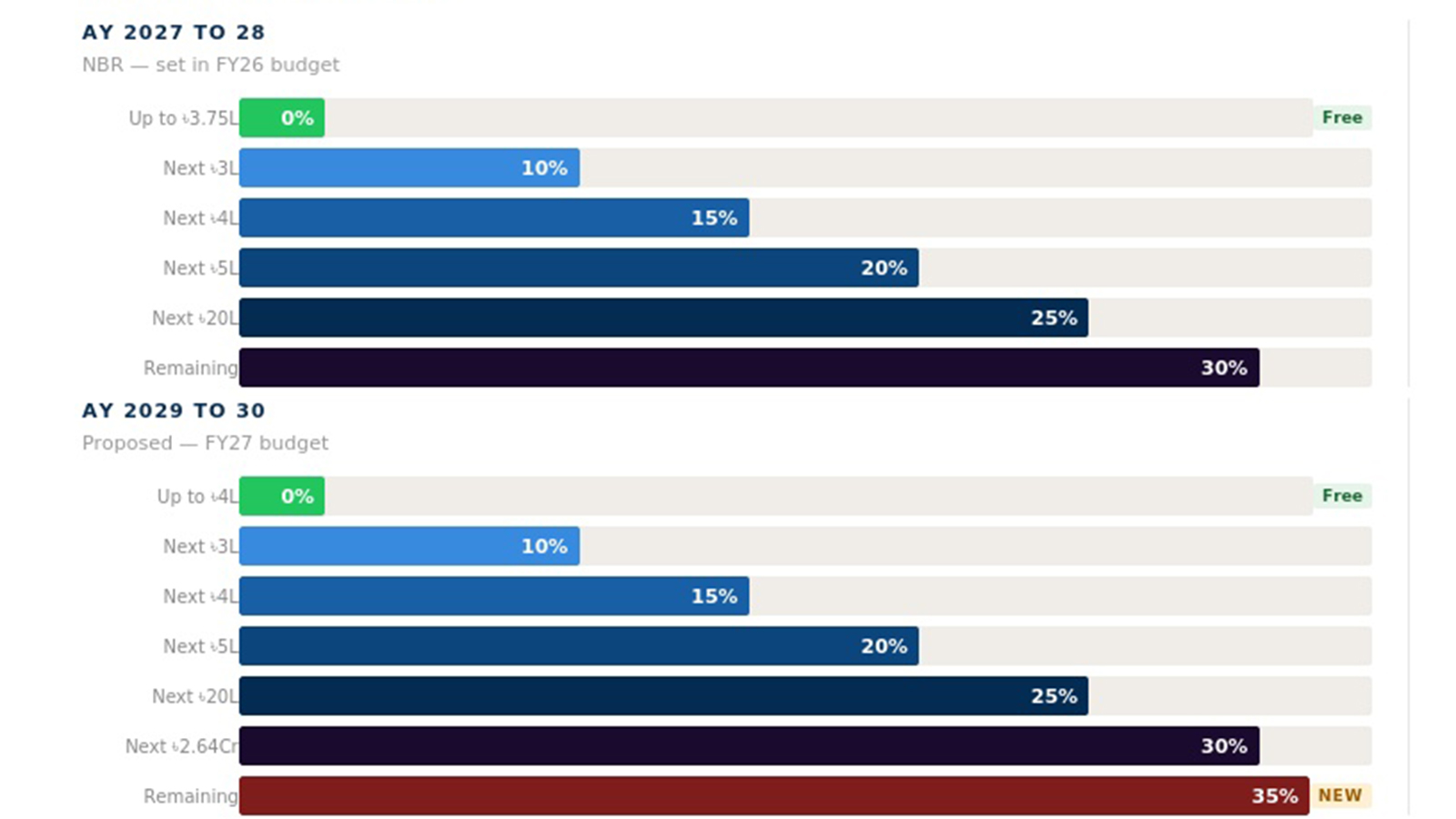
Indeed, several proposed measures may place a disproportionately larger burden on lower-income and middle-income taxpayers. For example, while the tax-free income threshold has been increased by Tk 25,000, the initial five percent tax bracket has been abolished and replaced by a 10 percent rate. This change will increase the tax burden on those who already pay taxes. Moreover, this change is proportionately larger for lower-income earners than for higher-income groups. An analysis by Samakal shows that, under the proposed tax structure, an individual earning Tk 74,000 per month will see their tax liability increase by 49 percent. By contrast, those earning Tk 250,000 or more per month will see a tax increase of only around 10.5 percent.
Tax rebates available to individual taxpayers for investments have also been reduced, further increasing the burden on taxpayers. Currently, taxpayers receive rebates on investments in nine categories, including savings certificates, deposit pension schemes (DPS), and life insurance premiums. Under the existing system, the rebate is determined by whichever is the lowest: three percent of total income, 15 percent of approved investments, or a maximum of Tk 10 lakh. The new proposal reduces the approved investment limit from 15 percent to 10 percent and lowers the maximum investment ceiling from Tk 10 lakh to Tk 7.5 lakh. As a result, taxpayers will receive approximately Tk 5,000 less in tax relief for every Tk 100,000 invested.
Tax has also been increased on the returns from savings certificates, on which middle-class households and pensioners are heavily dependent. Currently, profits from savings certificates are subject to a withholding tax of five percent for investments up to Tk 10 lakh and 10 percent for investments above that amount. Under the existing system, this withholding tax is treated as the final tax liability, meaning no further tax is payable on this income. The new budget proposes abolishing this arrangement. Instead, profits from all savings certificates will be subject to a 10 percent withholding tax, which will no longer be treated as the final tax liability. Rather, the income will be added to a taxpayer’s total income and taxed according to the applicable income tax slab. The withholding tax deducted at source will be treated as an advance tax payment that can be adjusted when filing tax returns. As a result, middle-class families and pensioners holding savings certificates worth Tk 500,000-700,000 will see a reduction in their net returns.
Hence, it is evident that, instead of fulfilling its electoral pledge to bring high-income individuals, professionals, businesspeople, and property owners under the tax net, the BNP government has increased the burden on the existing taxpayers.
Similarly, the advance tax of Tk 2 per Tk 1,000 imposed on small retailers as part of efforts to expand the tax base will ultimately increase the burden on ordinary consumers. This kind of taxation is not conducive to reducing the country’s already severe economic inequality.
Under the previous Awami League government, ordinary citizens suffered from widening economic inequalities. Following the anti-discrimination movement and mass uprising that led to that government’s fall, people expected the newly elected government to take meaningful steps to reduce inequality.
The BNP government should avoid policies that further deepen the existing disparities. It must move away from the “easy path” of increasing revenue through indirect taxes as well as through higher direct taxes on the existing salaried taxpayers. Instead, it should focus on expanding the tax base by bringing affluent individuals and businesses, who evade taxes, under the tax net.
Kallol Mustafa is an engineer and writer who focuses on power, energy, environment, and development economics. He can be reached at kallol_mustafa@yahoo.com.
Views expressed in this article are the author's own.
Follow The Daily Star Opinion on Facebook for the latest opinions, commentaries, and analyses by experts and professionals. To contribute your article or letter to The Daily Star Opinion, see our guidelines for submission.




Comments