


‘Gender equality must be at the heart of governance’

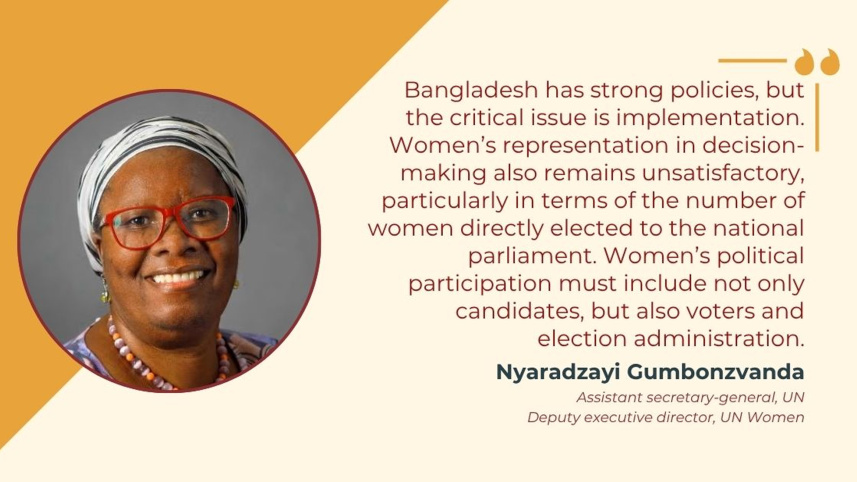
Nyaradzayi Gumbonzvanda, UN assistant secretary-general and UN Women deputy executive director, speaks about child marriage, sexual harassment, women’s political participation, and the broader state of women’s rights and gender equality in Bangladesh, in an exclusive interview with Naziba Basher of The Daily Star. The conversation was also joined by Christine Arab, UN Women regional director (Asia-Pacific), who set the regional context.
Christine Arab (CA): Last year marked the 30th anniversary of the Beijing Platform for Action, which remains the seminal global commitment to gender equality by member-states. Across Asia and the Pacific, formal discrimination has declined, particularly in constitutions and legislation, while services for gender-based violence and efforts to bring more women into the labour market have expanded.

However, women’s labour force participation and leadership in politics and the private sector are still not progressing fast enough, particularly in South Asia and the Pacific. Southern Asia also continues to record some of the world’s highest femicide-related crime rates.
Women’s participation in disaster risk reduction, climate mitigation and green initiatives has significantly increased over the last five years, with governments increasingly seeking UN Women’s support on these issues. But gender-based violence remains persistently high, with harmful practices such as child marriage continuing to be a major concern in South Asia.
Last week, for the first time in over a decade, UN Women and Saarc convened member-states on the care economy, now one of the biggest areas where governments across Asia and the Pacific seek UN Women’s support. Another major concern raised by governments is cybersecurity, particularly technology-facilitated violence against women.
Welcome to Bangladesh. What are your key takeaways from this visit, and where do you see the greatest opportunities for advancing gender equality in Bangladesh?
Nyaradzayi Gumbonzvanda (NG): Thank you so much. First, let me appreciate both of you and also appreciate the media. One of the 12 critical areas of concern identified at the 1995 Beijing Conference was women and the media, and the role of the media in advancing gender equality, women’s empowerment, and women’s rights.
We came to Bangladesh with the regional director to support UN Women’s efforts alongside the government and civil society, and what I experienced immediately was that UN Women is deeply embedded in the country’s wider ecosystem and engagement.
We met with the Ministry of Foreign Affairs, the Ministry of Women and Children Affairs, and the Election Commission, which gave us perspective on where the country stands only months after the national election. Bangladesh is widely recognised for signing and ratifying key international conventions advancing women’s rights, including CEDAW, but it is also acknowledged that more work remains.
The country has strong policies, but the critical issue is implementation. Women’s representation in decision-making also remains unsatisfactory, particularly in terms of the number of women directly elected to the national parliament. Women’s political participation must include not only candidates, but also voters and election administration.
We also engaged extensively with women’s rights organisations, wider civil society groups, young women, women with disabilities, and women involved in the August events. Implementation, access to services, and shifting social norms remain critical if we are to reduce gender inequality, empower women, and protect women’s rights.
The level of child marriage is also unacceptable. I call it child rape.
We also went to Cox’s Bazar. After what we saw there, we were crying with one eye, crying heavily, but also smiling a little with the other eye. The women want peace and they want to go home. But they also want to live in safety where they are now. They want skills and education, not only for themselves but for their children.
But why did I smile with the other eye? I was seeing refugee women’s courage—standing together to find solutions, building skills, creating women’s groups, and supporting one another.
And finally, I must mention the wonderful food in this country. Every bowl of rice has a woman’s hand on it. The woman farmer provides the nourishment we enjoy every day.
You spoke about lack of implementation and access. What other pressing gaps and unresolved challenges require urgent attention?
NG: It is important to address social norms boldly. Negative social norms can limit women and confine them to certain spaces. But what is critical is the transformation of those norms. Love is not oppressive; love is liberating.
When we speak about transforming social norms, we are not saying people should abandon their religion or culture. But respect for culture and religion must not be used to undermine women or justify violations against them. We must not rationalise the rape of children by calling it marriage.
The second major issue is access to services at the community level. It is one thing to have an education policy guaranteeing equal opportunity. It is another to ensure schools are close enough that girls don’t have to travel long distances where they may face harassment or abuse. Services must be accessible, affordable and of good quality.
A third critical issue is zero tolerance for impunity. Where there is impunity, violations continue.
 For all latest news, follow The Daily Star's Google News channel.
 CA: Another issue is care. Care is a public good. In South Asia, people often think immediately of childcare, but care also includes support for older persons, people with disabilities, and people living with mental health conditions.
Governments increasingly want stronger care policies, and public-private partnerships are essential. This is not about enormous new budgets but better coordination of existing systems and resources. Care spans multiple government entities throughout a person’s life cycle, while the private sector also has a crucial role to play.
Embedded within this discussion is the issue of domestic workers. Across South Asia, many domestic workers are migrants, either within the countries or across borders, making it essential to ensure that domestic work is safe, protected and formalised.
Which priority areas could most effectively accelerate Bangladesh’s progress in gender equality and women’s empowerment?
NG: First is the intentionality of the government. Setting clear priorities and allocating adequate resources is essential if gender equality and women’s empowerment are to be placed at the heart of governance.
Second is women’s economic empowerment at the community level. Women want to own land, gain practical skills, and overcome barriers that prevent them from earning effectively.
Third is strengthening women’s organisations and networks. Bangladesh has a remarkable history of developing community-based models that later became globally recognised. One particularly inspiring model we saw in Cox’s Bazar was the Integrated Multi-Purpose Women’s Centres serving Rohingya refugee women. Such integrated, one-stop centres could be replicated throughout the country.
Finally, urbanisation does not automatically create equal opportunity. Bangladesh must ensure that all women and girls have opportunities to live in safety, participate politically, and realise their full potential.
CA: I would also emphasise statistics. Bangladesh has made notable progress in strengthening gender-related data, which helps us understand how women in different regions and sectors are affected by economic and social changes.
Another issue repeatedly raised in our meetings was inheritance and land rights. Women may work the land, cultivate it and harvest it, but they often don’t own it.
Following the July uprising, there was a feeling that women would once again be at the forefront. But from what we have seen in the recent election, their participation in the movement did not translate into parliamentary representation. What enabling conditions and reforms are needed to strengthen women’s political leadership in Bangladesh?
NG: First, the political environment is shaped by electoral laws, and those laws must actively facilitate women’s participation.
Second, reform is needed within political parties themselves. Campaign financing is another critical issue. Running for office is expensive; women therefore need targeted support to compete on equal terms.
There is also an important national debate around quotas and direct elections. From the UN perspective, both are necessary.
Young women’s participation is especially important, but technology-facilitated violence disproportionately targets young women. Achieving meaningful representation requires multiple layers of intervention. Legal reform alone is not enough.
CA: That is why the forthcoming local elections present a significant opportunity. Community-led, multi-party dialogues on inclusion are crucial. We met many young women leaders, and it is clear that they deserve a far stronger voice.
How can Bangladesh strengthen protections against sexual harassment to ensure safer workplaces and public spaces for women?
NG: Women have repeatedly shared their experiences of harassment in public spaces. Now the sexual harassment law must be passed. It is long overdue. Such legislation would also align with ILO Convention 190, which addresses violence and harassment in the world of work.
But legislation alone is not enough. The private sector also has an important role to play. This issue is fundamentally about dignity. Dignity means being able to move through public spaces safely and freely. When women are harassed, their participation in public life is constrained.
Bangladesh should urgently enact the sexual harassment law and create the conditions necessary for women to live, work and participate without fear.
Many survivors of workplace harassment are employed in the informal sector, where the workplace may be someone’s home, as in the case of domestic workers. How can protections be extended to women in these settings?
NG: Many women remain silent because they fear losing their jobs. That is why awareness campaigns are so important. Women must also be protected from revictimisation and provided with meaningful access to justice.
It is important to recognise that the informal sector is not unstructured. It is organised; it is simply not always formally registered. Development efforts must therefore engage with market associations, transport groups, residents’ associations, and organisations working directly with informal workers. I have every confidence that sexual harassment and violence can be prevented in the informal sector. The key lies in adapting our approaches to those realities while maintaining the same commitment to accountability and justice.
Follow The Daily Star Opinion on Facebook for the latest opinions, commentaries, and analyses by experts and professionals. To contribute your article or letter to The Daily Star Opinion, see our guidelines for submission.
Comments