


‘Every child has the right to be taught by a properly trained teacher’
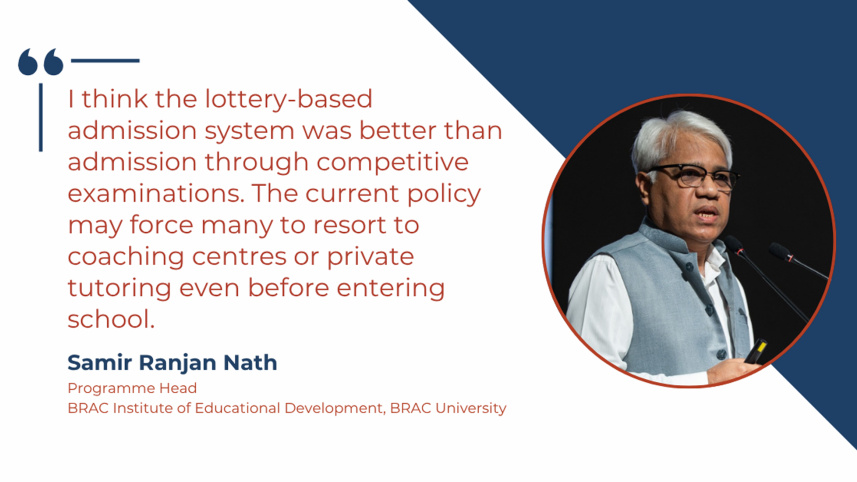
Samir Ranjan Nath, programme head at the BRAC Institute of Educational Development, BRAC University, talks with Naznin Tithi of The Daily Star about the persistent learning gaps in primary education, the need for properly trained teachers, teacher redistribution, and other issues.
Recently, an inspection by the Compulsory Primary Education Implementation and Monitoring Unit (CPEIMU) found significant learning deficits among students in nearly 2,100 government primary schools across four areas, including the Dhaka Metropolitan Area. How would you evaluate its findings?

To be frank, the CPEIMU report does not reveal anything entirely new. The findings are largely consistent with the results of various studies and assessments conducted over the past few years. For example, BBS and Unicef’s National Survey on Children’s Education in Bangladesh 2021, the Directorate of Primary Education’s National Student Assessment (NSA) 2022, and earlier studies have all revealed a similar picture. These studies found substantial deficiencies in students’ foundational literacy and numeracy skills.
In the BBS-Unicef survey, students were asked to read and comprehend a short paragraph consisting of just 72 Bangla words. The result showed that many students were unable to understand even this simple passage. Likewise, their basic mathematical skills were found to be weak. The Directorate of Primary Education’s assessments have also shown that many Class 3 students fail to achieve the competencies expected for their grade. Those who fall behind at an early stage tend to fall even further behind by the time they reach Class 5. In other words, instead of narrowing over time, the learning gap continues to widen.
Research conducted by the BRAC Institute of Educational Development during the Covid pandemic also identified significant learning losses. This latest assessment is particularly alarming because it shows that many students cannot even pronounce the Bangla alphabet or read common words correctly. Earlier studies generally reported that students struggled with reading comprehension or solving mathematical problems; the latest assessment highlights an even more fundamental problem.
What reforms are needed in primary education to address these deficits? How should struggling students be identified and supported?
I don’t think any major policy reforms are necessary. What is needed is for everyone involved in primary education to carry out their responsibilities properly. Teachers’ primary responsibility is to teach effectively in the classroom and ensure that students are learning. Unfortunately, this is where our greatest weakness lies. Headteachers provide leadership at the school level, and the quality of that leadership is extremely important. Above them are upazila and district education officials, whose responsibilities include regularly visiting schools, supporting teachers, and monitoring the quality of education. If classroom teaching is given the highest priority, with proper support and oversight from those in leadership roles, much of this problem can be addressed.

Another important issue is strengthening the connection between schools and students’ families. Maintaining regular communication with parents is very important. Government schools used to hold regular parent-teacher meetings, but this practice has largely disappeared over time. Overall, weaknesses in classroom teaching, school leadership, regular supervision, teacher support, and parental engagement all reflect a persistent lack of accountability and commitment. In my view, the learning deficit is fundamentally a reflection of weak accountability across the system.
Teacher shortages and the lack of qualified teachers have long been major concerns in primary schools. How can these shortages be addressed?
Teacher shortages certainly exist, but the issue is not just about the number of teachers; it is also about how they are allocated among the schools. There are now 65,567 government primary schools across the country. Of these, 133 schools have only one teacher, while 633 schools have only two. At a minimum, a school needs five teachers to teach the five grades, along with one headteacher. If a school has a pre-primary class, another teacher is required. Based on my calculations, nearly one-fifth of government primary schools have fewer than five teachers. This shows that the crisis is real.
At the same time, it is important to recognise that a large number of teachers have been recruited over the past two decades. In 2001, there were, on average, 67 students for every teacher. By 2024, that ratio fell to around 29 students per teacher. However, this improvement has not translated into better learning outcomes. One reason may be the unequal distribution of teachers. Some schools may still have 50 students per teacher, while others may have only 20.
Therefore, the government’s first priority should be to redistribute teachers more evenly across schools. Additional recruitment should then be carried out where necessary.
How important is teacher training to improve their skills?
The number of teachers and their competence must be considered together. Unfortunately, while there have been numerous studies on students’ learning outcomes, there has been very little research on teachers’ competencies. I think CPEIMU could assess teachers’ competencies just as it assesses students’. It is important to know how many teachers can effectively teach Bangla, mathematics, and other subjects. Teachers found to have skill gaps should receive needs-based professional training. If, even after receiving training, a teacher is found unable to teach effectively, difficult decisions may have to be made regarding the continuation of their service.
Unfortunately, nearly one-quarter of primary school teachers have still not received the necessary professional training. This is unacceptable. Every child has a fundamental right to be taught by a properly trained teacher.
What special measures can schools and the government take to help students who fall behind because of social, family, or economic disadvantages?
Every school should have a clear understanding of the socioeconomic backgrounds of its students. Schools should maintain a database of this information. Regardless of family background, every child deserves equal attention in the classroom. However, we know that children from disadvantaged families often do not receive adequate academic support at home. They, therefore, require additional assistance. A school’s responsibility does not end with delivering regular lessons; it must also ensure that students who are falling behind receive the support they need to catch up.

Teachers can identify struggling students through continuous classroom assessment. Based on that information, schools should organise appropriate remedial programmes. Schools can arrange remedial classes after school or during holidays. Schools with sufficient teachers can begin these interventions immediately. But those facing teacher shortages should first address the problem through teacher redistribution and then gradually recruit additional teachers where needed.
 For all latest news, follow The Daily Star's Google News channel.
 Do you find government supervision of schools to be adequate?
Most of the supervision that currently takes place focuses on infrastructure, while academic supervision and evaluation of classroom teaching are almost absent. Education officials at the upazila level should visit schools regularly to identify academic problems, provide guidance, and follow up to see whether their recommendations have been implemented. In other words, they need to work with schools continuously rather than conducting one-off inspections. Some NGOs have extensive experience working closely with families and teachers to promote quality education. So, a collaborative effort can be considered, as was done during the Education for All (EFA) movement.
Following a recent policy shift, children seeking admission to Class 1 will now be required to sit for entrance exams, raising concerns among parents about the likely effects on children. What changes do you think are needed in the admission policy and school system to ensure equal opportunities for all children?
I think the lottery-based admission system was better than admission through competitive examinations. The current policy may force many to resort to coaching centres or private tutoring even before entering school. Financially well-off families will be able to afford that, while others will not. As a result, inequality will increase. If a child becomes familiar with coaching before becoming familiar with school, it is a serious injustice. It encourages a coaching-dependent culture from the very beginning of a child’s education journey. Therefore, I believe the lottery-based admission system should be reinstated for the time being.
In the medium term, however, the best solution would be to introduce a catchment area-based admission system. Each school should have a clearly defined catchment area, and all children living within that area should attend that school. Such a system can be introduced immediately where possible. At the same time, the government must ensure that every school has adequate infrastructure, properly trained teachers, and the resources needed to provide quality education.
Follow The Daily Star Opinion on Facebook for the latest opinions, commentaries, and analyses by experts and professionals. To contribute your article or letter to The Daily Star Opinion, see our guidelines for submission.
Comments