


Threats against journalists are condemnable
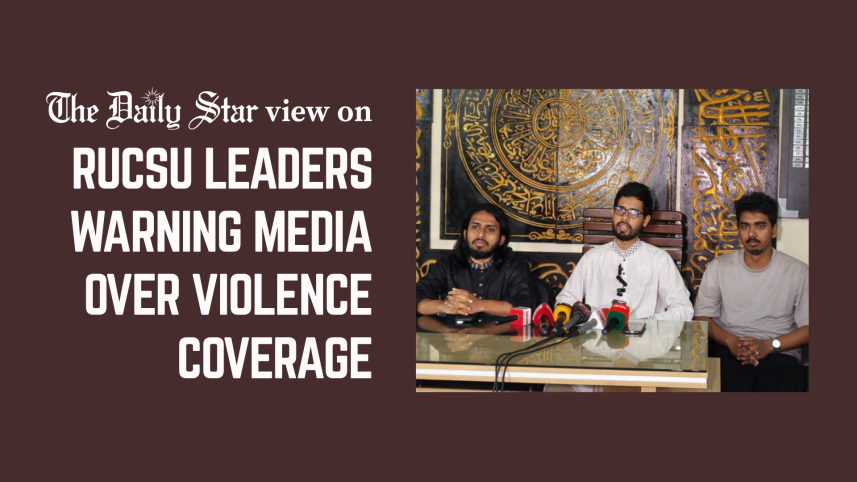
We are disturbed by the recent threats coming from a few student leaders, such as Rajshahi University Central Students' Union (Rucsu) executives, against journalists and media outlets over their coverage of the recent violence on the Rajshahi University campus. Their warning that journalists who, in their view, had portrayed Rucsu and Islami Chhatra Shibir unfairly would "face action" is unacceptable under any circumstances. Such threats have no place in a democratic society, especially from leaders of elected student bodies, who should respect democratic values and press freedom.
According to news reports, three students, including one claimed to be a former activist of the now-banned Bangladesh Chhatra League (BCL), were beaten by leaders and activists of Rucsu and Islami Chhatra Shibir at the university proctor's office and later at the central library on July 27, following an earlier dispute. At a press conference the following day, the Rucsu leaders objected to reports describing the incident as an "attack" rather than "resistance" and accused sections of the media of defending the banned BCL. Doing so, they fundamentally misunderstood the role of the media, which is not to endorse any group's version of events but to gather facts, present multiple perspectives, and inform the public. Those who disagree with a report have every right to challenge it through reasoned responses, requests for corrections, or legal means where appropriate. Resorting to threats against journalists, however, crosses a line that should never be crossed.

For many years, the country's media operated under severe pressure under authoritarian rule. Journalists faced intimidation, harassment, and legal restrictions for carrying out their work. In post-uprising Bangladesh, we should be striving to strengthen press freedom and freedom of expression, both of which are essential for a democratic society. Any attempt to intimidate journalists or silence critical reporting could bring back the culture of fear that the country should leave behind.
Only last December, the Rucsu leaders publicly called for the closure of Prothom Alo and The Daily Star at a protest march and ordered their journalists to leave the venue. The recurrence of threats against journalists should therefore concern not only media organisations but also university authorities, student leaders, and everyone who values democracy. Universities are meant to be places where ideas are contested through debate and evidence, not where journalists are threatened for doing their jobs.
Therefore, it would be prudent for Rucsu leaders to withdraw their anti-journalist remarks and threats. Such self-reflection is essential not only for protecting press freedom but also for preserving their credibility as the leaders of an elected student body and strengthening the country's democratic culture.
 For all latest news, follow The Daily Star's Google News channel.
Comments