


It’s time to complete July's agenda
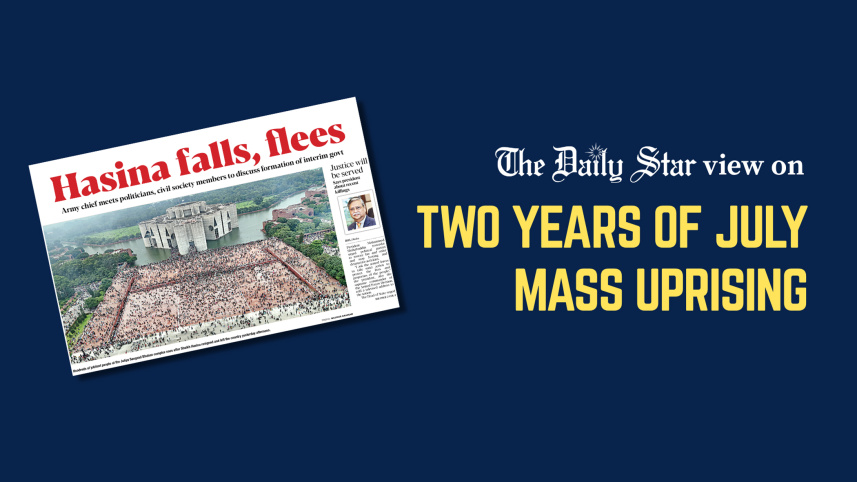
As we commemorate the second anniversary of the momentous July Mass Uprising against the dictatorial rule of Sheikh Hasina, who fled to Delhi in the face of the people’s march toward Gono Bhaban on August 5, 2024, we remember the ultimate sacrifices made by every martyr of the movement. We also pay tribute to the tens of thousands of victims who continue to live with life-changing injuries. However, on this occasion we also reflect on the aspirations that inspired the uprising: building a truly democratic country based on freedom of expression, the protection of human rights, accountability, and the rule of law. Our shared goal was to establish a political culture in which autocracy can never again take root.
To that end, after an arduous process of national dialogue on constitutional and other critical institutional reforms, which took more than a year, the July National Charter was adopted. Although not without reservations from different quarters, the charter emerged as a historic roadmap for implementing reforms that uphold the uprising’s spirit by building a democratic, non-discriminatory nation firmly rooted in the rule of law.

Now that the country has transitioned from a post-uprising interim administration to an elected government, all pro-democracy forces must ask why the unity of purpose that once defined the movement has gradually weakened, while the language of division and hostility has become increasingly common in politics. Differences over procedural issues appear to be distracting from—and potentially derailing—the implementation of the July charter. Critical reforms, such as the introduction of an upper house and the amendment of Article 70 to allow members of parliament to vote freely except on confidence motions and the budget, are increasingly receding from reach.
Both the ruling BNP and the Jamaat-led alliance, including the NCP, have pledged to pursue these reforms. However, they remain divided over the process: whether the reforms should be enacted through the Jatiya Sangsad or through the establishment of a reform council. While the Jamaat-led alliance has sought to advance its position through street mobilisation rather than sustained engagement within the parliamentary framework, the ruling BNP appears reluctant to build consensus with the opposition through meaningful dialogue. These developments are deeply concerning, as they risk creating political instability at a time when the country is confronting perhaps its gravest economic challenges in decades.
Two years ago, when the nation united against the oppressive and dictatorial rule of Sheikh Hasina and the Awami League, the global economy was already struggling with the consequences of Russia’s invasion of Ukraine, which disrupted global grain and energy supply chains. Since then, the world has witnessed another major conflict initiated by the United States and Israel against Iran, further destabilising the energy market. The cumulative impact of these wars has significantly disrupted Bangladesh’s economic stability.
Therefore, this is no time for political point-scoring. We call upon both the ruling party and the opposition to engage in sincere dialogue and resolve their differences through democratic means. Only by restoring the unity that inspired the July Mass Uprising can we implement its unfinished agenda and confront the economic challenges that lie ahead with confidence and purpose.
 For all latest news, follow The Daily Star's Google News channel.
Comments