

Emergency services need urgent bolstering
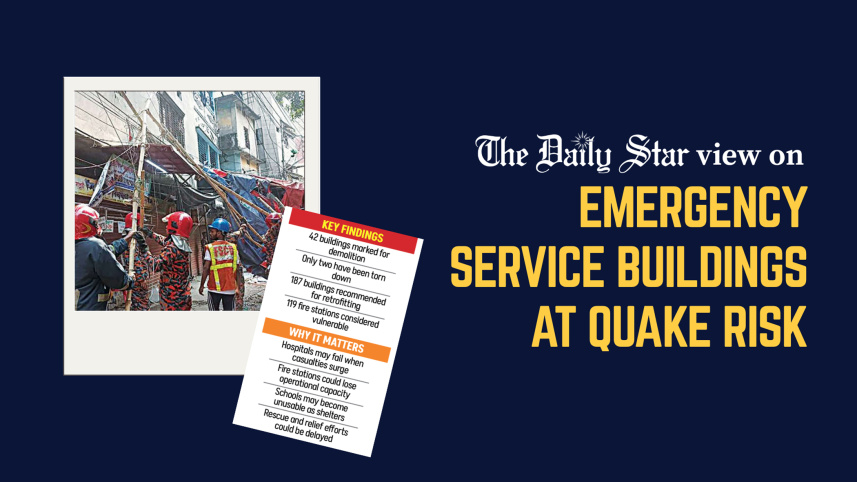
The fourth instalment of a series of reports in this daily, examining Bangladesh’s earthquake preparedness, presents the terrifying reality that many emergency service facilities are so structurally vulnerable that they could be severely compromised after a moderate-to-major earthquake. These are the very services a disaster-stricken population needs the most; hospital wards to treat injuries, fire trucks and fighters to address fires and rescue survivors, and police stations that respond to emergencies. Right now, according to Rajuk itself, many of them wouldn’t even survive the emergencies they exist to respond to.
In 2020, Rajuk began Rapid Visual Assessments of 3,252 government buildings under its Urban Resilience Project. By 2023, as many as 42 buildings had been ordered to be vacated within seven days and demolished within three months, while 187 more were marked for retrofitting. Of the 42 highest-risk buildings, most belonged to eight government and autonomous educational institutions. Three of them are located within Bangladesh Medical University (formerly PG Hospital). According to officials, progress has been slow because building owners cite financial constraints, some have secured court orders for more time, and Rajuk admits the problem exceeds its authority to resolve on its own. There have been repeated calls for an inter-ministerial approach, but this has yet to materialise.

To its credit, the fire service has not sat entirely idle. Old stations at Postogola, Mirpur, and Mohammadpur have been rebuilt, several others retrofitted, and a new Emergency Operations Centre opened in Mirpur. While the progress is promising, it is still not good enough: 119 of the country’s 537 fire stations, many dating to back to the pre-1971 era, remain classified as vulnerable, with no comprehensive timeline over which to fix the rest.
Experts have laid out some recommendations. The easiest step is a quick, low-cost building check by assigning trained eyes to look for obvious red flags (like cracks or tilting walls). From there, emergency buildings such as hospitals, fire stations, and police posts should be prioritised. Hospitals need to go a step further with detailed, facility-specific assessments and actual repair work. The hardest task, though, would be getting Rajuk, the fire services, city corporations, and disaster management authorities to work off a single coordinated, government-backed plan with real deadlines, instead of four different agencies each waiting on the others to move first.
Bangladesh may not know when its next major earthquake will strike, but what it does know from its own regulator’s findings, is that the buildings meant to save lives that day may fail before the rescue even begins. That is not a risk any government can afford to leave stalled. Rajuk and the relevant ministries must set firm, public deadlines for retrofitting the 187 identified buildings and demolishing what remains of the 42 condemned ones. And this time, it must follow through.
 For all latest news, follow The Daily Star's Google News channel.


Comments