


Delayed testing is hampering measles treatment
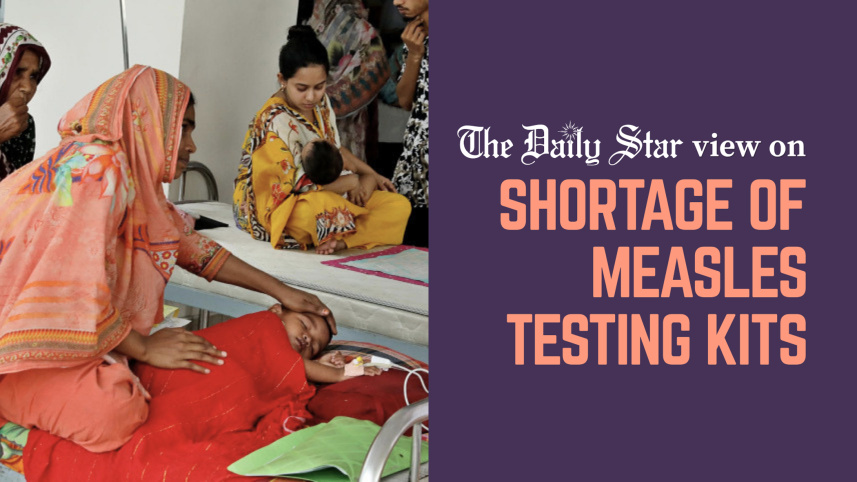
The ongoing measles situation has been a wake-up call for us all, but it should be especially so for the country’s health sector. After myriad issues regarding vaccine procurement and stocks, the government finally launched a nationwide measles-rubella vaccination campaign on Monday. Under the programme, around 1.8 crore children aged six months to 59 months will be vaccinated until May 20. We advise relevant authorities to ensure that this campaign runs smoothly and effectively, especially in rural and high-risk areas. However, it is most concerning that there is a dismal shortage of measles testing kits in the country.
According to a Prothom Alo report, the Institute of Public Health (IPH) in the capital’s Mohakhali receives around 300 samples and has the capacity to test 300-400 samples daily. However, it can only test 120 samples due to a kit shortage. The measles testing kits are supplied by the World Health Organization (WHO), and each kit can be used to test 90 samples. As of Sunday, the IPH had 63 kits, with 60 more arriving that evening. Many of these kits are stuck at the Dhaka airport, delayed by documentation hurdles. Given this situation, a large number of samples are not being tested in time.

What is unfathomable is that the IPH is the only public organisation in the country where samples are tested for measles. How is it that, even a month into this crisis, testing capacity has not been expanded to include facilities in other major cities? Why is it that measles samples from public hospitals outside Dhaka are sent all the way to this one institute situated in the capital?
It is true that the government’s response so far, considering all aspects of the crisis, has been admirable. But there are still several holes in its “plan,” and this might be one of the biggest so far. Given the seriousness of the situation and the death toll so far (with 181 suspected and 36 confirmed measles deaths till Sunday afternoon), we ask the relevant authorities to not only work on freeing the kits stuck at the airport, but to urgently communicate with the WHO to secure an adequate stock of measles testing kits. Vaccination is crucial for prevention, but timely diagnosis is equally important to ensure that patients older than the vaccination age receive the best possible care. Most importantly, diagnostic capacity in other divisions besides Dhaka must be strengthened to reduce the time between sample collection and diagnosis countrywide.
 For all latest news, follow The Daily Star's Google News channel.
Comments