


Vengeance brings disaster, dialogue is the way
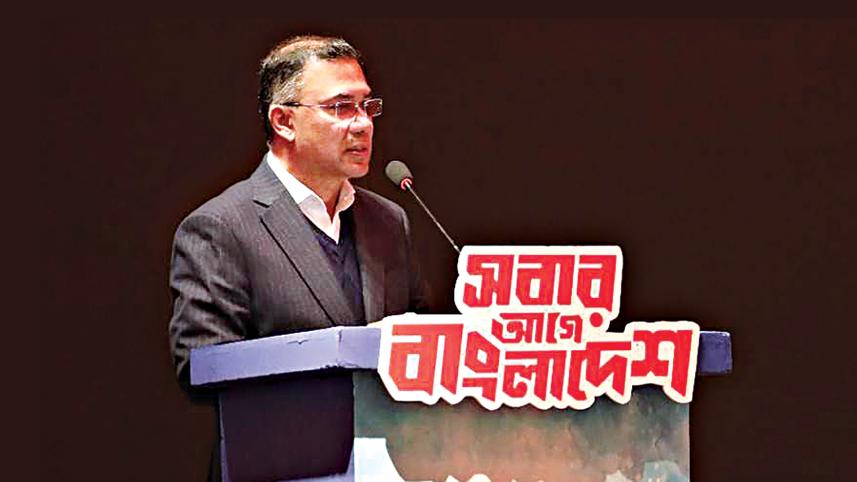
Sustaining the democratic process and ensuring accountability at every level, at any cost, is essential to bringing meaningful changes to the country, BNP Chairman Tarique Rahman said yesterday.
Bangladesh must be freed from the politics of vengeance, he said, stressing that political differences should never harden into deep divisions.

“We are facing tough challenges. The democratic process must be kept alive at all costs. We had problems, we have problems, but we do not want to return to the situation before August 5, 2024. Therefore, putting aside our differences, everyone must work together,” Tarique said at an event where he exchanged greetings with editors and journalists at a city hotel.
Recalling moments that shaped his political outlook, he referred to his father’s janaza in 1981, his mother’s janaza on December 31, 2025, and the events of August 5, 2024.
“So I feel this is not only about me. For the leaders and activists of my party, and for the people of the country as a whole, these examples are perhaps the clearest reasons why there is absolutely no need to go back to the situation before August 5,” he said.
Tarique warned that violence and cycles of retaliation inevitably lead to dangerous consequences.
“The nation has seen the consequences of vengeance or retaliation on August 5, 2024. Even if there are differences of opinion, they must be bridged through discussions. Differences should not escalate into conflicts,” he said.
He emphasised that the democratic process must continue at all national and local levels, including union parishad, municipal, and trade body elections.
Urging politicians to work for the country’s independence and sovereignty, Tarique said lessons must be drawn from pivotal moments in history, including 1971, 1990 and August 5, 2024.
“If we keep these events in mind and work honestly for the country, I firmly believe we can lead the nation in the right direction,” he said.
Calling on leaders of all parties and people from all walks of life to remain engaged, Tarique said that, as a political worker, he foresaw many difficult challenges ahead.
“We have different kinds of differences among us. We should be able to discuss these differences through dialogue,” he added.
Referring to his recent travels to different parts of the country since returning, he said he sensed a deep yearning for direction and hope, particularly among the younger generation.
“Not only the new generation, but every generation expects guidance. People have many expectations from those involved in politics. Even if it is not possible to fulfil all expectations, if politicians work to protect the country’s independence and sovereignty, it will be possible to lead the nation on the right path,” he said.
Seeking constructive engagement from the media, Tarique called for criticism that is purposeful rather than performative.
“Criticism is necessary, but not criticism for the sake of criticism. We want criticism that helps solve the country’s problems.”
Outlining policy ideas, Tarique said the BNP plans to introduce a “farmer card” for around one and a half crore farmers.
“The huge number of people who provide food for 20 crore citizens have no proper platform to raise their issues. We must hear their problems ourselves.”
Referring to the role of his late mother Khaleda Zia, he said the party also plans to introduce a family card to help educated women become economically self-reliant if the BNP is voted to power.
He said the party intends to adopt a prevention-based approach in the health sector to reduce costs and improve public wellbeing.
 For all latest news, follow The Daily Star's Google News channel.
 “If people are made aware of which foods increase the risk of kidney disease, heart problems or diabetes, state expenditure will fall and people will remain healthier,” he said, adding that healthcare workers would be appointed for this purpose.
Noting that the country’s population stands at around 20 crore, with a large proportion being young, Tarique stressed the urgency of creating employment opportunities at home and abroad.
“If we fail to do this, then whether we talk about August 5, the movement of 1990 or the Liberation War of 1971, I think all our hopes may be destroyed,” he said.
He also drew attention to the growing drinking water crisis, warning that pollution of major rivers could have devastating consequences.
“Today, the Buriganga is polluted, the Shitalakkya is nearly half polluted, and pressure on the Meghna is also increasing. If this trend continues, the future shortage of safe water could become catastrophic,” he said.
Tarique said the party’s plans also include health cards to ensure healthcare for all, modernisation of vocational and technical institutes, skills development through training, expansion of the IT sector, entrepreneurship promotion, development of IT parks with modern facilities, and easing barriers to content creation.
BNP Secretary General Mirza Fakhrul Islam Alamgir and Standing Committee members Mirza Abbas, Abdul Moyeen Khan, Amir Khasru Mahmud Chowdhury, Salahuddin Ahmed and Major (retd) Hafiz Uddin Ahmed were present at the event.
The programme was moderated by BNP Media Cell Convener Maudud Hossain Alamgir Pavel and Press Secretary Saleh Shibly.
Comments