


Untreated medical waste raises health risks in Ctg

Key points-
- Hospitals, diagnostics mixing medical waste
- Three tonnes of medical waste generated daily; half disposed of improperly
- Only three hospitals segregate waste at source
- Nagar Seba incinerates 750kg daily; backlog remains
- Liquid, hazardous waste spilling near CMCH
- Experts warn of severe health risks
Medical wastes from different hospitals and diagnostic centres across Chattogram city are being routinely collected and disposed of without proper segregation, raising serious public health risks, including the spread of infectious diseases.

Standard biomedical waste disposal protocols require different coloured bins for specific waste types: red bins for recyclable contaminated waste such as syringes without needles; yellow bins for soiled waste like bandages and cotton swabs; white puncture-proof containers for sharp objects including needles and blades; blue bins for glassware; and black bins for non-biomedical waste.
However, most health centres in the port city are mixing all waste before disposal, as witnessed by this correspondent during visits to several private hospitals in Panchlaish, Mehedibagh and Surson Road areas.
Contacted, Dr Shakeel Ahmed, a public health expert and retired professor of the Bangladesh Institute of Tropical and Infectious Diseases, said improper segregation of medical waste poses serious health risks.
“If medical wastes are collected and disposed of without segregation, there might be a risk of contamination of diseases like Hepatitis B, C and HIV among both the collectors and common people,” he said.
At Chattogram Medical College Hospital, the region’s largest healthcare facility, liquid waste was seen trickling down from unsegregated heaps of garbage onto the road and spreading towards the hospital’s emergency department, directly exposing patients and the public.
According to Dr Jahangir Alam, civil surgeon of Chattogram, there are 290 registered private medical facilities in the city, including 92 hospitals and 198 diagnostic centres, alongside two government hospitals and 14 upazila health complexes.
Sources said a number of unregistered clinics and diagnostic centres have also mushroomed in the city, evading regulatory oversight.
Around three tonnes of medical waste are generated in Chattogram city every day, according to sources at the Chattogram City Corporation. However, there is no study on the volume of medical waste produced across the 15 upazilas of the district.
Only one company, Nagar Seba, currently operates in the city to collect and dispose of medical waste from hospitals, clinics and laboratories. No such service operates at the upazila level.
Pranab Sharma, deputy chief conservancy officer of the city corporation, said the company uses an incinerator set up by the corporation under a JICA project at the Halishahar landfill to dispose of medical waste.
However, officials of Nagar Seba said the company is collecting and disposing of only half of the hazardous waste generated in the city, around 1.5 tonnes daily.
The remaining medical waste is reportedly being collected by city corporation workers along with general waste, meaning half of the city’s infectious waste is being improperly disposed of, further heightening public health risks.
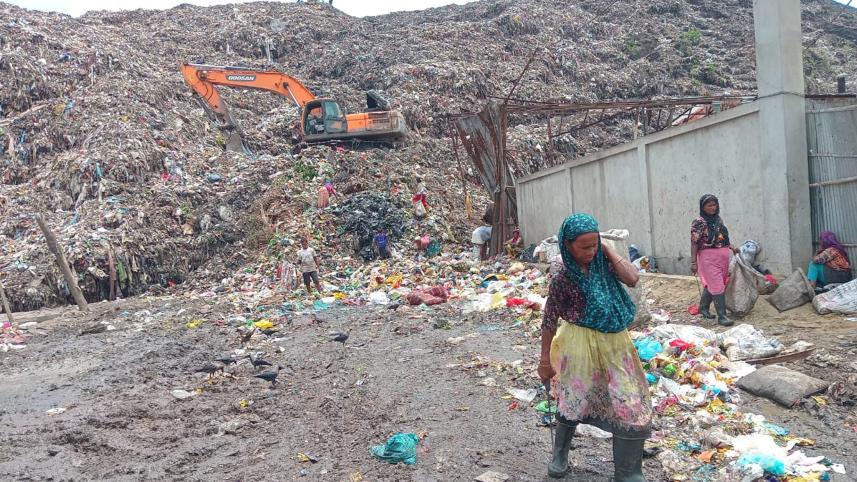
During a recent visit to the city corporation landfill at the Halishahar Anandabazar area, conservancy workers were seen dumping waste, while some people were collecting plastic materials from the landfill.
The incineration plant beside the landfill was not operational when this correspondent visited the site around noon. Medical waste in polythene bags was seen piled up and scattered along the road in front of the plant, with no visible signs of waste segregation.
Shimul Kanti Dey, foreman of the plant, said it usually operates for only three hours from 9:00am daily to avoid technical glitches.
“We can burn 750kg of medical waste a day in three hours, but around 1.5 tonnes of medical waste are brought in daily. The rest of the waste is kept on the ground in plastic bags,” he said.
Asked about waste segregation, he said that earlier, medical waste used to be delivered after segregation at the source, but over the past eight months, waste has been brought in without any sorting.
“We have to burn all waste together in the plant at the highest 820 degrees Fahrenheit temperature,” he added.
 For all latest news, follow The Daily Star's Google News channel.
 Contacted, Md Bokhtair, a director of Nagar Seba, said 150 of the 290 registered medical entities have signed memorandums of understanding with the company for waste collection and disposal.
“We collect 1.5 tonnes of medical waste daily. We realise monthly fees ranging from Tk 1,500 to Tk 20,000 from each entity for the service,” he said.
He added that some public hospitals, including Chattogram General Hospital and City Corporation Memon Hospital, have not signed MoUs with the company.
Asked about the issue, Dr Ekram Hossain, acting director of Chattogram General Hospital, confirmed that the hospital’s waste is handed over to city corporation conservancy workers instead of a specialised service, adding that he would need to check records to explain the absence of an MoU.
Contacted, Dr Imam Hossain Rana, chief health officer of the city corporation, said he was unaware whether Memon Hospital had signed an MoU with Nagar Seba. “I would look into the matter,” he said.
Mohammad Ismail, operations manager of Nagar Seba, said most facilities are ignoring the responsibility of waste segregation at the source.
“Waste segregation should be done at the source. However, only three hospitals -- Parkview, Evercare and Imperial -- provide medical waste after segregation. The rest of the hospitals and diagnostic centres provide waste without sorting,” he said.
Dr Shakeel Ahmed stressed that waste segregation must begin at hospitals and diagnostic centres and called for greater accountability.
“If any hospital or diagnostic centre does not segregate medical waste at source, the city corporation or the collecting organisations should file complaints with health authorities against them,” he said.
Contacted, Brig Gen Taslim Uddin, director of Chattogram Medical College Hospital, said medical waste segregation rules are supposed to be followed in every ward.
“I would look into whether the rules are being followed properly,” he added.
Comments