


Prelude to BNP's manifesto

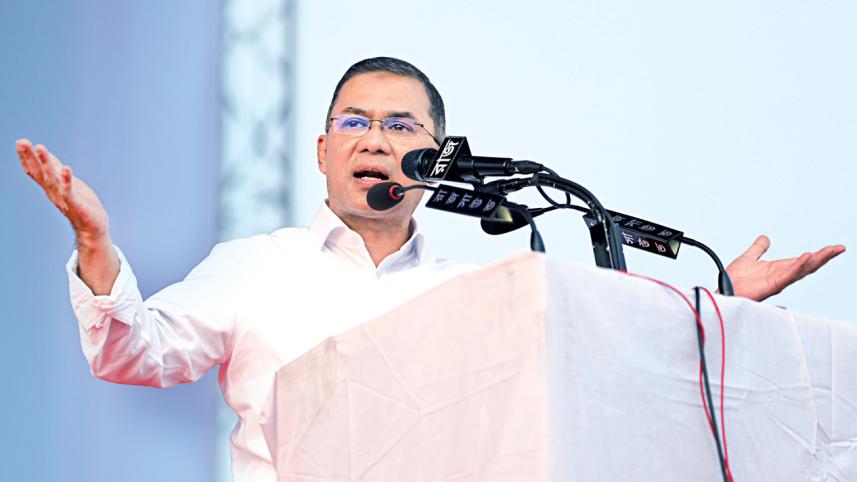
The newly anointed BNP chief, Tarique Rahman, set the tone at the beginning when he took the opportunity on Saturday to lay out glimpses of the plan, that he had loudly declared the day he arrived in Bangladesh, and what is most likely his party’s election manifesto. It was a meeting with journalists and editors, where the BNP chief stressed on the importance of democratic process and accountability. He said difference of opinion must not lead to division but should be resolved through dialogue.
Notably, Tarique spoke with a subdued tone, as if he were taking his interlocutors in confidence just as he would a few friends in his drawing room. He spoke with a semblance of humility and checked the right boxes when he spoke about the ‘plan’, which was clearly just a prelude to the full manifesto. Referring to his plan, Tarique said it revolved, to a large part, around women who account for half the country’s population.

When explaining his vision about the universal family cards, Tarique Rahman said one woman from each family would be issued with such a card. By way of rationale, he said, women spent their wisely, first on health of the family, second on children’s education and third on small investment. Taken together, he explained this would gradually lift households, villages, unions and upazilas gradually.
The BNP chair mentioned a few measures and touched on a few issues of immediate concern facing the country. He took note of farmers and expats. For expats, Tarique suggested upskilling them with vocational and language training. Tarique mentioned incentives for export-oriented industries and resolving payment gateway issues for tech freelancers. He also mentioned repurposing IT parks as startup offices for these internet professionals. He spoke about preventive healthcare and appointing 80–85% women as frontline health sector workforce who would go from door to door with awareness messages for health and family planning.
Tarique also took note of water scarcity that might paralyse the entire Dhaka city within just a few decades. Speaking about the individual safety, Tarique pointed to the thousands of lives lost and in road accidents every day and how there was no real remedy or relief for the victims. He talked about jobs and how the discussion about reforms could focus more on issues like jobs and women’s empowerment, health and children’s education—incidentally that was the only passing mention of education in general—that would benefit individual citizens.
While talking about a culture of tolerance and dialogue, employment and women’s emancipation, the BNP chief raised hopes and expectations about his party’s manifesto. At the same time, he raised the bar for his competitors but also for himself and his party. Family cards, vocational training, preventive healthcare or any other initiative will require detailed planning, sincere execution, not to mention funds and resources and that warrants rigorous examination.
Tarique Rahman will now have to make good on his hints and come forward with a manifesto that lives up to the expectations.
 For all latest news, follow The Daily Star's Google News channel.
Comments