


Parts of Lalar Dighi being filled up
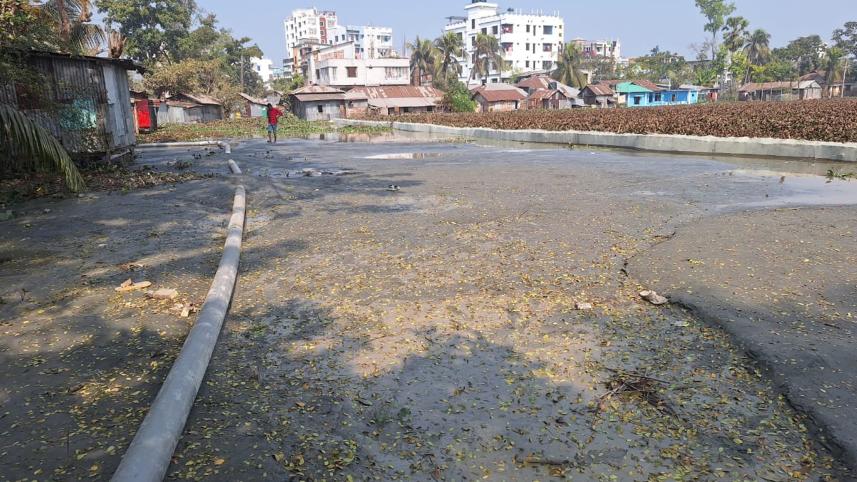
The National Housing Authority’s Rupatali unit in Barishal has been filling up a portion of Lalar Dighi, the largest natural waterbody in the city, raising serious environmental and legal concerns.
Locals said sand filling using pipes from a neighbouring river has been underway along the Lalar Dighi embankment adjacent to the Rupatali Housing Estate under Barishal City Corporation for the past 15 days.

The nearly six-acre waterbody is largely owned by the district administration. It is bordered by the Rupatali Housing Estate on three sides and a 12-foot-wide road on the western side.
The housing estate, one of Barishal’s most upscale areas, was developed in 1977–78 and now covers more than 40 acres.
According to SA land records, Lalar Dighi has around four acres of waterbody, with the remaining area comprising land surrounding it.
NHA authorities, however, claimed ownership of 50 decimals of land along the embankment on the western side of the dighi and said they were filling only that portion.
Officials argued that records identify the land as pond embankment rather than waterbody and that erosion over time caused it to submerge. They said the land is now being reclaimed and that no permission was required, as it is not classified as a waterbody.
However, an on-the-spot visit found that the portion being filled -- around 300 feet long and 80 feet wide -- appears to fall within the waterbody rather than on the embankment.
“This more than century-old waterbody has faced repeated attempts at illegal encroachment through forgery. No one could occupy or fill it earlier as the city corporation intervened. Now NHA is filling up part of it to prepare plots for sale,” alleged local resident Jahangir Molla.
Following the allegations, Dipak Lal Chatterjee, deputy assistant land commissioner in Barishal, visited the site recently. He said a portion of the land belongs to the district administration and that the issue has been brought under official notice.
Rafiqul Islam, administrative officer of the Rupatali Housing Estate, said the authority is reclaiming 50 decimals of land acquired in 1977–78 that later eroded into the dighi.
“As this is embankment land and not part of the dighi itself, we did not seek permission from the Department of Environment,” he said.
Environmentalists disagreed with the claim.
Rafiqul Alam, Barishal divisional coordinator of Bangladesh Poribesh Andolon, said, “Whether marked as pond or embankment, it is part of a major waterbody. Filling it and selling plots is not acceptable for a government institution.”
Echoing him, Lincoln Biyen, divisional coordinator of the Bangladesh Environmental Lawyers Association in Barishal, said the Department of Environment has been informed and legal notices have been served on nine entities, including the NHA, BCC and the DoE.
Under the Waterbody Conservation Act, 2000, and the Bangladesh Water Act, 2013, filling or altering waterbodies without environmental clearance from the DoE is a punishable offence.
Contacted, Kazi Saifuddin, assistant director of the DoE in Barishal district, said they have already asked NHA authorities to stop filling the waterbody and submit all documents related to land ownership.
 For all latest news, follow The Daily Star's Google News channel.
Comments