


‘Over 500’ killed in Iran anti-regime unrest
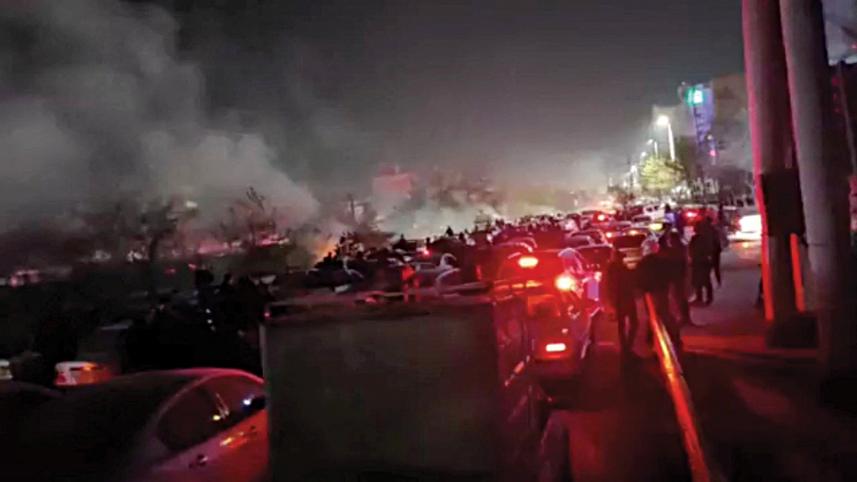
Unrest in Iran has killed more than 500 people, a rights group said yesterday, as Tehran threatened to target US military bases if President Donald Trump carries out threats to intervene on behalf of protesters.
With the Islamic Republic’s clerical establishment facing the biggest demonstrations since 2022, Trump has repeatedly threatened to intervene if force is used on protesters.

According to its latest figures, from activists inside and outside Iran, US-based rights group HRANA said it had verified the deaths of 490 protesters and 48 security personnel, with more than 10,600 people arrested in two weeks of unrest.
Iran has not given an official toll, and Reuters was unable to independently verify the tolls.
Trump was to be briefed by his officials on Tuesday on options over Iran, including military strikes, using secret cyber weapons, widening sanctions and providing online help to anti-government sources, the Wall Street Journal said yesterday.
CNN, quoting two officials, yesterday said Trump is weighing a series of potential military options in Iran.
Trump was briefed in recent days on different plans for intervention, the officials told CNN. Some of the discussions have also included options that do not involve direct US military force, one of the officials said.
The president has not yet made a final decision on intervention, the officials said, but he is seriously considering action as the death toll in Iran continues to rise.
The casualty figures were reported as Iranian authorities step up efforts to quell the country’s largest protests in years, which have seen thousands of people take to the streets in anger over the soaring cost of living and inflation.
The protests, which began on December 28, have spread to more than 100 cities and towns across every province in Iran, according to the BBC and other international media. Protesters are now calling for an end to the clerical rule of Iran’s Supreme Leader, Ayatollah Ali Khamenei.
Iranian Parliament Speaker Mohammad Baqer Qalibaf, speaking in parliament yesterday, warned against “a miscalculation”.
“Let us be clear: in the case of an attack on Iran, the occupied territories (Israel) as well as all US bases and ships will be our legitimate target,” said Qalibaf, a former commander in Iran’s elite Revolutionary Guards.
Earlier, Iran Human Rights, a Norway-based NGO, said at least 192 people have been killed in two weeks of protests. It said the toll could be much higher as a days-long internet blackout hampered verification, but did not break down the figures between protesters and security forces.
Meanwhile, Iran’s semiofficial Tasnim news agency yesterday reported that 109 security personnel had been killed in the protests across the country.
Staff at several hospitals told the BBC they have been overwhelmed with the injured and dead, with BBC Persian verifying 70 bodies brought to one hospital in Rasht city on Friday night and a health worker reporting around 38 people dying at a Tehran hospital.
Iran’s police chief said on state TV that the level of confrontation with protesters had been stepped up, with arrests on Saturday night of what he called “key figures”. He blamed a “significant proportion of fatalities” on “trained and directed individuals”, not security forces, but did not give specific details.
Contrary to media reports, Iran’s interior ministry said the “riots” are gradually subsiding while the attorney general has warned that those involved in the unrest could face the death penalty.
Speaking to state broadcaster IRIB, Iran’s President Masoud Pezeshkian yesterday said that the US and Israel want to “sow chaos and disorder” in Iran by ordering “riots”, and called upon Iranians to distance themselves from “rioters and terrorists”.
On Saturday, Reza Pahlavi, the US-based son of Iran’s ousted shah, urged Iranians to stage more targeted protests with the aim of taking and then holding city centres. He also said he was “preparing to return to my homeland” on a day he believed was “very near”.
However, analysts doubt how much support the shah still carries in Iran and say the protests appear to be spontaneous and targeted at “dictator Khamenei”, whom they blame for their economic woes.
 For all latest news, follow The Daily Star's Google News channel.
 Khamenei has dismissed demonstrators as a “bunch of vandals” seeking to “please” Trump.
Three Israeli sources, who were present for Israeli security consultations over the weekend, said Israel was on a high-alert footing, but did not elaborate on what that meant.
An Israeli government spokesperson declined to comment. The Israeli military did not immediately respond to a request for comment.
Israel and Iran fought a 12-day war in June last year, in which the US joined Israel in launching airstrikes. Iran retaliated for those US strikes by firing missiles at an American air base in Qatar.
The flow of information from Iran has been hampered by an internet blackout imposed by the authorities since Thursday. Internet monitoring watchdog Netblocks reported national connectivity levels remained about 1 percent of the norm.
Video verified by AFP showed large crowds taking to the streets in new protests on Saturday night in several Iranian cities, including Tehran and Mashhad in the east, where images showed vehicles set on fire.
A social media video posted on Saturday showed large crowds gathered in Tehran’s Punak neighbourhood at night, drumming rhythmically on the railings of a bridge or other metal objects in an apparent sign of protest. Reuters verified the location.
Iranian state TV broadcast funeral processions in western Iranian cities such as Gachsaran and Yasuj for members of the security forces killed in the protests.
The Revolutionary Guards on Saturday accused “terrorists” of attacking security facilities. On the same day, Iranian army said in a statement that it would defend the country’s “national interests” as it accused Israel and “hostile terrorist groups” of seeking to “undermine the country’s public security”.
Iran’s rulers have quelled previous bouts of unrest, most recently in 2022 over the death in custody of a woman accused of violating dress codes.
Trump, posting on social media on Saturday, said: “Iran is looking at FREEDOM, perhaps like never before. The USA stands ready to help!!!”
His comments came a day after he said Iran was in “big trouble” and again warned that he could order strikes.
“That doesn’t mean boots on the ground, but it means hitting them very, very hard – where it hurts,” the US president said.
In a phone call on Saturday, Israeli Prime Minister Benjamin Netanyahu and US Secretary of State Marco Rubio discussed the possibility of US intervention in Iran, according to an Israeli source who was present for the conversation.
A US official confirmed the two men spoke, but did not say what topics they discussed.
Israeli Foreign Minister Gideon Saar yesterday said that Israel supports the Iranian people in what he described as their “struggle for freedom”.
A senior US intelligence official on Saturday described the situation in Iran as an “endurance game”. The opposition was trying to keep up pressure until key government figures either flee or switch sides, while the authorities were trying to sow enough fear to clear the streets without giving the United States justification to intervene, the official said.
Comments