


Anti-venom shortage puts patients at risk

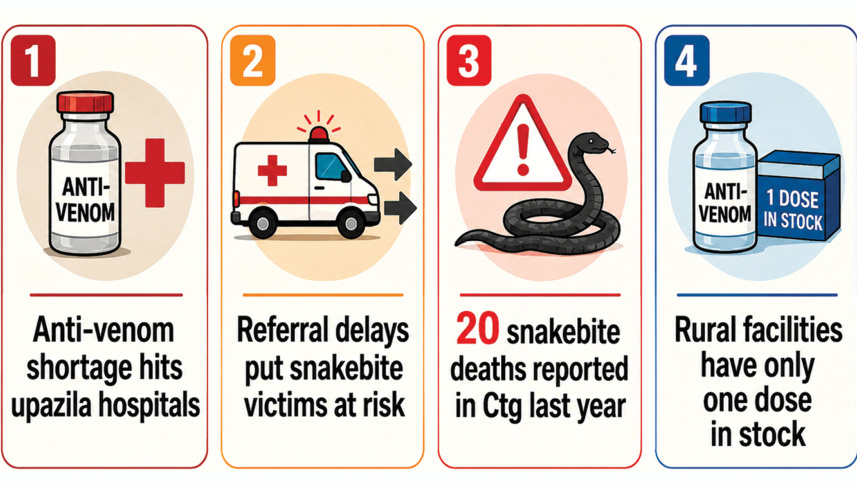
Upazila health complexes across Chattogram are facing an acute shortage of anti-venom for snakebite patients, while delays in administering the life-saving drug during referral to district-level or medical college hospitals have raised serious concerns.
Several snakebite victims have died in the region recently.

Most recently, Mohammad Ayat, 2, died on May 12 after a venomous snake bit him in the Suabil area of Nazirhat under Fatikchhari upazila.
Family members alleged that the child’s condition deteriorated because the local health centre did not have anti-venom in stock.
He was later referred to Chattogram Medical College Hospital and died after being taken there.
Hospital authorities said anti-venom was available at CMCH, but the child’s condition worsened before it could be administered.
The Chattogram Civil Surgeon’s Office later formed a committee to investigate the incident.
According to local news reports, at least 20 people died from snakebites across Chattogram last year, mostly during the monsoon. Green pit-vipers, monocled cobras, banded kraits and king cobras are the common culprits.
Although snakebite incidents are more common in villages, health officials say rural facilities rarely have more than one dose of anti-venom, or 10 vials, in stock.
Officials at the Chattogram Civil Surgeon’s Office and the Divisional Health Director’s Office said an adult snakebite patient usually requires one dose.
Before administering anti-venom, a blood clotting test must be conducted to determine whether the snake was venomous and how toxic the venom was.
In the case of children, the number of vials is determined based on body weight.
“We have instructed every health centre across the division to keep anti-venom for at least one patient. If multiple patients arrive, the local authority has been advised to collect additional supplies from nearby health centres through coordination,” said Chattogram Divisional Health Director Sheikh Fazle Rabbi.
“This anti-venom is not available in the open market. It is officially procured and stored in government facilities for supply. As official procurement has remained suspended, we are now trying to collect supplies from alternative sources to address the shortage,” he added.
According to the Directorate General of Health Services, more than 4,00,000 people suffer snakebites annually in Bangladesh, with around 24 percent of cases involving venomous snakes.
Last year, the annual death toll stood at 7,511. Around 95 percent of venomous snakebite incidents occur in rural areas.
Although venomous snakes are present at the Chittagong University campus, its medical centre also lacks anti-venom facilities.
In March 2018, Chittagong Medical College launched a Venom Research Centre to produce anti-venom locally. The centre currently houses more than 400 snakes.
Professor Aniruddha Ghosh of the medicine department at CMCH, also chief researcher at the Venom Research Centre, said the anti-venoms currently used to treat snakebite patients are produced in India.
“Differences in venom composition and characteristics across regions mean these medicines are not equally effective in all cases. Our research aims to develop anti-venom for the 10 venomous snake species found in Bangladesh,” he said.
 For all latest news, follow The Daily Star's Google News channel.
Comments