


Inside house of horror

From the outside, the ageing two-storey building inside the Rapid Action Battalion (Rab)-1 headquarters in Uttara appears almost idyllic.
Blanketed by lush green trees whose branches swayed gently in the breeze, the building offered a rare respite from the oppressive summer heat.

Behind those walls, however, lies one of Dhaka’s darkest secrets.
For the first time, local journalists were allowed inside the Task Force for Interrogation (TFI) Cell -- widely known as “Aynaghar” -- where investigators allege scores of political opponents and perceived dissenters under the Awami League government were secretly detained, tortured and, in some cases, never seen again.
Yesterday, judges of the International Crimes Tribunal-1, accompanied by prosecutors, defence lawyers, members of the Commission of Inquiry on Enforced Disappearances inspected the alleged detention centre as part of ongoing crimes against humanity trials over enforced disappearances.
The building, surrounded by nearly 10-foot-high boundary walls topped with barbed wire, contains 29 cells spread across its upper and lower floors. Prosecutors said almost all of the cells had their walls broken or removed in what appeared to be an attempt to destroy evidence after the 2024 political changeover. Piles of debris still litter many of the rooms.
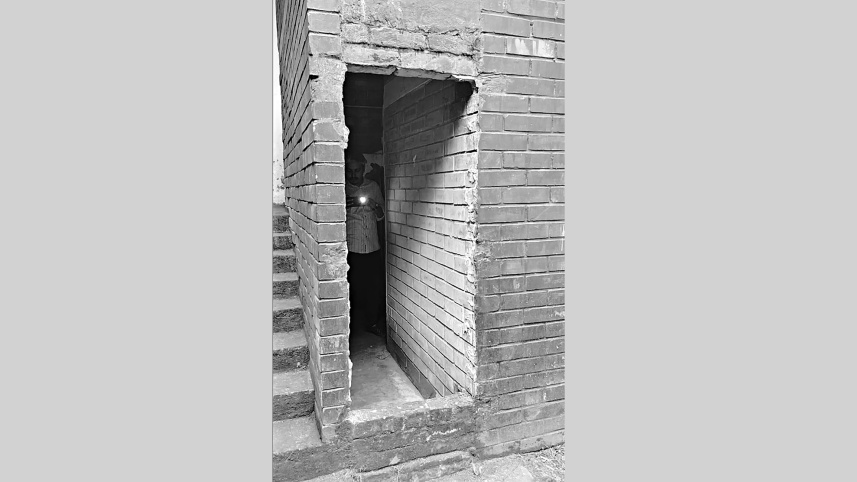
The narrow entrance on the ground floor, tucked beside a staircase, offers little clue to what lies inside. Visitors must lower their heads to squeeze through a cramped passage barely wide enough for one person. A few steps later, the passage opens into a maze of dim, narrow corridors lined with windowless concrete chambers.
Some of the chambers are so small they resemble concrete graves more than prison cells.
On the ground floor, investigators showed seven such compartments measuring roughly two feet by four feet, with ceilings so low that even a child would struggle to stand upright. An adult could do little more than sit with knees pressed against the chest. There was no sunlight, no fresh air, only a water tap and a small drainage opening through which detainees were forced to urinate and defecate.
Prosecutors, citing victims, said these are called the “cells of death”. They said that after the change of government in 2024, a wall had been built to seal off the entrance to these cells. Investigators later broke down the wall during their inquiry.
“Those seven cells were known as death cells because those taken there either never returned alive or were later taken away to be killed,” Prosecutor Shyikh Mahdi, a member of the investigation team probing enforced disappearance cases, told The Daily Star during the visit.
Mahdi alleged that many detainees were injected with heavy sedatives before being taken away unconscious, shot dead, their abdomens slit open, their bodies wrapped in sacks and dumped into rivers.
According to him, the TFI facility was operated by Rab’s intelligence wing until the fall of the Awami League government following the July uprising.
Outside the cells stood Sanjida Islam Tulee, coordinator of Maayer Daak, whose brother Sajedul Islam Sumon has remained missing since his enforced disappearance in December 2013.
“What we have learned is that my brother was picked up by Rab-1 members. We believe he was kept in one of these death cells,” she told The Daily Star.
“There can be no greater violation of human rights than this,” she said, demanding punishment for those responsible.
Although the building’s western wall stands only a few yards from the busy Dhaka-Mymensingh highway, prosecutors said no outsider could have known what was happening inside because the cells had no windows, only a few openings for exhaust fans.
Another staircase descends to a lower section containing 10 more small cells – five on each side of a narrow corridor. Each measures about five feet by eight feet and can only be entered through another low, narrow doorway. Every cell has an open hole to be used as toilet.
Prosecutors said current Home Minister Salahuddin Ahmed had been held in one of those cells for several days before being forcibly pushed across the Indian border.
Rab personnel assigned to guard the TFI cells, also referred to as the “hospital”, stayed in another section of the ground floor.
 For all latest news, follow The Daily Star's Google News channel.
 Because the building has no electricity connection, prosecutors accompanying journalists carried torchlights throughout the inspection.
The first floor contains another 10 cells, each measuring about 14 feet by four to five feet. Another section houses two larger so-called VIP cells each with a small attached toilet.
Mir Quasem Bin Arman, now Jamaat lawmaker was allegedly held in one of the VIP cells for around eight years before being released, prosecutors said.
Directly opposite the VIP cells are three soundproof interrogation rooms, prosecutors said. The rooms once contained equipment including a motor-powered rotating steel chair and electric shock tools used to torture detainees.
Those on trial in two cases concerning alleged enforced disappearances and secret detentions at the TFI Cell and the Joint Interrogation Cell allegedly operated by DGFI include deposed prime minister Sheikh Hasina and several former Rab officials who have denied the allegations.
“Many people may think the stories about the Aynaghar are nothing more than rumours. But this is the grim reality,” Chief Prosecutor Aminul at a briefing at Rab-1 premises after the inspection.
“Several victims came out of the detention cells after August 5, 2024. We still do not know the whereabouts or fate of more than 250 victims of enforced disappearance, including Ilias Ali and Sumon.”
Asked whether those responsible for allegedly destroying evidence at the TFI Cell would be brought to justice, Aminul said investigators would look into the matter.
ABM Hamidul Mishbah, a defence lawyer representing some of the accused Rab officials, told the briefing that the prosecution had failed to make any specific allegation that his clients had detained victims at the facility. “What is stated in the formal charge does not match what is here,” he said.
Comments