


Banking sector among most fragile as Bangladesh economy faces multiple risks: CPD
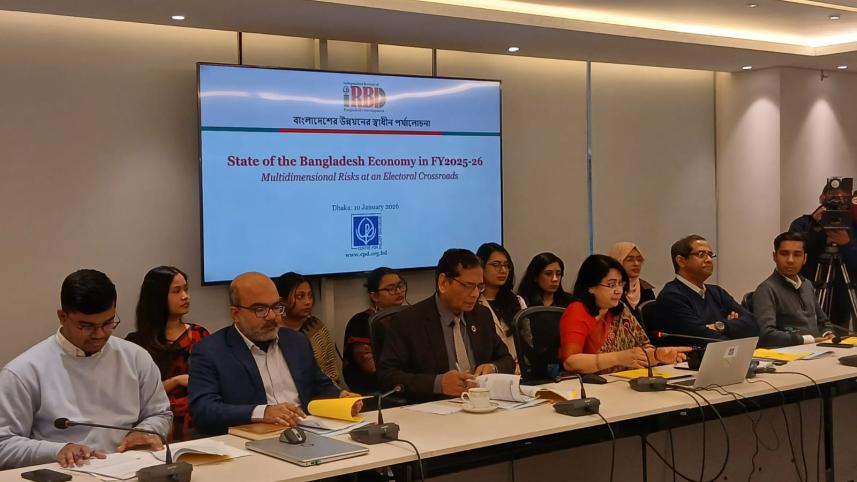
Bangladesh’s economy faces multidimensional risks at an electoral crossroads, with the banking sector remaining one of the most fragile pillars, said the Centre for Policy Dialogue (CPD) today.
The independent think-tank identified seven challenges, including increased dependence on bank borrowing to finance public expenditure, persistent inflation, food security challenges, and weak private investment.

“At the core of the current economic management challenge lies the need to restore fiscal discipline while safeguarding growth and social stability,” said the CPD in its independent review on the state of the Bangladesh economy for the first half of the fiscal year 2025–26.
CPD said Bangladesh is at a ‘critical juncture of its journey’ as the nation is bracing for the upcoming national elections, scheduled to take place on February 12.
“Citizens are genuinely concerned about and interested in gaining a deeper understanding regarding the socioeconomic trends in the run-up to the elections,” said its Executive Director Fahmida Khatun, presenting the assessment on the economy at a press conference at the organisation’s office in Dhaka.
Inflation has emerged as a structural concern rather than a temporary shock, the CPD said.
“Monetary tightening alone cannot resolve a problem that is increasingly rooted in supply-side rigidities, market distortions, and weak competition. The reform of food supply chains must therefore become a national priority,” the CPD said.
“Stabilising food prices is not only an economic necessity but also a social and political imperative.”
Third, it said, the food security challenge further underscores the urgency of reforming agricultural and food grain management systems.
Food security must be recognised as a macroeconomic and governance issue, closely linked to social protection, political stability, and poverty reduction.
Citing banking sector challenges, the CPD said the swift enactment and implementation of reform legislation, the restoration of Bangladesh Bank’s independence and authority, and the consistent application of the bank resolution framework are essential.
“A modern insolvency regime, supported by specialised courts and trained professionals, must be operationalised to resolve distressed assets efficiently.”
The think tank said private investment continues to be hampered by persistent uncertainty.
Simplifying the tax and VAT regimes, fully digitalising investment-related services, ensuring reliable access to gas and electricity, gradually easing interest rates as macro stability improves, and strengthening anti-corruption and legal reforms are all critical, it said.
It said the power and energy sector’s recent reforms have produced mixed outcomes.
“The next phase of reform must focus on accelerating investment in renewable energy, reducing excessive dependence on imported LNG by strengthening domestic gas exploration, phasing out inefficient and high-cost power plants, modernising the national grid, and ensuring transparency and accountability in sectoral financial management.”
On Bangladesh’s scheduled graduation from the category of least developed country in November this year, the CPD said a coherent, sustainable transformation strategy, backed by skilled human resource development and stable remittance channels, will be essential for navigating the post-LDC graduation landscape.
 For all latest news, follow The Daily Star's Google News channel.
Comments