


Yaba, crystal meth become the new narco currency

Bangladesh faces a growing drug crisis, with an estimated 8.2 million users. As the country does not produce narcotics, most are smuggled in from abroad. In a four-part series, The Daily Star explores the trafficking routes, the threats and the impacts of drug abuse. The second instalment looks at how drugs are used as a currency for illicit cross-border trade.
Bangladeshi smugglers have long supplied construction materials, fuel and food to armed groups in Myanmar’s conflict-ridden Rakhine State.

But cash is no longer the only currency in the illicit trade.
Myanmar rebel groups, including the Arakan Army (AA), which controls large parts of Rakhine, are increasingly using yaba and crystal meth to make partial payment for smuggled Bangladeshi goods, according to officials and sources familiar with the trafficking network.
The exchange takes place through maritime routes across the Bay of Bengal, where fishing boats carry Bangladeshi goods to Myanmar and return with narcotics, they said.
According to a source familiar with the trade, Bangladeshi suppliers usually receive half the payment through hundi before shipments leave Bangladesh. Another 25 percent is paid after the consignments depart a Myanmar jetty, while the remaining amount is settled during handover at sea.
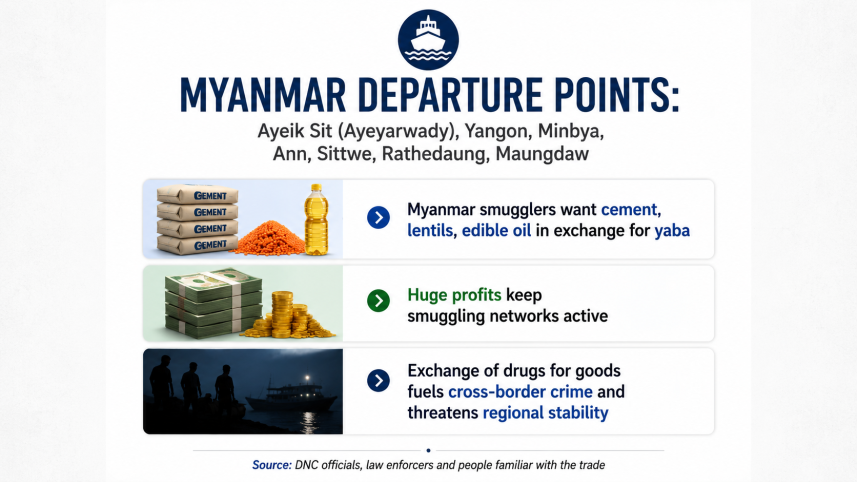
Smugglers on the Myanmar side prefer Bangladeshi goods such as cement, pulses and ginger because of acute shortages in conflict-hit Rakhine, the source said.
One trafficking route begins at Ayeik Sit jetty in Myanmar’s Ayeyarwady region, where drugs are packed and loaded onto fishing boats before being taken into the Bay of Bengal.
Another starts in Yangon and passes through Minbya, Ann, areas near Sittwe, Rathedaung and Maungdaw before reaching areas close to the Bangladesh border.
“Myanmar-side carriers allegedly use satellite devices to contact Bangladeshi receivers before handing over the consignments mid-sea,” the source said, requesting anonymity.
The consignments then enter Bangladesh through different points along the Naf River, the source said.
Confirming the use of yaba as a form of payment by Myanmar rebel groups, Somen Mondol, deputy director of the Department of Narcotics Control (DNC) in Cox’s Bazar, said daily essentials were being smuggled from Bangladesh while yaba entered the country in return.

“In many cases, fishing boats cross the border with goods. Later, while returning, they bring yaba in the same boats,” he told The Daily Star.
He said hundi had long been used to settle transactions, but the pattern had changed.
“Now, along with hundi, goods are being sent from here, and drugs are coming in return.”
Asked who was behind the trade, Somen said a section of Rohingyas was involved, assisted by local groups.
The source, who is familiar with the trade, also shared a wholesale price list for yaba and crystal meth.
According to the list, Diamond-brand yaba sells for Tk 120 per white tablet and Tk 110 per red tablet. Lion-Shingaw sells for Tk 105 per tablet, Seriya for Tk 100, Three Stars for Tk 95 and Zinfore for Tk 115.
 For all latest news, follow The Daily Star's Google News channel.
 Crystal meth, or “ice”, sells for Tk 4.5 lakh per kilogram for higher-quality products and Tk 3.5 lakh for lower-grade varieties.
The list showed Diamond to be the most sought-after yaba brand.
The flow of yaba from Myanmar has increased over the past two years after the Arakan Army took control of large stretches of the border, according to officials.
Fighting between Myanmar’s military and ethnic armed groups escalated in November 2023. The AA has since reportedly captured nearly 80 percent of Rakhine State. The military later cut off supply lines, triggering severe shortages of food, fuel and construction materials.
“To fill those shortages, the AA now depends heavily on supplies from Bangladesh, offering drugs in exchange,” a senior police official monitoring activities along the Myanmar border told The Daily Star on condition of anonymity.
The DNC’s Annual Drug Report Bangladesh 2025 also points to a sharp rise in trafficking.
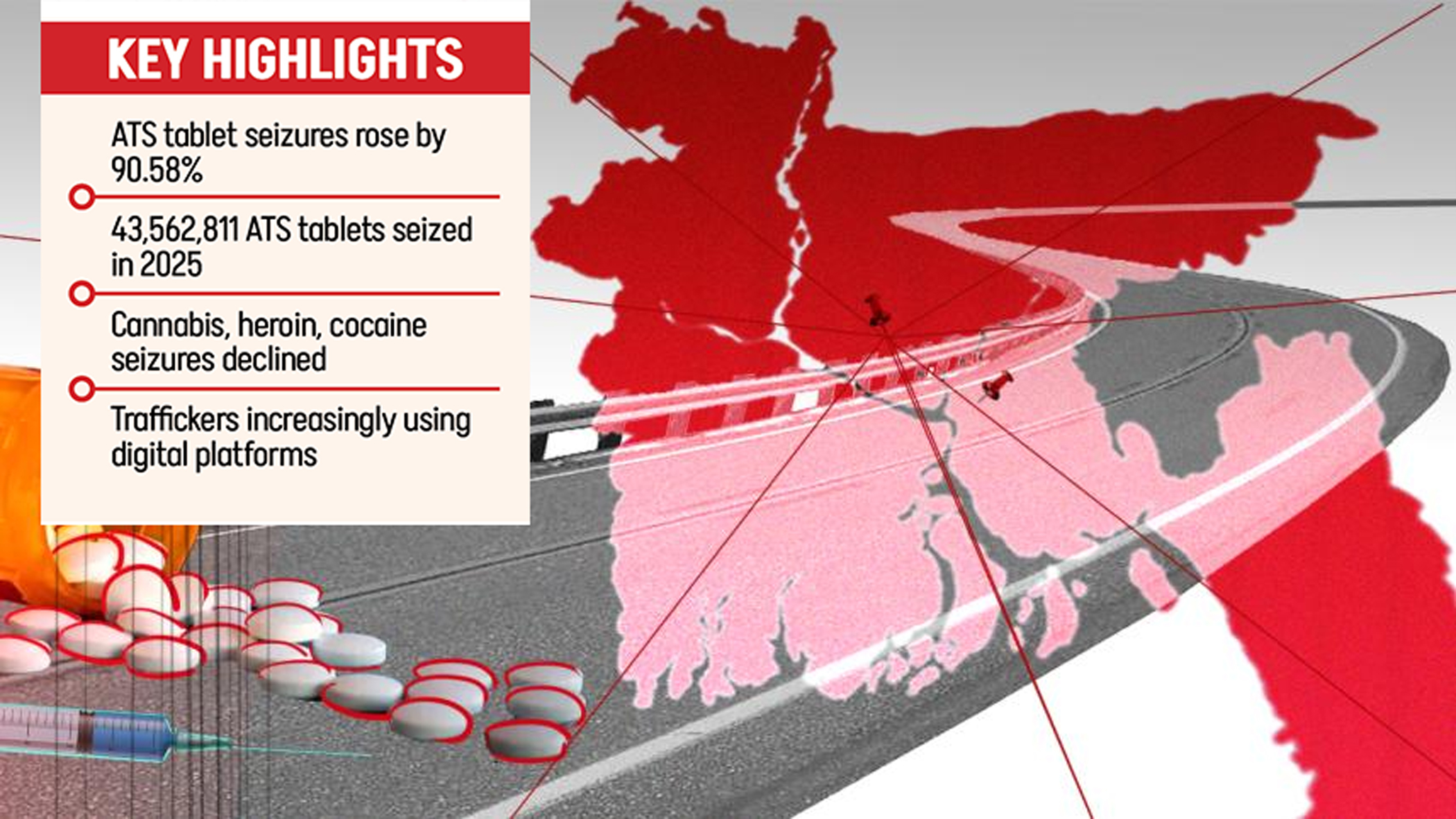
Law enforcement agencies seized 43,562,811 amphetamine-type stimulant (ATS) tablets in 2025, up 90.58 percent from 22,857,751 in 2024. In 2023, the figure stood at 42,977,219.
ATS refers to synthetic stimulant drugs, including methamphetamine-based yaba and MDMA.
DNC Director General Md Hasan Maruf said the growing supply was linked to Myanmar rebel groups using yaba as a “narco-currency”.
SHIPMENT TO MYANMAR
A suspected smuggler has been sending daily commodities, including cement, rice, lentils and edible oil, from Bangladesh to Myanmar at least three times a month and returning with yaba tablets, according to a fisherman who worked on his boat.
The suspect, identified as Khalil Majhi, lives in Manpura, Bhola, but operates a fishing boat between Chattogram port and Myanmar.
The fisherman, who requested anonymity, told The Daily Star that Khalil had been involved in the trade for the past year.
He said each round trip between Chattogram and Myanmar takes around five days. The head boatman receives Tk 3 lakh per trip, while other crew members are paid Tk 30,000 to Tk 40,000 each.
According to the fisherman, fishing nets and fish are kept on the boat’s upper deck. On outbound journeys, daily commodities are stored on the lower deck. On the return trip, fish brought from Myanmar are loaded there, with yaba tablets concealed inside the fish.
Contacted by The Daily Star, Khalil denied any involvement in illegal trade.
“I rented out my boat for the last six months. The person who took it on rent is doing this business. I am not involved in any illegal trade. Once I came to know about the activities, I recently brought the boat back under my control,” he said.
However, Khalil failed to identify the person to whom he claimed to have rented the boat.
SENT ABROAD
The source familiar with the trade with Myanmar rebel groups also claimed that while most of the drugs are consumed in Bangladesh, some consignments are flown to Oman, Saudi Arabia and Dubai through Dhaka and Chattogram airports.
Officials said almost all yaba and crystal meth entering Bangladesh originates in Myanmar, with 80 to 90 percent consumed domestically.
Only small quantities are smuggled abroad through air passengers or courier parcels, mainly to countries with large Bangladeshi migrant populations, a DNC official said on condition of anonymity.
“There have been attempts to send yaba to the Middle East, Europe and the United States, but these are not large-scale trafficking routes,” the official said.
Another DNC intelligence official said such attempts had declined significantly after airports strengthened security through improved scanning systems and CCTV surveillance.
Officials said traffickers had also used courier services to send drugs to the Middle East, Europe, the United States and Australia, but tighter monitoring has made the route increasingly difficult.
CONTINUOUS FLOW
The Border Guard Bangladesh’s 64 Battalion guards key stretches of the Naf River along Ukhiya and Teknaf in Cox’s Bazar.
Its commanding officer, Lt Col Md Zahirul Islam, said traffickers frequently shifted routes whenever surveillance was tightened, moving through other border points or maritime channels.
“Whenever pressure increases in one area, they look for alternative routes,” he said, adding that improved surveillance technology had helped increase yaba seizures.
The BGB said last year that the Arakan Army was directly involved in yaba trafficking and that smuggling had increased through remote areas of Bandarban’s Naikhongchhari.
Recent operations by the Bangladesh Navy also point to the scale of the cross-border smuggling network.
On June 26, naval personnel detained 21 alleged smugglers and seized two fishing boats carrying 1,450 sacks of cement in separate operations in the Bay of Bengal.
Earlier that month, on June 2, another operation near Saint Martin’s Island led to the arrest of 20 people and the seizure of 1,700 sacks of cement. The detainees told investigators the consignment was bound for Rakhine State, where the materials would fetch high prices.
In February, acting on intelligence about a major customs evasion network, the Navy detained 19 suspected smugglers near Saint Martin’s Island and seized 1,140 sacks of cement, 250kg of pulses, 160kg of ginger and 360 bottles of energy drinks.
In another operation in December last year, the Navy detained 11 people and recovered 650 sacks of Bangladeshi cement and 1,000 litres of diesel that were allegedly being smuggled to Myanmar.
Officials said the repeated interceptions reflected the growing demand for
Bangladeshi goods inside conflict-hit Rakhine, where prolonged fighting and military supply restrictions have created acute shortages of essential commodities.
Sources said severe shortages in Rakhine have made Bangladeshi goods extraordinarily valuable. A bag of cement worth around Tk 500 in Bangladesh can reportedly fetch as much as 100,000 Myanmar kyats in conflict-hit areas, generating huge profits that keep cross-border smuggling networks active despite intensified enforcement.
NOT JUST MYANMAR
The use of narcotics as a form of currency is not confined to Myanmar rebel groups.
Officials and law enforcers familiar with anti-drug operations in border areas said similar informal settlement systems are used in the narcotics trade along Bangladesh’s border with India.
They said traffickers also exchange narcotics such as Phensedyl, cannabis and heroin for commodities, alongside illegal hundi transactions.
Former Kasba Police Station sub-inspector Faruk Hossain, who served for several years in border areas and took part in multiple anti-drug operations, said traffickers use several covert methods to pay Indian suppliers for narcotics smuggled into Bangladesh.
According to Faruk and DNC officials, most payments are made through illegal hundi networks. Bangladeshi traffickers deposit money with local hundi operators or selected mobile financial service agents, while their counterparts in India receive the equivalent amount in rupees through coded transactions.
They said traffickers also use cash carriers to move money across the border, particularly in frontier areas. In some cases, cash or rupees are handed over directly to suppliers when drug consignments cross the border.
Faruk and DNC officials said payments are sometimes settled through cross-border trafficking of commodities such as gold, hilsa and other contraband instead of cash. In such cases, the value of those goods is adjusted against the price of narcotics supplied from India.
Comments